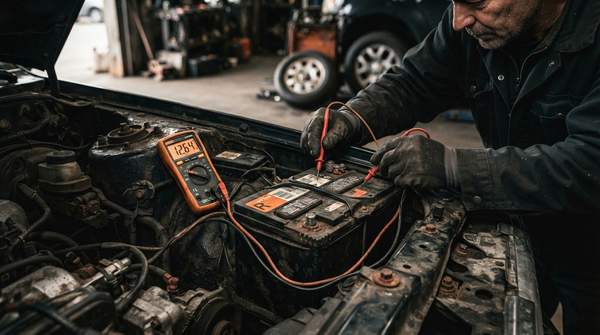
When your car refuses to start, the battery is the most common suspect. However, simply replacing it might not solve the problem if the issue lies with the charging system or another electrical component. A systematic approach can help you pinpoint the true cause, saving you time and money. By performing a few key checks with a digital multimeter, you can determine whether your battery needs to be recharged, replaced, or if the problem requires a professional mechanic. This guide provides a diagnostic process for common car battery issues but does not cover the high-voltage systems in hybrid or electric vehicles. The steps assume you have a digital multimeter and are familiar with its safe operation.
Recognizing Car Battery Problems: Initial Symptoms
The first signs of battery trouble are often clear indicators that your vehicle's electrical system is struggling. According to an article from Autozilla, one of the most obvious symptoms is an engine that cranks weakly or fails to start at all. You might hear a slow, sluggish cranking sound, which suggests the battery lacks the power to turn the engine over effectively. Other telltale signs involve your car's electronics. Dimming headlights or dashboard lights, especially when you try to start the car, can signal poor voltage. Similarly, power windows that operate more slowly than usual can also point to a weak battery. If your car repeatedly fails to start, it's time to investigate the issue rather than just reaching for jumper cables.
Step 1: Visual Inspection of Your Battery and Connections
Before using any tools, a simple visual check can sometimes reveal the problem. Pop the hood and locate your car's battery. Look closely at the battery terminals, which are the metal posts where the vehicle's cables connect. A common issue is the buildup of a white or bluish, crusty substance known as corrosion. According to guidance from Vann York Toyota, regularly cleaning the battery can prevent this buildup. Corrosion can interfere with the electrical connection, preventing the battery from delivering its full power or receiving a proper charge. While inspecting, also check the general condition of the battery case. Look for any cracks, leaks, or swelling, which are signs of physical damage that would require immediate replacement.
Step 2: Performing a Static Voltage Test with a Multimeter
To get a precise reading of your battery's state of charge, you will need a digital multimeter. An article from Champion Auto Parts explains the process: with the car's engine and all electronics turned off, connect the multimeter's red lead to the positive (+) battery terminal and the black lead to the negative (-) terminal. A healthy, fully charged battery should show a reading of 12.45 volts or higher. If your reading is below this threshold, the battery is discharged. This doesn't automatically mean the battery is bad; it could simply need a full charge from a battery charger. However, if it fails to hold a charge after being fully recharged, it likely needs to be replaced.
Step 3: The Headlight Load Test for Battery Health
A static voltage test shows the battery's charge at rest, but a simple load test can help determine if it can deliver power when needed. One instructional guide suggests a straightforward method using your car's headlights. With the multimeter still connected to the battery and the engine off, turn on the headlights. Watch the voltage reading on the multimeter. It is normal for the voltage to drop slightly when the headlights are on. However, if the voltage drops below 12 volts, it indicates the battery is weak and struggling to supply enough current to power the starter. This suggests the battery may be nearing the end of its life, even if it showed an acceptable static charge.
Step 4: Testing Your Car's Charging System (Alternator Check)
If your battery is discharged, it's crucial to determine whether the battery is at fault or if the vehicle's charging system is failing to replenish it. The alternator is responsible for charging the battery while the engine is running. To test it, start your car's engine. If the battery is very low, you may need to jump-start it first. With the engine running, measure the voltage across the battery terminals again with your multimeter. According to Autozilla, if the charging voltage is below 13 volts, the alternator may be faulty. A healthy charging system should produce a voltage significantly higher than the battery's resting voltage to effectively recharge it. A low reading suggests the alternator is not working correctly, and the car is running solely on battery power, which will eventually drain it completely.
Car Battery Troubleshooting Decision Flowchart
Follow these steps sequentially to diagnose the root cause of your car's electrical issue. The outcome of each test will guide you to the next step or a final diagnosis.
-
Identify Initial Symptoms
Does your car exhibit signs like a weak or non-starting engine, a clicking sound when you turn the key, or dimming lights and slow electronics? If yes, proceed to the next step. -
Perform a Visual Inspection
Examine the battery terminals for corrosion. If you see a white or blue crusty buildup, clean the terminals thoroughly with a wire brush. If the problem persists after cleaning, proceed to the voltage test. -
Conduct a Static Voltage Test (Engine Off)
Connect a multimeter to the battery terminals.- If the reading is 12.45V or higher: Your battery is well-charged. The problem is likely not the battery itself but could be a faulty starter or ignition system, which typically requires professional diagnosis.
- If the reading is below 12.45V: Your battery is discharged. Proceed to the next step to check the charging system.
-
Test the Charging System (Engine Running)
Start the engine (jump-start if necessary) and measure the battery voltage again.- If the reading is above 13V: The alternator appears to be charging correctly. This suggests your battery is likely old or damaged and can no longer hold a charge. Try fully recharging it with a dedicated charger. If it fails again soon after, the battery needs to be replaced.
- If the reading is below 13V: The alternator is likely faulty and is not recharging your battery. This requires professional repair or replacement of the alternator.
-
Assess for Recurring Problems
If you have recently replaced the battery and the charging system tests fine, but you still experience frequent dead batteries, you may have a parasitic drain. This is an electrical component that continues to draw power after the car is turned off. Diagnosing a parasitic drain can be complex and is best left to a professional mechanic.
When Professional Help is Necessary
While many battery issues can be diagnosed at home, some problems require the expertise and specialized equipment of a professional mechanic. According to Vann York Toyota, you should seek professional help if you experience frequent battery problems even after replacing the battery, as this points to a deeper underlying issue. Diagnosing and fixing a parasitic drain—an electrical fault that drains the battery when the car is off—can be a complex and time-consuming process that often requires professional tools. Furthermore, if your tests lead you to suspect a faulty starter or alternator, these are repairs that should be handled by a qualified technician. An article from Champion Auto Parts advises consulting a trusted mechanic if your starting problems persist after confirming the battery is healthy.
Your Next Step: Resolving Your Battery Issue
Based on the diagnostic steps, your path forward is now clearer. You should either recharge or replace the battery, address minor connection issues like corrosion, or seek professional help for complex charging system faults or parasitic drains. A successful resolution means your car starts reliably, its lights are bright, and the electrical system functions as expected. The measurable indicator of a healthy system is a battery that maintains a proper voltage. It should read above 12.45V when the car is off and show a charging voltage above 13V when the engine is running. If these conditions are met but problems persist, it confirms the need for professional service to investigate other parts of your vehicle's electrical system.
Sources
- How to Troubleshoot Your Car’s Battery Issues? — Autozilla
- Battery Blues? Troubleshooting Common Car Battery Issues — Vannyorktoyota
- Battery Troubleshooting Guide — Champion Auto Parts | Replacement & Aftermarket Auto Parts