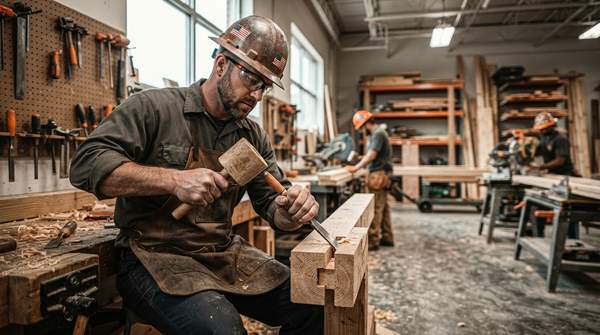
The way you join two pieces of wood is the single most important factor in your project's strength and longevity. This basic woodworking joints guide for DIY projects introduces fundamental techniques that separate amateur efforts from professional-quality craftsmanship, essential for building durable furniture and fixtures.
Joinery is the term woodworkers use for the method of joining two pieces of wood. While glue is a powerful adhesive, it is often not enough on its own, especially on certain parts of the wood. For example, applying glue to endgrain—the porous surface you see at the end of a board—does not create a reliable joint. This is where mechanical joints come in. They create interlocking connections that provide structural integrity, ensuring your projects can withstand stress, weight, and daily use. This guide will walk you through nine essential joints, their applications, and how to create them.
What Is Wood Joinery?
Wood joinery connects pieces of wood to create complex structures, acting as the project's skeleton. Strong joinery prevents wobbling, sagging, and structural failure, ensuring tables, shelves, and drawers last. Joint choice depends on required strength, appearance, and skill level; mastering basic types expands project scope and quality.
There are many ways to connect wood, but most methods fall into a few key categories. Some rely on simple surface-to-surface contact reinforced with fasteners, while others involve cutting interlocking shapes into the wood itself. The nine basic woodworking joints that form the foundation of most projects are the butt, pocket-hole, miter, biscuit, dowel, mortise and tenon, dado, lap, and tongue and groove joints, according to woodworking resource learn.kregtool.com. Each has its own set of advantages and ideal uses.
Essential Woodworking Joints for DIY Beginners
This section details nine fundamental joints, from simplest to most complex. Each entry includes a description, common uses, required materials, and a step-by-step guide to its creation.
1. The Butt Joint
The butt joint is the most basic way to join wood. You simply "butt" the end of one piece against the edge or face of another. Because it often involves gluing weak endgrain, this joint is structurally weak on its own. It almost always requires reinforcement.
- Common Uses: Simple box construction, basic frames, and situations where it will be heavily reinforced.
- Materials Needed: Wood pieces, wood glue, clamps, and a reinforcement method (screws, nails, or dowels).
- How to Make It:
- Ensure the ends of your boards are cut perfectly square at 90 degrees.
- Apply a thin, even layer of wood glue to the endgrain of one board.
- Press the glued end against the face or edge of the other board.
- Clamp the pieces firmly together until the glue dries completely.
- Add reinforcement by driving screws or nails through the face of the second board into the endgrain of the first.
2. The Pocket-Hole Joint
A pocket-hole joint is a strong, fast, and easy-to-make connection. It is a variation of a butt joint, but the reinforcement is more sophisticated. You drill an angled hole, or "pocket," into one board and then drive a specialized screw through that pocket into the second board. This creates a very strong mechanical connection.
- Common Uses: Face frames for cabinets, furniture assembly, and general repairs.
- Materials Needed: Pocket-hole jig, specialized drill bit, pocket-hole screws, drill, wood glue, clamps.
- How to Make It:
- Set your pocket-hole jig to the correct depth based on your wood's thickness.
- Clamp the jig onto the board where you want to make the joint.
- Use the specialized drill bit to drill the angled pocket hole.
- Apply glue to the end of the board you just drilled.
- Clamp the two pieces of wood together firmly in their final position.
- Drive a pocket-hole screw through the pocket to secure the joint.
3. The Miter Joint
A miter joint forms a clean 90-degree corner by cutting two board ends at 45-degree angles. Like a butt joint, a simple glued miter is weak and requires reinforcement with nails, splines, or biscuits.
- Common Uses: Picture frames, door and window trim, and boxes where you want the grain to "wrap" around the corner.
- Materials Needed: Miter saw or miter box, wood glue, clamps, and reinforcement (splines, biscuits, or nails).
- How to Make It:
- Set your miter saw to a 45-degree angle.
- Carefully cut the end of each board that will form the corner.
- Do a "dry fit" to ensure the two pieces form a perfect 90-degree angle.
- Apply glue to both cut surfaces.
- Press the pieces together and use a corner clamp or band clamp to hold them securely while the glue dries.
- Add reinforcement once the glue is set.
4. The Dowel Joint
Dowel joints use small, cylindrical wooden rods to align and strengthen connections. Corresponding holes are drilled into both pieces, glue applied, and dowels inserted, adding significant mechanical strength and preventing twisting—a major upgrade from a simple butt joint.
- Common Uses: Edge-to-edge panel glue-ups, furniture construction, and cabinet assembly.
- Materials Needed: Dowels, drill, drill bit matching the dowel diameter, dowel jig or dowel centers, wood glue, clamps.
- How to Make It:
- Mark the locations for your dowels on the edge of one board.
- Use dowel centers to transfer those exact locations to the second board.
- Use a dowel jig to drill straight, perfectly aligned holes at each mark.
- Apply glue into the holes and along the edge of the board.
- Insert the dowels into the holes on one board.
- Align and press the two boards together, then clamp securely.
5. The Mortise and Tenon Joint
The mortise and tenon, a centuries-old, incredibly strong joint, involves cutting a square or rectangular hole (mortise) into one piece and a corresponding pin (tenon) on another. The tenon fits snugly into the mortise, creating a powerful interlocking connection.
- Common Uses: Table and chair legs, bed frames, doors, and any frame construction requiring maximum strength.
- Materials Needed: Chisel and mallet, drill, saw (tenon saw or handsaw), marking gauge, square.
- How to Make It:
- Lay out the mortise on one piece of wood using a marking gauge.
- Remove the bulk of the waste from the mortise by drilling a series of overlapping holes.
- Use a sharp chisel and mallet to square up the walls of the mortise.
- Lay out the tenon on the end of the other piece, ensuring its dimensions match the mortise exactly.
- Use a saw to cut the "cheeks" and "shoulders" of the tenon.
- Test the fit. The tenon should slide into the mortise with firm hand pressure. Adjust with a chisel if needed.
- Apply glue and assemble the joint, clamping as needed.
6. The Lap Joint
A lap joint is made by removing half the thickness from each of two crossing boards, allowing their faces to sit flush. Simple to make, it is stronger than a butt joint.
- Common Uses: Frame construction, grid-like structures (like a wine rack), and simple cabinet bracing.
- Materials Needed: Saw, chisel, marking gauge, square, wood glue, clamps.
- How to Make It:
- Position the two boards as they will be joined and mark where they overlap.
- Set a marking gauge to half the thickness of the wood.
- Mark the depth of the cut on the edges of both boards within the overlap area.
- Use a saw to make a series of cuts (kerfs) across the grain within the waste area, stopping at the depth line.
- Use a chisel to remove the waste wood, creating a flat-bottomed recess.
- Repeat for the second board. Test the fit, apply glue, and clamp.
7. The Dado Joint
A dado is a square-bottomed channel cut across the grain of a board, into which another board is fitted. This joint provides excellent support for shelves, common in cabinet and bookshelf construction.
- Common Uses: Bookshelves, cabinet carcasses, and drawer construction.
- Materials Needed: Router with a straight bit or a table saw with a dado blade stack, square, clamps.
- How to Make It:
- Mark the location and width of the dado on your workpiece. The width should match the thickness of the shelf board exactly.
- Clamp a straightedge to your workpiece to act as a guide for the router or saw.
- Set the cutting depth to about one-third to one-half the thickness of the workpiece.
- Make the cut in one or more passes.
- Test the fit of the shelf board. It should be snug. Apply glue and insert the shelf.
8. The Tongue and Groove Joint
The tongue and groove joint connects boards edge-to-edge. A slot (groove) is cut along one board's edge, and a corresponding ridge (tongue) on another. The tongue fits into the groove, creating a strong, continuous surface.
- Common Uses: Hardwood flooring, paneling, and making wide tabletops from narrower boards.
- Materials Needed: Router with a tongue and groove bit set or a table saw.
- How to Make It:
- Set up your router or table saw with the groove-cutting bit or blade.
- Run the edge of one board through to cut the groove.
- Switch to the tongue-cutting bit or blade configuration.
- Run the edge of the mating board through to cut the tongue.
- Test the fit. The tongue should slide into the groove without excessive force.
- For assembly, apply a small amount of glue inside the groove before joining the boards.
9. The Biscuit Joint
A biscuit joint uses a small, compressed wood oval (a "biscuit") to align and strengthen a joint. A special tool called a biscuit joiner cuts a crescent-shaped slot in the mating edges of two boards. Glue is applied to the slots and the biscuit, which expands when it absorbs the glue's moisture, creating a tight fit.
- Common Uses: Edge-joining boards for panels, miter joints, and cabinet construction.
- Materials Needed: Biscuit joiner, wood biscuits, wood glue, clamps.
- How to Make It:
- Align the two boards and mark the locations for the biscuits across the joint line.
- Set the cutting depth on your biscuit joiner to match the size of the biscuit you are using.
- Align the joiner with your mark and plunge the blade to cut the slot. Repeat for all marks on both boards.
- Apply glue to the slots and the edges of the boards.
- Insert the biscuits into the slots on one board, then join the two boards together and clamp.
Safety First
Always wear safety glasses when cutting, drilling, or routing wood. Use sharp blades and bits for cleaner, safer cuts. Disconnect power before changing blades or bits, and always read your power tool manual.
Choosing the Right Wood Joint for Your Project
A joint perfect for a picture frame would be dangerously weak for a chair leg. Therefore, selecting the appropriate joint is critical for a successful project. Your decision must be based on three main factors: strength, aesthetics, and complexity. Always match the joint to the job.
For projects that require maximum strength, such as the frame of a table or bed, the mortise and tenon is the traditional choice. For building sturdy cabinet boxes or bookshelves, the dado joint is superior because it provides excellent support for shelves. When appearance is key, like on a mitered box, you might choose a reinforced miter joint or a more advanced dovetail joint. For quick, strong, and hidden joinery in cabinet face frames, the pocket-hole joint is often the most efficient option. A guide from Popular Woodworking suggests that a rabbet joint, a variation of a butt joint using a notch, can be a good choice for drawers when skills for more complex joints are limited.
| Joint Type | Primary Use Case | Relative Strength | Skill Level |
|---|---|---|---|
| Butt Joint | Basic boxes (with reinforcement) | Low | Beginner |
| Pocket-Hole | Cabinet face frames, quick assembly | High | Beginner |
| Miter Joint | Picture frames, trim work | Low (without reinforcement) | Beginner |
| Dowel Joint | Panel glue-ups, aligning parts | Medium-High | Beginner-Intermediate |
| Mortise and Tenon | Furniture frames (chairs, tables) | Very High | Intermediate-Advanced |
| Dado Joint | Bookshelves, cabinet shelves | High | Intermediate |
Why Wood Joinery Matters
Proper wood joinery is the foundation of durable, high-quality woodworking, transforming simple pieces of lumber into functional and beautiful objects that can be used for generations. A well-made joint distributes stress across a larger area, preventing failures at connection points. This is especially important for items that bear weight, like chairs, or that are subject to movement, like drawers. Learning these fundamental skills improves the quality of your work and deepens your understanding of wood as a material, allowing you to build with confidence, knowing your creations are not just visually appealing but also structurally sound.
Frequently Asked Questions
What is the strongest woodworking joint?
The mortise and tenon joint is widely considered one of the strongest and most durable woodworking joints. Its interlocking design provides excellent resistance to racking and pulling forces, which is why it has been a staple in furniture and structural timber framing for thousands of years.
Can I make these joints without expensive power tools?
Yes, many of these joints can be made with basic hand tools. A mortise and tenon can be cut with a saw and chisel. A lap joint requires only a saw and chisel as well. While power tools like routers and table saws can make the process faster and more repeatable, learning to cut joints by hand is a valuable skill detailed in many guides to hand tool woodworking.
How do I know which joint to use for my project?
Consider the forces the joint will need to resist. For shelves, you need to support weight, making a dado ideal. For a chair leg, you need to resist racking and twisting, making a mortise and tenon the best choice. For a picture frame, aesthetics are key, so a miter joint is common. Always think about function first.
The Bottom Line
Mastering basic woodworking joints is essential for any DIY enthusiast aiming to create strong, lasting projects. Begin with simpler joints like the butt and pocket-hole, then gradually progress to more complex techniques such as the mortise and tenon. By choosing the right joint for each application, you ensure your work is not only beautiful but also built to last.