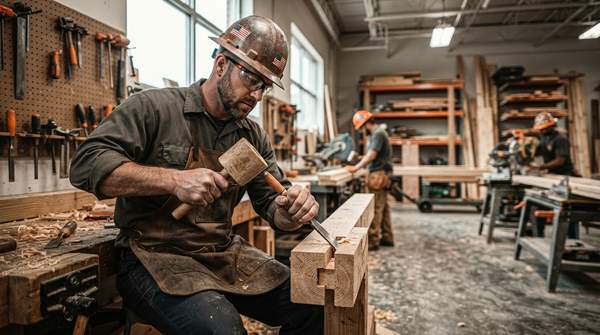
Since late 2022, demand for robotics technicians has spiked an astonishing 107%, directly contradicting the widespread fear that AI would eliminate manual jobs. Demand for robotics technicians has spiked an astonishing 107%, alongside a 67% rise in demand for HVAC engineers and a 30% increase for construction positions, signaling a profound shift in the labor market, according to HR Dive. The rapid expansion of artificial intelligence infrastructure is creating, not destroying, a critical need for skilled hands.
Many commonly believe AI will automate away all manual jobs, posing a significant threat to traditional trades. However, AI's rapid expansion is generating a substantial surge in demand for these very skilled trades, creating an unexpected counter-narrative.
Companies will increasingly struggle to find the human talent required to build and maintain the physical infrastructure that AI relies upon, leading to a revaluation of skilled trades as critical economic drivers. This dynamic challenges the notion that AI's primary impact will be job displacement, instead highlighting its role in reshaping and elevating manual labor.
The rapid growth of artificial intelligence infrastructure directly correlates with a significant surge in demand for skilled trades. Hiring for these critical roles has increased to support the physical expansion of AI, according to HR Dive. Specifically, demand for robotics technicians has spiked 107% since late 2022, with HVAC engineers seeing a 67% rise and construction roles climbing 30%. This substantial uptick in specialized manual labor fundamentally contradicts the common belief that AI's primary impact would be widespread job automation. Instead, it highlights how the digital revolution relies heavily on analog labor, requiring skilled workers to build and maintain the complex hardware, cooling systems, and physical structures that power AI operations. The need for these hands-on experts extends far beyond initial construction phases. Ongoing maintenance, precise calibration, and intricate repair of advanced machinery, server racks, and vast data centers demand a workforce with highly specialized technical capabilities. Persistent demand solidifies skilled trades as a secure and fast-growing career path, directly challenging fears that AI will render manual labor obsolete. The foundational requirements of AI are creating a robust and unforeseen market for expert craftsmanship.
The Automation Anxiety: Why We Feared AI Would Kill Manual Jobs
Many young workers are shifting towards skilled trades, driven by fears of job losses due to AI, according to Reuters. This widespread public perception suggests that artificial intelligence systems are destined to automate away a broad spectrum of manual jobs, from intricate manufacturing processes to routine maintenance tasks. The pervasive narrative often portrays AI as a direct replacement for human labor, particularly in roles deemed repetitive, predictable, or physically demanding. Public discussions frequently focus on algorithms performing tasks once requiring human dexterity or judgment, leading to anxieties about widespread unemployment in blue-collar sectors. This pervasive fear, while understandable given historical industrial shifts, has obscured the more complex and often beneficial ways AI is reshaping the labor market for certain professions. It has prevented a clear understanding of how AI's foundational requirements create new, specialized opportunities rather than simply eliminating existing ones. The focus on direct displacement overlooks the intricate physical infrastructure needed for AI to operate at scale, a dependency that human expertise alone can fulfill.
The Unseen Demand: How AI's Growth Fuels New Trade Opportunities
The time required to hire skilled trade workers now exceeds that for knowledge workers, with trades taking 56 days on average compared to 54 days for knowledge workers, according to HR Dive. The extended hiring period directly refutes the idea that manual labor is easily replaceable or requires minimal specialization. The longer time-to-hire for skilled trade workers (56 days) compared to knowledge workers (54 days) suggests that the perceived 'low-skill' nature of manual labor is a dangerous misconception, suggests that the perceived 'low-skill' nature of manual labor is a dangerous misconception, as these roles are now more difficult to fill than many office-based positions. Companies investing heavily in AI infrastructure, facing a 107% spike in demand for robotics technicians and a 67% rise for HVAC engineers, are encountering a critical bottleneck in skilled labor. The talent gap risks significant project delays and increased operational costs if not proactively addressed, underscoring the vital, unacknowledged role of trades in AI expansion. The ethical implication for businesses is clear: a failure to invest in robust training and recruitment programs for these essential roles constitutes a significant operational and strategic oversight. The demand for technicians capable of installing, maintaining, and repairing complex AI systems demonstrates that physical infrastructure remains foundational, requiring human expertise beyond pure software development. These roles demand problem-solving skills and adaptability that current automation cannot fully replicate.
A New Appeal: Why 'Hands-On' Work is Becoming a Smart Bet
The labor market, reshaped by AI, shows 'hands-on' jobs gaining significant appeal, according to Reuters. Renewed interest positions skilled trades as a resilient and strategically valuable career path in an economy increasingly shaped by artificial intelligence. Reuters' observation that young workers are shifting to skilled trades due to fears of AI job losses reveals a profound market irony: the very technology causing anxiety is simultaneously creating the most robust and secure career paths, making skilled trades a strategic hedge against future automation. The shift is not merely a cultural preference; it is a direct response to the tangible, physical demands of AI's expansion, proving that the digital revolution still relies heavily on analog labor. The stability offered by these roles, often less susceptible to remote work or direct algorithm replacement, makes them particularly attractive to a new generation seeking tangible career security. As AI continues its rapid development, the need for human workers to build, install, and service the physical world it inhabits will only intensify, solidifying the long-term value and ethical necessity of a robust skilled trades workforce. Ongoing demand ensures that those with practical, specialized skills will remain indispensable.