Before buying a single panel or roll of mass-loaded vinyl, homeowners need to answer one question: is the goal to keep sound out, or to tame sound within the room? The soundproofing industry measures these two jobs with different ratings, and confusing them is the most expensive mistake in residential acoustics. Sound blocking is rated by Sound Transmission Class, or STC, which describes how well a barrier stops airborne noise such as speech, music, or TV sound from passing through it. Sound absorption is rated by the Noise Reduction Coefficient, or NRC, which describes how much sound a surface soaks up rather than reflects. Acoustic specialists at New York Soundproofing emphasize that many people assume the two ratings measure the same thing, but they serve entirely different purposes.
Understanding Your Sound Problem: Blocking vs. Absorption
The two goals feel similar but involve different physics. Blocking is about transmission: sound energy traveling as vibrations through a wall, floor, or ceiling into another space. Absorption is about reflection: sound bouncing off hard interior surfaces and building up as echo and reverberation inside a single room. New York Soundproofing's guide frames it plainly—whether you need to block outside noise or improve acoustics inside a room determines the entire material selection, and the best results come from layering different techniques to match the specific problem. A home theater usually needs both: isolation from the rest of the house, plus internal treatment so dialogue stays clear.
Sound Transmission Class (STC): Blocking Noise Between Spaces
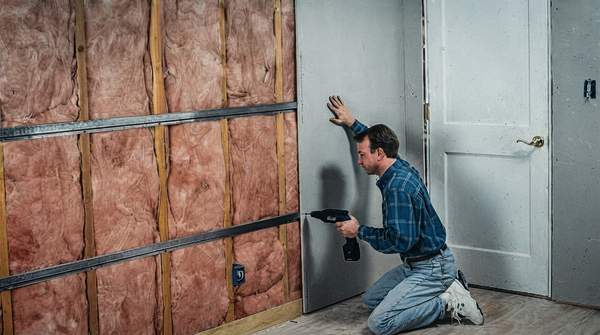
STC rates how well a material or assembly blocks airborne sounds like speech, music, or TV noise. As a benchmark, New York Soundproofing notes that a standard drywall partition may carry an STC rating around 35, at which normal conversation can still be heard through the wall, while a properly soundproofed wall can reach STC 50 or higher, blocking most noise. Higher values mean better blocking. Two caveats matter when comparing products. First, STC applies to airborne noise, not structure-borne or impact noise like footsteps from above, which requires different solutions. Second, a rating describes the assembly as tested, so field performance depends on the complete wall or ceiling build and installation quality, not the material alone. Gaps and leaks around doors, ducts, and outlets—what the Soundproofing Company calls flanking—can undermine an otherwise strong barrier.