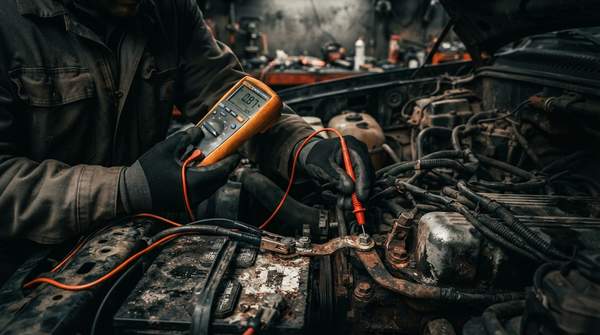
The global automotive diagnostics scan tool market is projected to nearly double from USD 43.99 billion in 2025 to USD 87.53 billion by 2035, driven by increasingly complex vehicle systems, according to Precedence Research. This 6.96% CAGR growth from 2026 to 2035 is a direct result of modern vehicles, including advanced driver-assistance systems (ADAS), demanding more sophisticated diagnostic and calibration tools.
Vehicle systems are becoming exponentially more complex, but diagnostic tools vary widely in their ability to keep pace. While companies like Snap-on invest in higher-value ADAS equipment and software, a significant market segment still relies on basic hardware and USB connectivity, according to Ad-hoc-news De. This disparity creates a performance gap for technicians.
Shops investing in high-value, advanced diagnostic systems will gain a competitive edge; those relying on slower tools risk falling behind. Caranddriver data shows a nearly 50% difference in code retrieval times between the fastest (Motopower MP69033 at 17.3 seconds) and slowest (Gearwrench scanner at 25.4 seconds) basic tools. Technicians not prioritizing efficiency lose valuable minutes per job, directly impacting profitability and customer throughput.
Advanced Features for Complex Vehicles
1. Innova 5610
Best for: Technicians requiring broad diagnostic capabilities and detailed data insights for modern vehicles.
The Innova 5610 offers 19 Live Data PIDs, 12 Freeze Frame Data PIDs, and 6 I/M Monitors with a 73.0-inch cord, according to Caranddriver. It provides extensive diagnostic capabilities, bidirectional control, and additional suggestions, making it a comprehensive solution for intricate repair scenarios.
Strengths: Extensive diagnostic features, bidirectional control, detailed suggestions. | Limitations: Not the absolute fastest code retrieval. | Price: Moderate to high.
2. Motopower MP69033
Best for: Professionals prioritizing rapid code retrieval and essential real-time data for quick assessments.
The Motopower MP69033 reads codes in 17.3 seconds, making it the fastest tested scanner, according to Caranddriver. It provides 16 Live Data PIDs, 13 Freeze Frame Data PIDs, and 12 I/M Monitors with a 33.5-inch cord, balancing speed with crucial data access.
Strengths: Fastest code retrieval, good data PID coverage. | Limitations: Shorter cord length than some alternatives. | Price: Affordable.
3. Ancel BD310
Best for: Mechanics seeking a balance of strong display, good data, and flexible connectivity, including Bluetooth.
The Ancel BD310 receives a code in 18.6 seconds via plug-in to Bluetooth, as reported by Caranddriver. It features 18 Live Data PIDs, 13 Freeze Frame Data PIDs, 6 I/M Monitors, and a 55.0-inch cord. While identified as the 'Best Display OBD-II Scanner for DIY Use,' its capabilities extend to professional applications.
Strengths: Strong display, good Live Data PIDs, Bluetooth connectivity. | Limitations: Slightly slower code retrieval than Motopower. | Price: Moderate.
4. BlueDriver Pro
Best for: Technicians valuing wireless connectivity and comprehensive diagnostics for various vehicle makes.
The BlueDriver Pro receives a code in 22.4 seconds, according to Caranddriver. Its wireless capabilities offer convenience for mobile diagnostics and reduce workshop cable clutter, despite not being the fastest.
Strengths: Wireless connectivity, ease of use. | Limitations: Slower code retrieval than top performers. | Price: Moderate.
5. Gearwrench Scanner
Best for: Entry-level technicians or those needing a basic, reliable scanner for fundamental code reading.
The Gearwrench scanner displays a code in 25.4 seconds, the slowest among tested basic diagnostic tools, according to Caranddriver. Its utility is fundamental code reading, lacking advanced features of higher-tier devices.
Strengths: Simplicity, basic code reading. | Limitations: Slowest code retrieval, limited advanced features. | Price: Low.
Benchmarking Diagnostic Speed and Connectivity
| Tool Name | Code Retrieval Time | Live Data PIDs | Connectivity |
|---|---|---|---|
| Motopower MP69033 | 17.3 seconds | 16 | Wired (33.5-inch cord) |
| Ancel BD310 | 18.6 seconds | 18 | Plug-in to Bluetooth (55.0-inch cord) |
| BlueDriver Pro | 22.4 seconds | N/A | Wireless |
| Innova 5610 | N/A | 19 | Wired (73.0-inch cord) |
| Gearwrench Scanner | 25.4 seconds | N/A | Wired |
Even small differences in code reading speed and reliable connectivity significantly impact technician efficiency and shop productivity. The market's continued reliance on basic hardware and USB connectivity, despite the need for advanced solutions for complex vehicle systems, indicates a focus on volume over integrated capabilities.
The Enduring Importance of Hardware in Diagnostics
Hardware segments dominated the market in 2025, according to Precedence Research. The preference for robust physical equipment highlights the industry's reliance on durable tools for demanding workshop environments. While software and wireless capabilities advance, foundational hardware provides the necessary interface and processing power for consistent diagnostic performance. Therefore, shops that fail to invest in high-value hardware and advanced software, like those offered by Snap-on for ADAS, will likely find their basic tool offerings outpaced by evolving vehicle technology.
Frequently Asked Questions
What tools do I need to start as an automotive technician?
New automotive technicians need a quality diagnostic scanner (e.g. Motopower MP69033 for rapid code retrieval), essential hand tools (wrenches, sockets, screwdrivers, pliers), a reliable multimeter for electrical diagnostics, and appropriate personal protective equipment.
How do ADAS systems impact diagnostic tool selection?
ADAS requires specialized diagnostic tools for code reading and precise calibrations. Technicians must invest in equipment with advanced software and dedicated calibration targets to accurately service vehicles with features like adaptive cruise control or lane-keeping assistance, moving beyond basic OBD-II functions.
Why is USB connectivity still dominant in 2025 despite wireless advancements?
USB connectivity dominated the market in 2025 due to its established reliability, lower cost, and consistent data transfer speeds. While wireless offers convenience, USB provides a direct, stable connection, often preferred for critical software updates and extensive data logging.