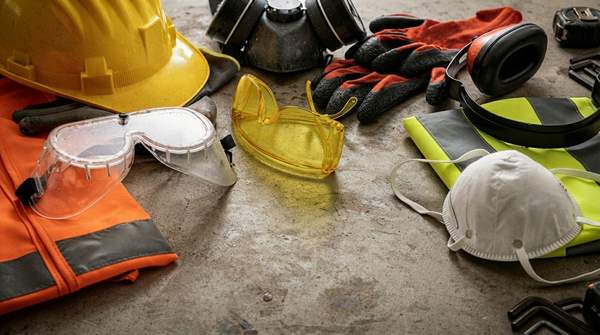
Choosing landscaping PPE comes down to two questions: what hazard does this task create, and what certification proves the gear can handle it? The five categories that cover most routine outdoor work are eye and face protection, hearing protection, gloves, protective footwear, and respiratory protection. For each one, a specific marking tells you the equipment is built for the job—ANSI Z87+ on eyewear, an NRR rating on hearing protection, ANSI/ISEA 105 classifications on gloves, and ASTM F2413 on footwear. This guide maps each item to the hazards it addresses, the standards to look for, and how to assemble a kit for mowing, trimming, and hardscaping.
Landscaping PPE: Hazard-to-Standard Quick Reference
Use this table as a purchasing checklist. Each row connects a hazard you will actually encounter—flying debris, machine noise, sharp tools, dropped pavers, airborne dust—to the PPE category that addresses it and the certification that verifies performance.
| PPE Item | Protects Against (Hazard) | Key Features to Look For | Relevant Safety Standard |
|---|---|---|---|
| Eye & face protection | Debris and dust propelled at high speed by mowers, trimmers, and blowers | Impact-rated safety glasses with side shields; add a face shield over glasses for heavy debris | ANSI Z87+ marking on glasses or face shield |
| Hearing protection | High noise from mowers, blowers, chainsaws, and trimmers | Earplugs or earmuffs with an appropriate Noise Reduction Rating (NRR) | ANSI S3.19, which specifies NRR ratings |
| Hand protection | Cuts, splinters, abrasions, punctures, and chemical exposure | Glove matched to the material: general work, cut-resistant, or chemical-resistant | ANSI/ISEA 105 performance classification for cut, abrasion, and puncture resistance |
| Foot protection | Dropped heavy objects such as pavers and rocks; punctures from nails, wire, and thorns; slips on wet or uneven ground | Protective (steel) toe, puncture-resistant sole, stable traction, and ankle support | ASTM F2413 (OSHA also accepts ASTM F-2412-2005, ANSI Z41-1999/1991, or equivalent protection) |
| Respiratory protection | Harmful dust and chemical inhalation | Mask or respirator selected for the specific contaminant, per manufacturer instructions | Match the respirator to the contaminant; follow manufacturer guidance |
The reasoning behind the table is straightforward: the hazard defines the category, and the standard defines whether a given product actually performs. A pair of ordinary sunglasses, for example, offers no verified impact resistance—only eyewear marked Z87+ does.