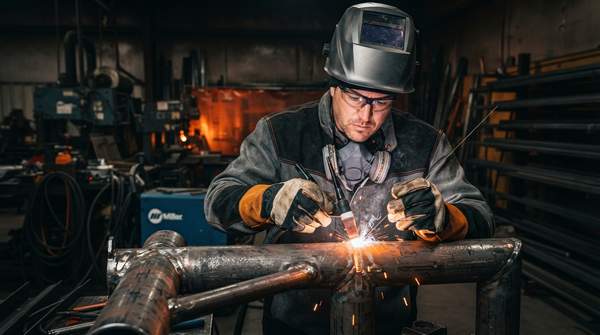
Welding exposes workers to five primary hazards: optical radiation in the ultraviolet and infrared range, flying metal and slag, fumes and gases, burns from heat and sparks, and electrical shock. Every piece of welding PPE addresses one or more of these hazards, according to safety training provider Safety Evolution, which bases its equipment guidance on Canadian Centre for Occupational Health and Safety (CCOHS) recommendations and the CSA W117.2 standard. This guide breaks down the five essential PPE categories, what each protects against, and the features that matter when selecting them.
Understanding Welding Hazards and the Role of PPE
CCOHS emphasizes that personal protective equipment and clothing may be needed not only for the welder but for welding personnel — operators, helpers, managers, supervisors — and any person nearby. That scope matters: radiation, sparks, and fumes do not stop at the welder's booth, and the CSA standard W117.2-19 (R2023), Safety in welding, cutting and allied processes, applies to all personnel working in an environment affected by welding, cutting, and allied processes.
The hazards fall into distinct categories that map onto distinct equipment. Intense visible light and UV/IR radiation attack the eyes; hot slag and flying particles strike the face and scalp; heat and sparks burn exposed skin; fumes and gases — including metal oxides, ozone, and nitrogen dioxide — damage the lungs; and electrical shock threatens the hands. Because each hazard requires a different barrier, no single item of PPE covers them all, which is why the essential kit spans eye and face protection, head protection, hand and arm protection, body protection, and respiratory protection.
Industry writing reinforces the point. A Mitti guide by Leon Altomonte describes the welding helmet as equipment you "can't weld without," and notes that appropriate PPE gives welders a solid protection layer that prevents accidents and improves workplace safety. CCOHS adds a maintenance dimension that is easy to overlook: lenses must be cleaned as needed, and pitted, cracked, or damaged lenses must be replaced and discarded, since a clear retaining lens is what keeps broken pieces away from your eyes.
Welding PPE Selection Guide
The table below consolidates the five essential categories, drawing on CCOHS guidance and the equipment list Safety Evolution compiled from CCOHS and CSA W117.2. Use it to match each item to the hazard it addresses and the features to check before buying or inspecting it.
| PPE Category | Primary Protection Against | Key Selection Features |
|---|---|---|
| Welding helmet or hand shield (with safety glasses underneath) | UV/IR radiation, flying particles, hot slag, intense visible light | Correct shade filter lens for the process and current; intact, clean lenses; undamaged clear retaining lens |
| Flame-resistant head covering (skull cap or balaava) worn under the helmet | Sparks, spatter, and burns to exposed scalp and neck | Flame-resistant material; coverage of skin the helmet leaves exposed |
| Welding gloves | Heat, sparks, spatter, cuts, and electrical shock to hands and arms | Material and thickness matched to the welding process and heat exposure |
| Flame-resistant clothing, leather apron or jacket | Heat, sparks, slag, and radiation burns to the body | Flame-resistant materials; full coverage of exposed skin; fabrics kept clean and free of combustible materials that a spark could ignite |
| Respirator | Welding fumes, metal oxides, ozone, nitrogen dioxide | Type matched to the fume (particulate, metal fume, or gas); selected after a hazard assessment and within an appropriate respiratory protection program |
Two qualifications from the underlying guidance deserve emphasis. First, protection is specific to the type of hazard and its intensity — a glove thickness that works for one process may be inadequate for a hotter one, and glove material and thickness vary with the welding process and heat exposure. Second, respiratory protection is not automatically required in every job: CCOHS states it is needed when ventilation is not sufficient to remove welding fumes or when there is a risk of oxygen deficiency, and it recommends seeking expert advice, conducting a hazard assessment, and initiating an appropriate respiratory protection program, with respirators selected and used in compliance with applicable regulations.
Choosing the Correct Filter Shade
The filter shade is the most technical choice in the kit, and CCOHS is explicit about how it works: for arc welding, the correct filter shade is selected according to the welding process, the wire diameter, and the operating current. CCOHS publishes shade numbers for different situations drawn as samples from CSA Standard W117.2-19 (R2023), and other processes are listed in the full standard. One instruction stands out: always use the suggested shade numbers rather than the minimum shade numbers. In practice, that means identifying your process and amperage first, then consulting the standard's table rather than settling for the lightest lens that technically passes.
This article is a general guide and does not replace specific training or adherence to local safety regulations, nor does it interpret the full legal requirements of OSHA or CSA standards. It also cannot give definitive PPE recommendations for specific processes such as MIG versus TIG; the shade table in the CSA standard is the controlling reference for those process-specific numbers.
Making Informed PPE Choices for Welding Safety
Welders should always select and use appropriate PPE based on the specific hazards of their welding task, ensuring proper fit and maintenance. The decision path is straightforward: identify the hazards present — radiation, sparks, fumes, heat, electrical risk — then match each hazard to the corresponding category in the table, verifying that materials, shade numbers, and respirator type fit the process and conditions at hand.
The measurable indicator of whether your PPE choices remain sound over time is regular inspection of PPE for damage and adherence to manufacturer guidelines and safety standards. CCOHS's own maintenance guidance makes the standard concrete: clean lenses as needed, and replace and discard any pitted, cracked, or damaged lens rather than continuing to weld behind it. A weekly check of helmets, gloves, and clothing against that benchmark — plus a hazard assessment before any job where ventilation may be inadequate — is the observable routine that keeps the five categories doing their jobs.
Sources
- PPE for Welding: Safety Equipment Guide — Safetyevolution
- Product — CSA
- Welding - Personal Protective Equipment and Clothing — CCOHS
- A Quick Guide to Welding PPE Essentials — Mitti