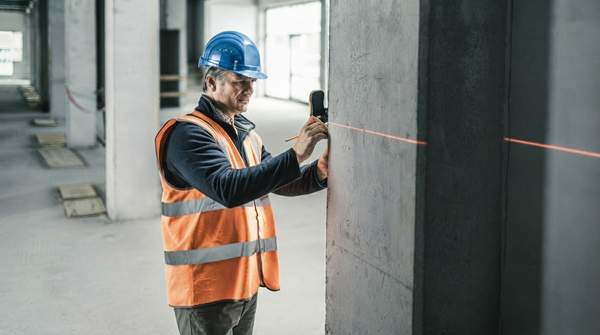
The right laser distance measure depends on two questions: where you mostly work, and how complex your measurements need to be. Indoor DIY projects can be handled by a basic red-beam tool, while outdoor construction demands long range, high visibility, and durable construction. The American Institute of Architects frames the selection process around visibility and accuracy in your working environment, and manufacturers note that construction-grade devices typically cover 20–60 meters. This guide turns those criteria into a practical decision framework.
Introduction to Laser Distance Measures
A laser distance measure replaces the metal tape measure with a device that emits a laser pulse at a target, receives the reflection, and calculates the exact distance from the time span between emission and return. As tool manufacturer SOLA explains, this lets you measure distances precisely and conveniently in just a few seconds.
The practical appeal is speed and one-person operation. Outdoor Life's gear coverage describes the shift plainly: no more stretching out a tape only to have it collapse, or sending someone up a ladder to hold the other end. Just point, click, and you have your measurement. Many models also perform calculations for area, volume, and square footage automatically, which serves both professional builders doing estimates and DIYers planning materials.
That growing capability is exactly why selection has become harder. As the AIA observes, professionals have increasingly shifted from tape measures to laser distance meters, and the market now offers a wide range of options—so the features you pay for should map to the jobs you actually do.
Key Features for LDM Selection
Three core features drive most purchasing decisions: range, accuracy, and beam visibility. Range varies greatly between models, and SOLA notes that laser distance meters used in the construction industry usually cover measurement distances of 20–60 meters. Matching the tool's maximum range to your largest typical measurement prevents buying inadequate capability—or paying for distance you will never use.
Beam color is the second major differentiator. Traditional red-beam lasers have limited visibility outdoors, according to the AIA: bright sunlight easily obscures the beam, making it difficult to aim and often requiring repeated adjustments. Green beams are generally easier for the human eye to see, which matters in well-lit indoor spaces as well as outdoors, though tools with them typically cost more.
Accuracy interacts with the environment rather than being a fixed number. Sunlight can interfere not only with your view of the beam but with the laser's reflected signal itself, affecting the measurement result. Accuracy ratings also vary greatly between models, so comparing stated tolerances against your precision needs—material estimation versus fine finish work, for instance—is worthwhile before purchase.
Advanced Functions and Their Practical Applications
Advanced functions are where LDMs earn their price premium, because each one solves a specific field problem. Area and volume calculation, available on many models at the touch of a button, removes manual multiplication when estimating flooring, paint, or concrete—SOLA lists this among the core capabilities of more capable devices.
Indirect measurement, often called Pythagorean mode, uses the geometric relationship between the sides of a right triangle to calculate distances you cannot measure directly. As the DIY writer behind Uncharted Steve explains, LDM manuals often fail to explain what these functions actually do, but the practical value is clear: you can determine heights and inaccessible distances from a fixed position, without ladders or scaffolding.
Devices with an integrated tilt sensor extend this further, determining inaccessible distances or heights via angle measurements. SOLA's guidance is direct on this point: users who want to calculate areas and volumes and determine inaccessible heights should think about purchasing a more complex device equipped with that sensor.
Finally, Bluetooth connectivity addresses documentation rather than measurement. Paired with an app, lengths can be sketched and dimensioned directly on a smartphone, and results saved, managed, and shared—a meaningful efficiency for professionals who must record and communicate measurements, and largely unnecessary for a homeowner hanging shelves.
Environmental Factors Affecting Performance
Environment is the most underestimated selection factor. Direct sunlight is the primary enemy of both visibility and accuracy: the AIA notes that sunlight obscures the beam and interferes with the reflected signal, while EngineerSupply's guidance is even more blunt—in full sun, you may not be able to see the laser pulse beyond about 30 feet, and in some cases not past nine feet.
Target surfaces matter too. SOLA cautions that measurements may become less accurate in adverse conditions such as a poorly reflective surface, or when measuring on glass or glossy surfaces, which can lead to measurement errors. A dark, textured wall behaves very differently from a window or polished floor.
Features can mitigate these problems. A more visible beam color helps with aiming in bright conditions, and some models include camera or viewfinder functions that let you locate the target point when the dot itself is hard to see. For anyone whose work regularly happens outdoors or in glare, these are not luxuries—they are what make the tool usable at all.
Decision Framework: Selecting Your Laser Distance Measure
The framework below maps the three most common user scenarios to the minimum features each requires. Read down the column that matches your primary work environment, then check that any model you consider meets those requirements before comparing price.
| Project Type / Environment | Essential Features | Recommended Tool Class |
|---|---|---|
| Indoor DIY and crafts | Basic distance measurement with a beam visible in typical indoor lighting; area and volume functions are useful but optional add-ons | Entry-level to mid-range LDMs; a red beam is generally adequate indoors |
| Professional interior work (flooring, painting, drywall) | Higher accuracy for material estimation, area and volume calculation, and indirect measurement for complex layouts; enhanced beam visibility for varied indoor lighting | Mid-range to professional-grade LDMs, with advanced functions and stronger visibility |
| Outdoor / construction site | Long range (construction models typically cover 20–60 meters), maximum beam visibility in sunlight, robust construction, and tilt-sensor or viewfinder support for hard-to-aim shots | Professional-grade LDMs built for outdoor conditions |
The logic behind the framework is straightforward. Indoor DIY work involves short distances and controlled lighting, so visibility and range demands are low. Professional interior work adds complexity—layouts, estimates, obstructed heights—so calculation functions and accuracy become essential. Outdoor construction compounds every challenge at once: long distances, sunlight that can hide a red beam within 30 feet, and reflective or glossy surfaces that degrade accuracy, which is why the tool class steps up again.
Making the Right Choice: Your Next Steps
To select an appropriate laser distance measure, evaluate your primary work environment (indoor versus outdoor) and the complexity of your measurement tasks (basic versus advanced calculations) against the tool's range, beam visibility, and available advanced functions. If most of your work is indoor and simple, a basic red-beam model suffices; if you estimate materials or measure obstructed heights indoors, step up to calculation functions and a tilt sensor; if you work outdoors, prioritize visibility and range before anything else.
The measurable indicator of success is simple: the user successfully identifies a laser distance measure class—entry-level, mid-range, or professional—that aligns with their project needs and budget, based on the framework provided. Before buying, verify the model's stated range covers your largest typical measurement and that its beam is visible in your actual working light; if you cannot confirm those two things, the tool is the wrong class regardless of its other features.
Sources
- Sharper, safer, smarter: Picking the right laser distance meter — The American Institute of Architects
- Laser Distance Measurers: Fast and Precise – SOLA
- Best Laser Tape Measures of 2026, Tested and Reviewed — Outdoor Life
- Laser Distance Meter How To: Basic, Advanced, Pythagorean — Uncharted DIY
- How do laser measuring tools work? — EngineerSupply