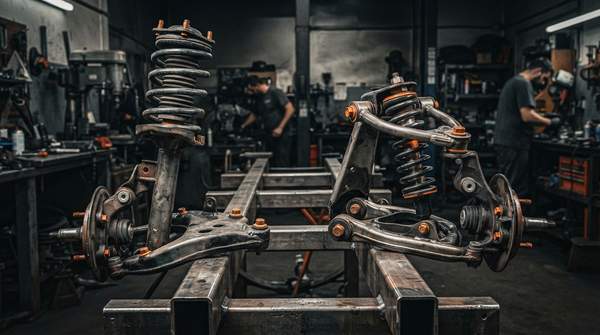
The difference between a jarring thud and a gentle undulation when driving over a pothole is the precise harmony of a vehicle's suspension system. This sophisticated network of springs, dampers, and linkages is fundamental to performance, providing a comfortable ride while critically ensuring vehicle handling, stability, and overall safety by keeping tires in firm contact with the road surface through every turn and bump.
What Is an Automotive Suspension System?
The automotive suspension system connects a vehicle's frame to its wheels, managing dynamic forces. It comprises springs, shock absorbers, struts, and control arms, which collectively absorb shocks and bumps from uneven road surfaces. This system is essential for maintaining passenger comfort, ensuring stable and predictable handling, and maximizing tire-to-road friction for safety.
How an Automotive Suspension System Works: Step by Step
A suspension system operates as a continuous, four-stage process, reacting in fractions of a second to changing road conditions. Its dynamic behavior constantly adjusts to maintain equilibrium and control, especially when a wheel encounters an obstacle.
- Step 1: Encountering an Obstacle and Initial Impact The process begins the moment a tire makes contact with a road imperfection, such as a pothole, speed bump, or uneven pavement. The force of this impact is transferred vertically from the tire and wheel assembly into the suspension system. The primary goal is to absorb this sudden energy before it can be transmitted to the vehicle's chassis and, subsequently, to the occupants.
- Step 2: Energy Absorption by the Springs First, the springs are tasked with absorbing the impact. Springs, most commonly coil springs in modern vehicles, are designed to bear the entire weight of the vehicle. When a wheel is forced upward by a bump, the spring compresses, converting the kinetic energy of the vertical movement into potential energy stored within the spring. It then expands to push the wheel back down, attempting to maintain contact with the road surface. Without the next step, however, the vehicle would continue to oscillate or bounce uncontrollably as the spring repeatedly compresses and expands.
- Step 3: Dampening Oscillations with Shock Absorbers Next, the shock absorbers, also known as dampers, come into play to control the spring's oscillations. As the spring compresses and rebounds, the shock absorber resists this movement through hydraulic pressure. Inside a shock absorber is a piston that moves through a cylinder filled with hydraulic fluid. Small orifices in the piston allow the fluid to pass through slowly, creating resistance that converts the spring's kinetic energy into heat. This action dampens the bouncing motion, settling the vehicle's body quickly and preventing the continuous oscillation that would otherwise occur.
- Step 4: Maintaining Wheel Alignment and Control Finally, a network of control arms, linkages, and joints ensures the wheel remains in its proper orientation relative to the vehicle's body and the road. Control arms pivot to allow the wheel to move up and down in a controlled path while preventing unwanted forward, backward, or lateral movement. This structural support is critical for maintaining consistent tire contact, which is essential for effective steering, braking, and cornering. Stabilizer bars (or anti-roll bars) also connect opposite wheels to minimize body roll during turns, further enhancing stability.
Understanding the Core Components of Automotive Suspension
Modern automotive suspension systems work through individual components, each with specific functions. Though distinct, these parts are designed to operate as a cohesive unit, which is essential to their overall performance.
- Springs: These are the primary energy-absorbing components. While various types exist, coil springs are the most common in passenger cars. They support the vehicle's weight and compress to absorb bumps. Some systems use other types, such as leaf springs (common in trucks) or torsion bars. According to MotorTrend, advanced air suspension systems replace traditional coil springs with flexible, pressure-filled rubber bags. These air springs are often progressive, meaning their stiffness increases as they are compressed, providing a variable and adaptable response.
- Shock Absorbers (Dampers): A shock absorber's sole purpose is to control the unwanted motion of the spring. As detailed by Spinny, they dampen the oscillations by converting motion into heat, preventing the vehicle from bouncing after hitting a bump. Without functional shock absorbers, a vehicle would feel unstable and difficult to control.
- Struts: A strut is a common suspension component that combines a spring and a shock absorber into a single, integrated unit. This assembly not only performs the duties of both parts but also serves as a structural element of the suspension, often providing a pivot point for the steering system. Struts are frequently used in the front suspension of modern front-wheel-drive vehicles due to their compact design.
- Control Arms: These are hinged linkages that connect the vehicle's frame to the steering knuckle or axle housing where the wheel is mounted. They allow the wheel to move up and down in a controlled path while restricting other movements. Bushings, typically made of rubber or polyurethane, are used at the pivot points to absorb minor vibrations and reduce noise.
- Stabilizer Bar (Anti-Roll Bar): This is a short torsion bar that connects the left and right sides of the suspension. During a turn, as the vehicle's body leans or "rolls" to the outside, the stabilizer bar twists. This resistance to twisting helps to keep the vehicle level, improving cornering stability and tire grip.
Different Types of Modern Suspension Systems Explained
While all suspension systems share the same fundamental goals, modern automotive engineering has produced several distinct types, each offering different levels of performance, comfort, and adjustability.
Passive Suspension: As the most common and basic type, passive suspension utilizes a fixed set of springs and shock absorbers with characteristics (stiffness and damping rate) predetermined by the manufacturer. This reliable and cost-effective solution is designed to offer a balanced compromise between ride comfort and handling for typical driving conditions.
Semi-Active (Adaptive) Suspension: This advanced system can change its damping characteristics in real-time. According to a study published by PMC, the active detection of road information is key to the performance of these systems. They use a network of sensors to monitor vehicle speed, steering angle, body movement, and road conditions. An electronic control unit (ECU) processes this data and adjusts the stiffness of the shock absorbers, often via a magnetorheological fluid that changes viscosity when a magnetic field is applied. This technology allows the suspension to be soft and comfortable during cruising but firm and responsive during aggressive driving, effectively improving both ride comfort and handling stability.
Active Suspension: Taking things a step further, fully active suspension systems use actuators to actively move the wheel in response to road imperfections, rather than just reacting to them. These systems can nearly eliminate body roll, dive, and squat. One example of a cutting-edge system is Tenneco's CVSA2/Kinetic suspension, which, as reported by Automotive IQ, is featured in high-performance vehicles like McLaren hypercars. These systems offer unparalleled control but are complex and expensive, generally reserving them for luxury and high-performance applications.
Air Suspension: This type replaces conventional steel springs with air springs or bags. Modern air suspension systems typically include an onboard air compressor and sometimes a separate air tank. A key advantage is adjustability; air bags can be inflated or deflated, often at the touch of a button, to instantly alter the vehicle's ride height and stiffness. This allows a driver to raise the vehicle for clearing obstacles or lower it for better aerodynamics and handling at high speeds.
Frequently Asked Questions
How do I know if my shocks or struts are failing?
Common signs of worn shocks or struts include excessive bouncing after hitting a bump, a "nose-dive" motion where the front of the vehicle dips excessively during braking, visible fluid leaking from the shock or strut body, and uneven or cupped tire wear. A rough or unstable ride is also a primary indicator.
What is the functional difference between a shock and a strut?
While both dampen spring oscillations, a strut is also a structural component of the suspension and steering system. It replaces the upper control arm and serves as a pivot point for the steering knuckle. A shock absorber, on the other hand, is purely a damping device and does not support any vehicle weight or connect steering components.
Can I upgrade from a passive suspension to an adaptive or air system?
Yes, aftermarket kits are available to upgrade many vehicles to a more advanced suspension type. Air suspension kits are a popular modification for trucks and custom cars, offering adjustable ride height. Coilover kits, which are adjustable shock-and-spring units, are a common performance upgrade. However, converting to a factory-style adaptive system is often complex and cost-prohibitive due to the need for sensors, wiring, and an ECU.
The Bottom Line
A modern automotive suspension system is an intricate collaboration of components engineered for safety, comfort, and control. Springs absorb impacts, while shock absorbers manage that energy, a dynamic crucial to vehicle performance. For technicians or enthusiasts, regular inspection of these components is critical for maintaining peak performance and ensuring a safe driving experience.