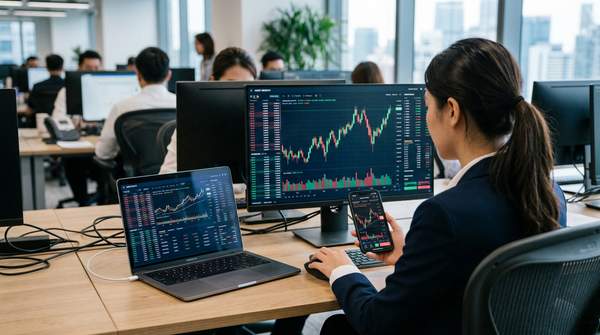
C.H. Robinson has deployed over 30 AI agents. These agents now perform millions of shipping tasks daily. They manage complex logistical operations, from freight matching to route optimization. This reduces manual intervention and accelerates delivery timelines across the supply chain. C.H. Robinson's deployment of over 30 AI agents, performing millions of shipping tasks daily, signals a fundamental shift in industrial material handling.
AI agents execute millions of shipping tasks. Many businesses still underestimate the speed and scale of this operational transformation. This creates a critical gap. Early adopters gain an insurmountable lead over those slow to integrate advanced systems.
Companies trade traditional operational models for AI-driven efficiency. Those failing to adapt risk significant competitive disadvantage and obsolescence.
The Booming Market for Logistics Tech
- 65% — of technology providers in the logistics sector reported sales growth of 10% or more year-over-year, according to 2026 logistics tech trends.
- 52% — of technology providers in the logistics sector saw their customer base grow by 10% or more, according to 2026 logistics tech trends.
65% of technology providers in the logistics sector reported sales growth of 10% or more year-over-year, and 52% saw their customer base grow by 10% or more, confirming a booming market. Demand for advanced logistics solutions drives this growth. The rise in sales and customer acquisition for logistics technology providers marks a major industry pivot. Businesses now prioritize automated material handling systems and AI-driven platforms. This expansion proves confidence in these solutions to enhance operational efficiency and competitive standing.
AI's Tangible Impact on Operations
| Company | AI Integration | Operational Shift / Benefit |
|---|---|---|
| Flexport | AI-driven fulfillment model | 100% growth reported by transitioning from manual pick-and-pack processes, according to Global Trade Magazine. |
| DHL Supply Chain | AI agents for routine tasks | Employees redirected from handling routine calls and emails to high-value exception management, according to Transport Topics. |
Flexport's reported 100% growth by adopting an AI-driven fulfillment model and DHL Supply Chain's redirection of employees to high-value exception management prove AI's practical impact. Flexport reported 100% growth by adopting an AI-driven fulfillment model. Companies retaining manual pick-and-pack processes sacrifice exponential market share. AI agents, like those at C.H. Robinson, perform millions of shipping tasks. Operational efficiency is no longer an advantage; it is a baseline requirement. Human roles shift to high-value exception management, away from routine execution. This transformation defines industrial material handling.
Enabling Technologies and Strategic Partnerships in AI Logistics
Specialized AI tools drive this automation wave. GreyOrange launched GreyMatter Foundry, an AI simulator. It unifies warehouse flow design, technology sizing, and layout planning, according to DC Velocity. This platform optimizes complex warehouse operations before physical implementation. SVT Robotics launched Softbot Intelligence. This new data platform enhances integration and orchestration of diverse robotic systems, according to Robotics & Automation News.
GreyMatter Foundry and Softbot Intelligence accelerate next-generation logistics infrastructure. AI simulation platforms, like GreyMatter Foundry, show the future of industrial logistics. It is not about automating single tasks. It involves designing self-optimizing supply chain ecosystems. Piecemeal automation efforts become obsolete. These advancements set the standard for material handling.
Sectors Undergoing Transformation
AI-driven logistics impacts diverse industrial sectors. Food and beverage, manufacturing, and retail are top industries served by logistics technology vendors. 75% of vendors serve these sectors, according to 2026 logistics tech trends. The 75% adoption rate of logistics technology vendors serving food and beverage, manufacturing, and retail proves a universal imperative: businesses must integrate advanced material handling systems, regardless of product focus.
The pervasive demand, with 75% of vendors serving food and beverage, manufacturing, and retail sectors, confirms AI and automated logistics are not niche trends. They are critical for competitive operations across all industries. AI-powered solutions meet a universal need for efficiency and scalability. Businesses must navigate complex supply chains with these tools.
The Future of Automated Logistics
Integrated solutions define the next wave of AI-powered logistics. They move beyond singular tasks to complex operational challenges.
- Fortna and Jacobi Robotics partnered to implement AI-powered mixed-case palletizing. This impacts distribution and fulfillment operations, according to Logistics Business.
The partnership between Fortna and Jacobi Robotics to implement AI-powered mixed-case palletizing shows a broader trend: specialized AI solutions from strategic collaborations. These ventures address intricate challenges. Varied product handling and optimized space utilization are critical for industrial material handling efficiency. Integrated approaches push the boundaries of automated systems. Failure to adopt these integrated solutions will leave companies with fragmented, inefficient operations, unable to compete with optimized ecosystems.
Preparing for a Future-Ready Supply Chain
Siemens and KION partner to make supply chains and warehouses future-ready, according to Automation.com. Siemens and KION's partnership to make supply chains and warehouses future-ready creates robust, adaptable systems. These systems integrate new AI material handling trends. Businesses prioritizing such partnerships and sophisticated AI solutions will likely secure a competitive advantage. If current trends continue, companies failing to implement AI-driven material handling systems by Q3 2026 risk significant market share erosion, mirroring the 100% growth seen by early adopters like Flexport.