A brick wall can carry a crack across several courses while remaining largely intact. When the repair calls for stitching that masonry together, choosing between 6mm and 8mm helical bars becomes a specific design decision involving the steel, the mortar joint and the way the reinforcement will be anchored.
HeliMate Australia supplies both diameters in cold-pressed 316L stainless steel, with 1,000mm straight bars and coiled options. The choice gives repair professionals a consistent material family with two reinforcement sizes, rather than a collection of unrelated products to assess for each job.
Compare the Two HeliMate Bar Sizes
Both bars have a twisted helical profile intended to be embedded in a prepared masonry joint with compatible bonding material. They share their stainless steel grade and supply formats, but their different diameters change the physical arrangement inside the joint.
| Feature | 6mm helical bar | 8mm helical bar |
|---|---|---|
| Nominal diameter | 6mm | 8mm |
| Material | Cold-pressed 316L stainless steel | Cold-pressed 316L stainless steel |
| Straight supply length | 1,000mm | 1,000mm |
| Coiled stock | Available | Available |
| Bonding options | EzyBond or EzyGrout in compatible applications | EzyBond or EzyGrout in compatible applications |
| Design question | Does the joint and repair detail call for 6mm reinforcement? | Does the joint and repair detail call for 8mm reinforcement? |
The 8mm bar has a nominal diameter one-third greater than the 6mm version. For the same length, that changes how much room the steel occupies and how the joint must accommodate the bar and its bedding material.
A larger diameter is a different reinforcement option, not an automatic upgrade for every crack. The engineer’s specification establishes the size through the masonry condition, required structural behaviour and approved installation details.
The Mortar Joint Shapes the Choice
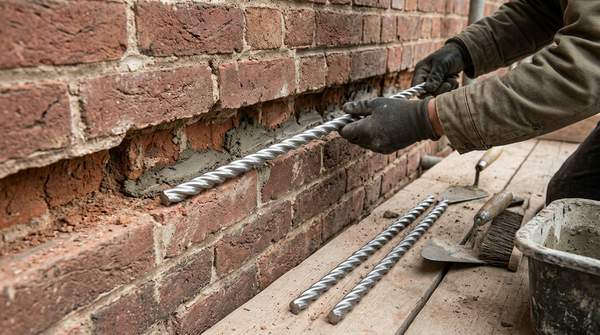
Brick stitching commonly places steel within horizontal bed joints, making the repair largely concealed once the mortar is reinstated. The installer prepares a slot long enough to cross the fracture and provide the anchorage shown in the repair detail.