Picking the right concrete or masonry anchor comes down to three questions: how heavy is the load, does the fixture ever need to come off the wall, and what's the base material? Among the four most common mechanical anchors, wedge anchors deliver the highest holding strength for permanent structural work, drop-in anchors suit flush, serviceable overhead mounts, hammer drive anchors handle quick light-duty fixings, and concrete screws are the one removable option. This guide compares all four so you can match the anchor to your project rather than guessing at the hardware aisle.
Wedge Anchors: For Heavy-Duty Permanent Loads
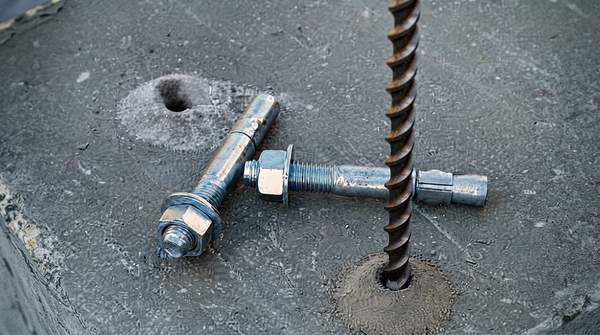
Wedge anchors—also called stud anchors—are mechanical expansion anchors built around a threaded stud with an expansion clip and wedge at the end. You drill a hole, insert the anchor through the fixture, and torque the nut; the wedge expands at the bottom of the hole, locking the stud permanently in place. According to supplier and manufacturer comparisons, wedge anchors carry higher tension and shear capacities than drop-in anchors of the same diameter, which is why they're the default for structural attachment work: heavy machinery, structural framing, handrails, and machine bases.
One documented data point from a fastener distributor's comparison puts a 1/2-inch wedge anchor at 8,679 pounds of tension and 8,050 pounds of shear in 4000 PSI concrete—figures to treat as an example of the class's strength, not a rating for every product. Wedge anchors are also noted as compatible with cracked concrete, making them suitable for seismic applications. The trade-off is permanence: the stud stays expanded in the hole, and removal generally isn't practical without damaging the concrete. The protruding stud, nut, and washer also remain visible on the surface.
Drop-In Anchors: Ideal for Suspended and Flush Applications
Drop-in anchors reverse the wedge anchor's geometry: instead of a male stud, you get a female, internally threaded socket that sets flush with the concrete surface. Installation happens in two stages—drill the hole, insert the anchor, and drive it down with a setting tool to expand it, then thread a bolt into the socket when you're ready to mount the fixture.
The flush profile is the main draw for overhead work. Industry comparisons recommend drop-in anchors for suspended ceilings, hangers, and serviceable equipment mounts, where a protruding stud would be unacceptable and the fixture may need to come down for maintenance. Load capacity is moderate rather than structural—reliable within rated limits, per the wedge-versus-drop-in comparison, but below a same-diameter wedge anchor. Removability is partial: the bolt can be removed and replaced repeatedly, but the anchor body itself is permanent once set, and it isn't reusable. Drop-ins are intended for solid concrete or grout-filled masonry, with one supplier's selection guidance noting uncracked concrete specifically.