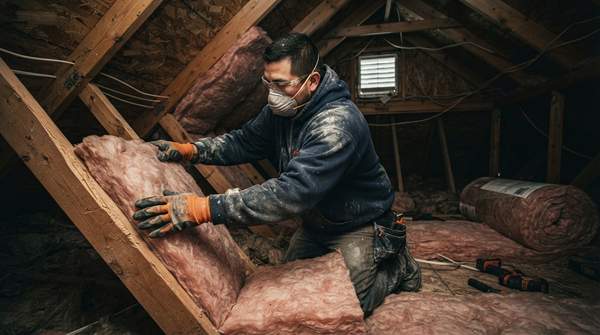
There is no single best insulation for a whole house. The right choice depends on where you are insulating, how much space you have, and how much moisture the area encounters. Closed-cell spray foam delivers the highest thermal performance per inch—roughly R-6.0 to R-6.5—and resists moisture, making it a strong fit for crawl spaces and irregular cavities. Fiberglass batts, at about R-3.0 to R-4.3 per inch, remain the affordable default for open attics and standard wall cavities. Rigid foam boards span roughly R-3.8 to R-6.8 per inch depending on the type and excel on basement and crawl space walls, while cellulose, around R-3.1 to R-3.8 per inch, is a common blown-in choice for attics and wall cavities.
Comparing Common Insulation Types
R-value measures a material's resistance to heat flow—the higher the number, the better it insulates. But R-value per inch is only part of the decision. Two other factors matter just as much: how the material handles moisture, and whether its installation method suits the space you are filling. A material with a modest R-value installed at the correct thickness can outperform a premium material squeezed into a space it does not fit.
Spray foam's standout trait is that it does more than insulate. As Green Builder Media's editor Matt Power notes, it "seals air leaks, especially in tough spots, such as around plumbing penetrations and wire entry points." Closed-cell spray foam is the most common form because its densely packed, closed pockets make it moisture resistant, according to Focus on Energy. Fiberglass is affordable, widely available, and easy to install, but it is water-sensitive: Retrofoam of Michigan warns that fiberglass in areas prone to condensation, such as rim joists, can lose effectiveness and support mold and mildew growth.
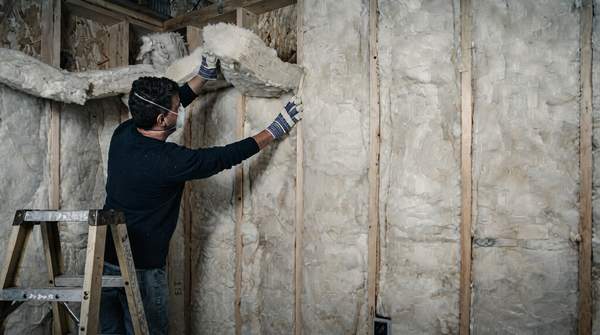
Rigid foam boards are moisture- and pest-resistant, though Consumer Reports cautions that they are hard to fit snugly in unusually shaped spaces and require taped seams to form an effective air and moisture seal. Cellulose, made from treated recycled material, is commonly blown into attics and wall cavities but is dusty to handle and requires a respirator during installation.
Insulation Material Comparison Matrix
Use this matrix to match a material to your project. Read across each row to see how the four most common residential options compare on thermal performance, typical applications, and moisture behavior, then check the area-specific sections below for the reasoning behind each recommendation.
| Insulation Type | R-Value per Inch | Best For (Home Area) | Moisture Resistance |
|---|---|---|---|
| Spray foam (closed-cell) | R-6.0 to R-6.5 | Irregular spaces, attics, walls, crawl spaces, rim joists | High; closed pockets resist moisture and it does not retain water |
| Fiberglass | R-3.0 to R-4.3 | Walls, attics, floors | Low; water-sensitive and can support mold if it stays wet |
| Rigid foam board (polyiso, XPS, EPS) | R-3.8 to R-6.8, depending on type | Basement and crawl space walls, exterior walls, wall sheathing | High; XPS is particularly moisture-resistant, but seams must be taped |
| Cellulose | R-3.1 to R-3.8 | Attics and wall cavities (blown-in) | Treated to resist mold, but not described as moisture-impermeable |
Two caveats apply to every row. First, these are per-inch values; your total R-value depends on installed thickness, so a deep layer of fiberglass can match a thinner application of spray foam. Second, rigid foam board is a family of products: Consumer Reports identifies polyiso as having the highest R-value, extruded polystyrene (XPS) as particularly moisture-resistant, and expanded polystyrene (EPS) as often the cheapest.
Best Insulation for Attics
Because warm air rises, the attic is the place to start, particularly in colder climates, as Consumer Reports advises—and the Environmental Protection Agency estimates that nine out of ten U.S. homes are underinsulated. That makes the attic the highest-impact project for most homeowners.
For an open, unfinished attic floor, blown-in cellulose and fiberglass batts are the standard choices. Cellulose fills the joist cavities evenly and is commonly used exactly for this purpose; fiberglass batts are inexpensive and easy to lay between joists yourself. Neither offers the air sealing of foam, so pairing either with separate air-sealing work at top plates and penetrations improves results. If your attic has irregular framing, kneewall cavities, or hard-to-reach gaps around wiring and plumbing, spray foam's ability to expand and seal those spaces is where it earns its premium price. Focus on Energy even offers DIY rebates for self-installed attic insulation and air sealing, which suggests attic projects are among the most accessible for homeowners.
Best Insulation for Walls
Wall choice hinges on whether the walls are open or finished. For open stud cavities during new construction or a remodel, fiberglass batts are the straightforward, widely available option. For existing finished walls, blown-in cellulose can be injected into cavities without demolitating the interior, which is why Consumer Reports lists wall cavities among its most common uses.
When wall depth limits how much insulation you can fit, high-density spray foam's R-6.25 per inch lets you pack substantial insulating power into a small space, as Green Builder Media explains. Spray foam also seals the air leaks that batts leave open around penetrations, and it adds some structural rigidity. For exterior upgrades, ENERGY STAR guidance based on the 2021 International Energy Conservation Code recommends adding insulative wall sheathing beneath new siding—R-10 for insulated 2x4 wood-frame walls in climate zones 4 through 8. Rigid foam board is the natural product for that job, since it works as continuous insulation on a house's exterior. Note that condensation inside wall cavities, caused by air leakage and insufficient insulation, can lead to mold and mildew, so moisture behavior matters in walls too, not just in basements.
Best Insulation for Crawl Spaces and Basements
Moisture is the deciding factor below grade. Retrofoam of Michigan is direct about this: crawl space walls "should be insulated with non-water sensitive insulation that will prevent interior air from touching the cold surfaces." That rules out fiberglass in most crawl space applications, since it can hold water and feed mold growth in damp conditions.
The practical contest is between closed-cell spray foam and rigid foam board. Spray foam conforms to irregular surfaces and seals rim joists and penetrations in one step, while rigid foam board is the code-recognized option for basement and crawl space walls: ENERGY STAR's 2021 IECC-based guidance calls for R-5 insulative wall sheathing or an R-13 batt in zone 3, R-10 sheathing or R-13 batt in zones 4A and 4B, and R-15 sheathing or R-19 batt in zones 4C through 8. If you choose foam board, tape all seams between boards to create an effective air and moisture seal, as Consumer Reports advises. Spray foam generally requires professional installation, so factor that into your planning.
Making Your Insulation Choice
Select the insulation type that best balances R-value, moisture resistance, and suitability for the specific home area (attic, walls, crawl space) to optimize energy efficiency and prevent moisture-related issues. In practice: fiberglass or cellulose for open attic floors and standard wall cavities, spray foam where air sealing and irregular spaces demand it, and closed-cell spray foam or taped rigid foam board anywhere moisture is present. The measurable indicator of a successful choice is reduced energy bills and absence of moisture-related problems (e.g., mold, dampness) in insulated areas. Check your climate zone against the 2021 IECC-based targets before buying, and remember that per-inch R-values only deliver their rated performance at the thickness you actually install.
Sources
- Insulation R-Values Chart and Buyer Guide — Greenbuildermedia
- Three Types of Insulation, Which Is Best for Your Home? — Focus on Energy
- Foam vs Fiberglass vs Cellulose: Which Insulation is Best for My Existing House? — Retrofoamofmichigan
- How to Shop for Home Insulation in 2025 - Consumer Reports
- Recommended Home Insulation R–Values — ENERGY STAR