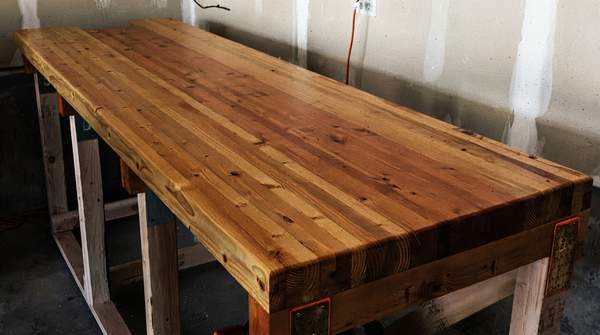
You can build a solid, stationary workbench for a home workshop with nine 2x4s, one sheet-top panel, and five basic tools. The plan below follows Ana White's "Sturdy Work Bench" design, a roughly 24-by-48-inch bench built entirely with screws and straight cuts—no mortise-and-tenon joinery, no specialty equipment. Before you cut anything, though, you need to make one real decision: what to use for the top. This guide compares three proven options—a laminated pine board, MDF project panels, and a repurposed solid-core door—then walks through the full build.
Choosing Your Workbench Top: Pine, MDF, or Solid-Core Door?
The top is the part of the bench you actually work on, and the three materials that appear most often in proven DIY plans each suit a different situation. Ana White's plan calls for a 24-by-48-by-1-inch laminated pine board, which she priced at about $20 from Home Depot. That gives you a traditional wood surface sized exactly to the frame, with no cutting required.
Jonny Builds, who documented a one-hour workbench built with limited tools, used 3/4-inch MDF project panels—pre-cut 2-by-4-foot panels sold in the plywood aisle of most home centers. He notes that buying four project panels costs about $5 more than a full sheet of MDF, but the smaller panels are far easier to transport, especially without a truck. Because they're cheap and standardized, panels like these are a practical choice if you expect to rough up the surface and want an inexpensive replacement down the road.
The third option comes from an Instructables guide on building a sturdy workbench inexpensively: a solid-core wooden door repurposed as the bench top, mounted on a 2x4 frame. That builder reported a finished bench—80 inches long, 36 inches wide, and 34 inches tall—costing a little over $80 and being "rock solid." A used door can make this the cheapest heavy-duty top of the three, though you'll need to size your frame to the door rather than the other way around.
Workbench Top Material Comparison
Use this table to match the top to your budget, your projects, and how much punishment the surface will take. All three options are drawn from published DIY builds, so each has been used successfully on a 2x4-framed bench.
| Material | Relative Cost | Best For | Considerations |
|---|---|---|---|
| Laminated pine board (24"x48"x1") | About $20, per Ana White's plan | A traditional woodworking surface that fits the plan's frame exactly, with no cutting | A specific recommendation of the Ana White plan; price is as stated in the source |
| MDF project panels (3/4", 2'x4') | About $5 more than a full MDF sheet for four panels, per Jonny Builds | Low-cost, easily handled panels; a practical choice if you want a cheap, replaceable surface | Full sheets are cheaper, but panels are far easier to transport without a truck |
| Solid-core door | Can be inexpensive, especially if sourced used; one builder's full bench cost a little over $80 | Heavy-duty durability; one builder described the finished bench as "rock solid" | You must size the frame to the door; the Instructables example was 80" long by 36" wide |
The decision framework is straightforward. If you want the simplest path that matches the cut list below, buy the laminated pine board. If your budget is tight or you expect a hard-used, sacrificial surface, MDF project panels keep replacement cheap. If you can find a solid-core door and want maximum durability for heavy work, build the frame to fit it.