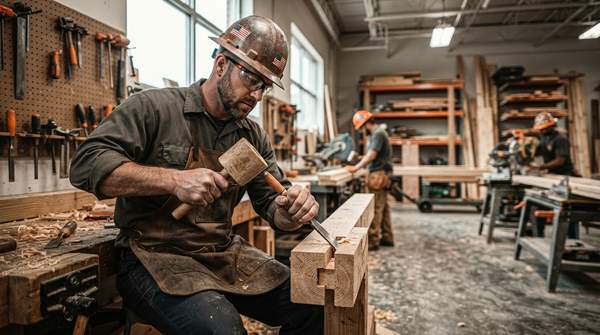
A beginner's woodworking journey doesn't start with a table saw, but with a 12-15 inch No. 5 Jack plane and a precisely filed 26-inch rip hand saw. These foundational tools enable the precise shaping and cutting that define true craftsmanship. Many aspiring woodworkers believe advanced projects require expensive power tools, but the most critical skills and precision are developed with a focused selection of hand tools. Investing in and mastering essential hand tools early on leads to greater proficiency, satisfaction, and a more sustainable woodworking practice, potentially delaying or reducing the need for extensive power tool purchases.
A beginner woodworking kit, according to The English Woodworker, should include a 12-15 inch No. 5 Jack plane, a set of three chisels (up to 1/4", 3/8"-1/2", and 3/4"), a combi square, a 6" rule, a marking knife, a pencil, a tape measure, and a marking gauge. While this source advocates a minimalist approach, others like Garrett Wade offer more comprehensive sets, often featuring a #4 Smoothing Plane, a #60½ Low Angle Block Plane, and a 4-piece chisel set. This variation reveals a core tension: novices must choose between starting with bare essentials or making a more extensive, hand-tool-focused investment. Aspiring woodworkers who bypass the foundational discipline of specialized hand tools for the perceived efficiency of power tools trade immediate gratification for a superficial understanding of their craft, hindering long-term skill development.
Precision in Numbers: Understanding Tool Specifications
- 18" — Tenon Saws are recommended at this length, requiring a depth of cut of at least 3.5 inches and approximately 10 teeth per inch (ppi), according to Renaissance Woodworker.
- 12-14" — Carcass Saws of this length are recommended for final dimensioning tasks, featuring 12 ppi with crosscut filed teeth, as reported by Renaissance Woodworker.
Specific dimensions and teeth-per-inch (ppi) counts are not arbitrary. They dictate a saw's intended purpose and efficiency for different cuts, ranging from intricate joinery to general dimensioning. These detailed specifications, such as a '26" 5 ppi Rip Hand Saw' or a '12-14" Carcass Saw with 12 ppi crosscut filed teeth', confirm that true woodworking precision is not an inherent tool feature, but a skill cultivated by the craftsman's deliberate choice and mastery of specific instruments.
The Core Arsenal: Essential Planes and Chisels
1. Chisels
Best for: Joinery, paring, shaping wood joints, and cleaning out mortises.
A versatile chisel set is fundamental. The English Woodworker recommends three chisels (up to 1/4", 3/8"-1/2", and 3/4"). Garrett Wade offers a 4-piece set (1/4, 1/2, 3/4, and 1-inch). Renaissance Woodworker suggests 1/8, 1/4, 3/8, and 1/2-inch Bench Chisels, plus a 1.5 to 2-inch Paring Chisel. The variety in recommended sizes reflects the diverse demands of fine joinery and stock removal.
Strengths: Essential for fine detail and joinery; provides direct control. | Limitations: Requires regular sharpening; challenging for beginners to master. | Price: Moderate for quality sets.
2. No. 5 Jack Plane
Best for: General stock removal, flattening boards, and preparing surfaces.
The 12-15 inch No. 5 Jack plane is a foundational tool for initial stock preparation, explicitly included in beginner kits by The English Woodworker.
Strengths: Highly versatile for various planing; good for roughing and initial smoothing. | Limitations: Not for final finishing; requires practice for consistent results. | Price: Moderate to high for a quality tool.
3. Japanese Back Saw (Ryoba Saw)
Best for: Versatile cutting for both rip and crosscut applications, especially for joinery.
The Ryoba Saw is recommended for beginners due to its cost-effectiveness and disposable blades, making it suitable for joinery tasks, according to The English Woodworker. Garrett Wade includes a 9.5-inch Ryoba Saw with a replaceable blade in its complete sets.
Strengths: Cuts on pull stroke for greater control; dual-edge for rip and crosscut; cost-effective. | Limitations: Challenging for those accustomed to push-stroke Western saws; replaceable blades add long-term cost. | Price: Low to moderate.
4. Marking Knife
Best for: Achieving precise and clean layout lines for accurate cuts and joinery.
A marking knife creates accurate layout lines, ensuring precise cuts. Family Handyman confirms its necessity for precision layout, and The English Woodworker includes it in beginner kits.
Strengths: Creates a fine, indelible line; reduces tear-out. | Limitations: Requires a steady hand; difficult to see on dark woods. | Price: Low.
5. Tape Measure
Best for: General measurements of stock, project dimensions, and layout.
A tape measure is fundamental for all measurement tasks. Family Handyman lists it as essential, and The English Woodworker includes a 12 or 16-foot tape in beginner kits.
Strengths: Quick and easy for rough and general measurements; flexible for curves. | Limitations: Less precise for fine joinery than a rule or marking gauge; prone to errors. | Price: Low.
6. Combi Square
Best for: Marking square and mitered lines, setting depths, and checking squareness.
The combi square is a versatile tool for marking and checking squareness, included in recommended beginner kits by The English Woodworker.
Strengths: Multi-functional for various marking and measuring; ensures accuracy. | Limitations: Less precise than dedicated fixed squares for critical work; requires careful calibration. | Price: Low to moderate.
7. Marking Gauge
Best for: Scribing parallel lines from an edge for joinery and accurate stock preparation.
A marking gauge is essential for accurately scribing parallel lines and transferring measurements, complementing the marking knife for precise layout. The English Woodworker includes it in beginner kits.
Strengths: Produces consistent, parallel lines; highly accurate for repetitive marking. | Limitations: Limited to marking parallel to an edge; requires sharp pin or wheel. | Price: Low to moderate.
8. Sharpening Stone
Best for: Maintaining sharp edges on chisels, plane irons, and other cutting tools.
A double-sided Norton oil stone is recommended by The English Woodworker for sharpening edge tools. Maintaining tool sharpness is fundamental for effective, safe, and precise hand tool woodworking.
Strengths: Essential for tool performance and safety; extends tool life. | Limitations: Requires practice to master sharpening; can be messy. | Price: Moderate.
9. Spokeshave
Best for: Shaping curves, rounding edges, and fine-tuning profiles on curved workpieces.
A spokeshave, like the 9½-inch model with a 2-1/2 inch carbon steel blade included in Garrett Wade's sets, is designed for shaping curves and rounding edges, adding versatility for intricate work.
Strengths: Excellent for controlled shaping of curved surfaces; provides tactile feedback. | Limitations: Challenging for beginners to set and use; not suitable for straight cuts. | Price: Moderate.
A versatile set of chisels and a low-angle block plane are crucial for precise shaping, joinery, and fine-tuning, offering control that power tools often lack. Companies marketing 'beginner' woodworking kits that heavily feature power tools often set up novices for frustration. A curated selection of hand tools is the true gateway to understanding wood and developing fundamental techniques.
Cutting Through Choices: Hand Saws for Every Task
| Saw Type | Primary Use | Recommended Length | Teeth Per Inch (PPI) | Grain Direction |
|---|---|---|---|---|
| Rip Hand Saw | Quick ripping chores, cutting along the grain | 26 inches | 5 ppi | Along the grain |
| Crosscut Hand Saw | Quickly cutting rough stock to size, cutting across the grain | 26 inches | 8 ppi | Across the grain |
Understanding the distinction between rip and crosscut saws, based on their tooth geometry and ppi, is fundamental for efficient and clean cuts along or across the grain. The sheer variety and specificity of hand saws (rip, crosscut, tenon, carcass, dovetail, ryoba) recommended across sources confirm that fundamental woodworking mastery is less about brute force cutting and more about selecting the precise blade for each unique cut and joint.
Beyond the Basics: Specialized Shaping and Fine Work Tools
Once core skills are established, woodworkers enhance precision and expand capabilities.lities with specialized hand tools. The #4 Smoothing Plane, included in a Garrett Wade set, refines surfaces beyond the initial work of a Jack plane, achieving a superior finish. Achieving a high-quality finish is a multi-step, nuanced process that cannot be shortcut by a single machine.
If aspiring woodworkers prioritize mastering foundational hand tools, they will likely produce higher quality projects than those who rely solely on quick power tool solutions, a distinction evident in the precision achieved with a well-tuned #4 Smoothing Plane.