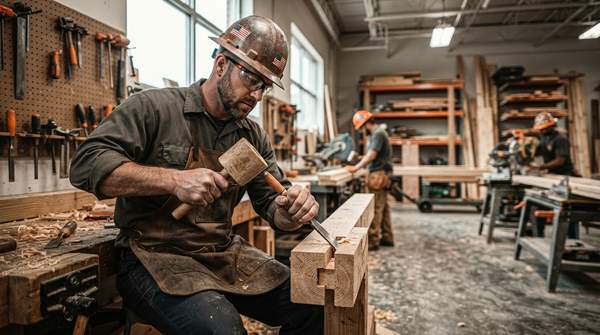
This ranked guide details critical personal protective equipment (PPE) for tradespeople, from general construction workers to specialized electricians and welders. PPE includes gloves, safety glasses and shoes, earplugs or muffs, hard hats, and respirators. Items are ranked by their ability to prevent life-threatening injuries, frequency of use across trades, and importance in meeting regulatory compliance standards.
This list was compiled by evaluating federal safety regulations, common workplace hazard assessments, and the prevalence of specific injury types across the skilled trades.
1. Head Protection (Hard Hats) — For Preventing Critical Impact Injuries
Hard hats are the most critical PPE, serving as the first line of defense against falling objects, fixed hazards, and electrical shock on industrial or construction sites. They are essential for personnel in areas with overhead dangers, electrical risks, low-hanging equipment, or fall hazards, as highlighted by Tempstar Staffing.
The primary limitation of hard hats is their reliance on a proper fit and suspension system; an improperly worn hard hat offers significantly reduced protection. Tempstar Staffing also notes key classifications: Type I hats protect from top-of-head impacts, while Type II protect from side impacts as well. Electrical classes include Class G (General) for low voltage (2,200 volts), Class E (Electrical) for high voltage (20,000 volts), and Class C (Conductive), which offers no electrical protection.
2. Eye Protection (Safety Glasses & Goggles) — For Guarding Against Common Hazards
Ranked second, eye protection is crucial due to the high frequency and potential severity of injuries from projectiles, dust, chemicals, and radiation. It is essential for carpenters, metalworkers, plumbers, and anyone operating power tools or handling hazardous liquids. OSHA requires most PPE meet ANSI standards; ANSI Z87.1 is key for eye protection. A drawback: glasses and goggles can fog in humid conditions, impairing vision if not properly ventilated or treated.
3. Foot Protection (Safety Boots) — For Foundational Site Safety
Safety boots protect against crushing injuries from heavy objects, punctures from sharp materials like nails, and slips on hazardous surfaces, making them fundamental for nearly every tradesperson. Tempstar Staffing emphasizes their necessity for workers around heavy equipment or slippery surfaces. Specialized boots can be heavy and rigid, causing fatigue. Key features include steel or composite safety toes, puncture-resistant midsoles, and slip-resistant outsoles rated for specific conditions.
4. Hand Protection (Gloves) — For Versatile Barrier Protection
As the most frequently used PPE, gloves protect against cuts, abrasions, burns, chemical exposure, and electrical shock. Specific designs exist for nearly every task, from leather for welders to insulated rubber for electricians and cut-resistant fabric for material handlers. A primary drawback is the trade-off between protection and dexterity, as heavily insulated or armored gloves can hinder handling small components. ANSI/ISEA 105 ratings (A1-A9) quantify cut resistance to match gloves to hazards.
5. Hearing Protection (Earplugs & Earmuffs) — For Preventing Permanent Hearing Loss
Hearing protection is critical for preventing noise-induced hearing loss (NIHL), a permanent and cumulative condition caused by exposure to loud machinery and tools. This is essential for carpenters, machine operators, and anyone working in environments where noise levels exceed 85 decibels (dBA) over an 8-hour period, per OSHA guidelines. Its importance lies in preventing an irreversible occupational disease. A limitation is that earplugs or earmuffs can sometimes block out essential communication or warning sounds, requiring workers to remain visually alert. Protection is measured by the Noise Reduction Rating (NRR), indicating how many decibels the device can reduce noise exposure.
6. Respiratory Protection (Respirators) — For Shielding Against Airborne Contaminants
Respirators protect workers from inhaling hazardous dusts, mists, fumes, and vapors that can cause acute or chronic respiratory diseases. They are vital for painters, masons, insulation installers, and workers in poorly ventilated areas. This PPE is critical because the hazards it protects against are often invisible and have long-term health consequences. The main challenge is that respirators, especially non-disposable types, require a professional fit test to ensure a proper seal. Without a seal, their effectiveness is compromised. Ratings from the National Institute for Occupational Safety and Health (NIOSH), such as N95, indicate the filter's efficiency (e.g., 95%) against airborne particulates.
7. High-Visibility Clothing — For Preventing Struck-By Accidents
High-visibility vests, shirts, and jackets are designed to make workers conspicuous in low-light conditions and near moving traffic or equipment. This PPE is mandatory for road crews, surveyors, and anyone working around vehicles. Its sole purpose is to increase worker visibility and prevent life-threatening struck-by incidents. The main limitation is that its effectiveness is diminished when the garment is dirty or faded, requiring regular cleaning and replacement. The ANSI/ISEA 107 standard defines performance classes (1, 2, and 3) based on the amount of reflective material and fluorescent background required for different work environments.
8. Fall Protection Systems — For Working at Heights
A personal fall arrest system, typically including a full-body harness, lanyard, and anchor point, is essential for anyone working at heights where a fall could be fatal. This is non-negotiable for roofers, steel erectors, and tower technicians. It directly addresses one of the leading causes of death in the construction industry. The primary drawback is the complexity of proper use; extensive training is required to ensure correct fitting, inspection, and connection to a suitable anchor. Failure to do so can render the system ineffective or even dangerous.
9. Face Protection (Face Shields) — For Full-Face Hazard Defense
Face shields provide a broad barrier of protection against chemical splashes, flying debris, and sparks. They are best for grinders, welders, and lab technicians who need protection beyond what safety glasses alone can offer. A face shield's advantage is its wide coverage area. However, it is considered secondary protection and must always be worn with primary eye protection like safety glasses or goggles underneath, as it does not seal around the eyes to protect from all angles.
10. Full-Body Protection (Coveralls) — For Specialized Hazard Isolation
Coveralls and full-body suits provide a barrier against chemical spills, biological hazards, and excessive grime. According to SafetyCulture Marketplace, body protection is one of the seven main types of PPE. This equipment is best for painters, hazardous material handlers, and industrial cleaners. Its value is in providing comprehensive skin protection from systemic toxins or contaminants. The main limitation is that such suits can be cumbersome, hot, and may restrict movement, potentially leading to heat stress.
| Item Name | Category/Type | Key Metric/Standard | Best For |
|---|---|---|---|
| Hard Hat | Head Protection | ANSI Z89.1 (Type I/II, Class G/E/C) | All construction and industrial site workers |
| Safety Glasses | Eye Protection | ANSI Z87.1 | Workers exposed to projectiles, dust, or splashes |
| Safety Boots | Foot Protection | ASTM F2413 | Personnel around heavy equipment or sharp objects |
| Gloves | Hand Protection | ANSI/ISEA 105 (Cut Level) | Nearly all manual tasks in every trade |
| Earplugs/Earmuffs | Hearing Protection | Noise Reduction Rating (NRR) | Workers in environments over 85 dBA |
| Respirator | Respiratory Protection | NIOSH Rating (e.g., N95) | Workers exposed to airborne particulates or fumes |
| High-Visibility Vest | Body Protection | ANSI/ISEA 107 (Class 1/2/3) | Personnel near moving vehicles or equipment |
| Fall Harness | Fall Protection | ANSI Z359 | Anyone working at unprotected heights |
How We Chose This List
The items on this list were selected and ranked based on a hierarchy of controls that prioritizes protection against the most severe outcomes. First consideration was given to equipment that prevents fatalities and life-altering injuries, such as hard hats and fall protection. Second, we evaluated PPE that addresses the most common non-fatal injuries, including eye and hand protection. Finally, we considered the breadth of application across multiple trades and the requirements set forth by regulatory bodies like OSHA. This list represents a foundational toolkit; specialized tasks will always require additional, specific forms of PPE.
The Bottom Line
While job hazards vary, head, eye, and foot protection form the non-negotiable PPE foundation for nearly every tradesperson. For high-risk situations like working at heights or near traffic, fall protection and high-visibility clothing are equally critical. All personnel must be adequately trained on the proper use, care, and limitations of their assigned PPE.