A standard circuit breaker and a whole-house surge protector protect your home from two entirely different electrical threats, and neither can do the other's job. The breaker, installed in your main panel, guards your wiring by tripping when current exceeds safe levels—its main job, as component maker ICM Controls puts it, is "to keep the wiring inside your home or business from starting a fire." A surge protective device (SPD), by contrast, shields your electronics by clamping and diverting transient voltage spikes before they reach sensitive equipment. Understanding this distinction is the first step in assessing what your home actually needs.
Understanding Home Electrical Hazards
The two devices answer two different problems. The first is overcurrent: a sustained flow of electricity beyond what a circuit's wiring can safely carry, typically caused by an overloaded circuit or a short circuit. Left unchecked, overcurrent heats wiring and can ignite a fire. The second is the voltage surge—a brief spike in electrical potential above the normal supply level, caused by events such as lightning strikes, power outages, grid switching, or inductive loads inside the home.
These hazards differ in both scale and speed. An overload develops over seconds or longer and damages conductors through heat; a surge can pass through in microseconds and destroy semiconductor components in a television or computer outright, or, as ICM Controls notes, quietly decrease their lifespan through repeated smaller spikes. A breaker is built for the first hazard; an SPD is built for the second. A surge can sail right past a functioning breaker, because the total current involved may never exceed the breaker's trip threshold—the danger is the voltage, not the amperage.
Standard Circuit Breakers: Protecting Your Wiring
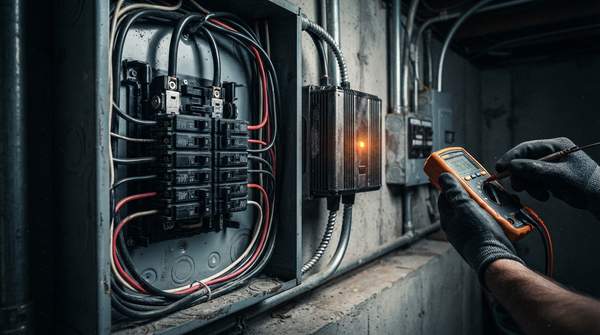
A circuit breaker is an automatic switching device installed in series within a main or branch circuit. When it detects a fault—an overload, a short circuit, or in some designs a ground fault—it trips and cuts off the electrical supply, preventing overheating and the fire risk that follows. Unlike a fuse, which must be replaced after it blows, a breaker is resettable: you switch it back on once the fault is cleared, and it returns to service.
Breakers are rated for the sustained current a circuit's wiring can safely carry, and they respond in milliseconds to seconds depending on the fault's magnitude. Their protection target is the infrastructure: the cables inside your walls, the distribution panel, and the connections between them. They are an essential code-required feature of modern electrical systems. What they do not do is regulate voltage. As long as the current stays within its rating, a breaker will happily pass a 6,000-volt spike straight into whatever is plugged into the circuit—which is why a home full of healthy breakers can still lose its electronics in one lightning storm.