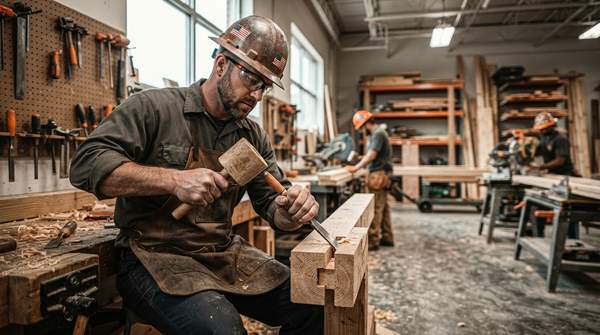
Custom trim can provide around 70 percent of its cost back when selling a home, making thoughtful carpentry a powerful investment. This return, reported by Whitecapbuilders, proves the financial impact of accessible home improvements. Focusing on simple rules for finish carpentry in 2026 yields substantial value.
Many homeowners assume superior finish carpentry demands specialized skills and costly equipment. However, successful projects prioritize visual judgment, simplicity, and effective problem-solving, rather than expensive tools or overly complicated designs.
Homeowners who adopt a 'less is more' approach to finish carpentry will likely see greater aesthetic and financial returns than those pursuing overly complex or expensive solutions. This strategy emphasizes cultivating an eye for proportion and trusting visual judgment.
What are the basic principles of finish carpentry?
Strong finish carpentry relies on creativity, proportion, and problem-solving, not just expensive tools, states Finehomebuilding. Success comes from balancing simplicity, efficiency, and visual judgment to create refined work. The core lesson: 'It’s the archer, not the arrow.' This means skill and judgment outweigh equipment, making careful planning and precise measurements fundamental to any installation.
Does finish carpentry require specialized tools?
Common perception holds that high-quality finish carpentry demands specialized skills and costly equipment. Finehomebuilding states craftsmanship relies more on creativity, proportion, and problem-solving than on expensive tools or complex designs. This means perceived barriers to entry are largely unfounded. The myth of specialized expertise deters homeowners from a powerful, visually-driven home improvement. Essential tools prioritize simplicity: a reliable tape measure, a miter saw for precise cuts, and a nail gun for efficient fastening. These support refined work without extensive investment.