EV and hybrid powertrains' complex onboard systems demand diagnostic tools beyond simple OBD-II code reading. This guide compares top advanced options for professional technicians, evaluating their software capabilities, depth of system access, bi-directional control features, and overall value in a professional service environment.
Manufacturer specifications, EV-specific diagnostic feature sets (like battery health monitoring), and active test capabilities for high-voltage components informed this comparison. Sources include mythinkcar.com and Maverick Diagnostics.
1. THINKSCAN 689BT — Best for Advanced Control and Coding
The THINKSCAN 689BT supports bi-directional/active tests and ECU coding, making it essential for technicians needing more than code reading. Bi-directional control allows the scan tool to send commands to a vehicle's ECU, actuating components like a battery cooling fan or ABS pump. This enables direct component functionality testing without manual removal. ECU coding is valuable for replacing modules, matching new components to existing vehicle systems, according to the manufacturer.
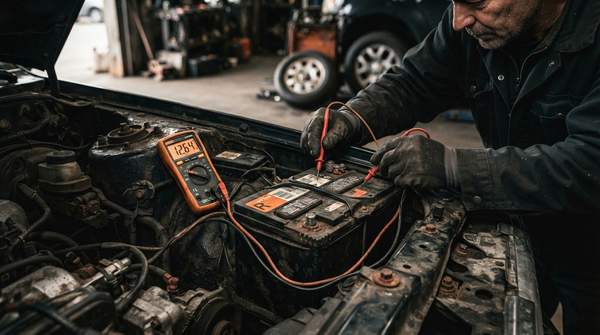
This tool is best for the experienced technician who regularly performs module replacements or needs to diagnose intermittent electrical faults in complex systems like thermal management or charging circuits. It ranks over simpler scanners by providing the active control necessary to confirm a diagnosis. The primary limitation is its complexity; the extensive features for coding and active tests may present a steep learning curve for technicians accustomed to basic code readers and can be excessive for shops that primarily handle routine maintenance.
2. MUCAR 892BT — Best for Comprehensive Maintenance Routines
The MUCAR 892BT offers 34+ maintenance functions, addressing the numerous electronic resets modern vehicles—especially hybrids and EVs—require after routine service. These functions include electronic parking brake retraction, battery management system (BMS) resets after 12V battery replacement, and steering angle sensor calibration. Mythinkcar.com notes the tool moves technicians beyond DTC identification toward final repair, an integrated approach valuable in busy shops.
This scanner is ideal for general repair shops that are increasing their volume of late-model hybrid and EV service. It excels over basic code readers by consolidating dozens of specific reset procedures into a single interface, saving time and reducing the need for multiple specialized tools. Its drawback is that while it is comprehensive in maintenance functions, it may lack the deep, OE-level bi-directional control and coding found in more specialized diagnostic platforms. It is a powerful service tool, but not a full-fledged programming station.
3. MUCAR BT200 MAX — Best for Foundational Full-System Scans
The MUCAR BT200 MAX provides true full-system diagnostics, offering a complete picture of vehicle health before advanced diagnosis. It accesses engine, transmission, ABS, airbag (SRS), body control (BCM), and, critically for EVs, battery management (BMS) and high-voltage powertrain controllers. Scanning all available modules establishes a baseline, a correct first step in modern diagnostic procedures, according to the manufacturer.
This tool is best suited for the diagnostic apprentice, the quick-lube technician needing to perform initial vehicle health checks, or as a secondary tool in a larger shop for rapid triage. It ranks over standard OBD-II dongles by offering access to manufacturer-specific codes across all modules, providing a much more detailed initial report. Its limitation is that it is primarily a diagnostic tool; its active test capabilities are not as extensive as higher-end models like the THINKSCAN 689BT. It tells you what is wrong but offers fewer functions to actively test the solution.
4. Dedicated OBD Dongle + App — Best for Real-Time Battery Monitoring
For any EV, "the battery pack is the most important and expensive part," according to a report from evparts4x4.com. Unlike internal combustion vehicles with standardized data protocols, EV data streams are often proprietary. A high-quality OBD dongle paired with specialized EV diagnostic software (like A Better Routeplanner or Power Cruise Control) can unlock this data. This combination allows a technician to see what the car's computers are seeing in real time, including individual cell voltages, pack temperature, state of health (SoH), and charging performance. This is critical for diagnosing battery degradation or charging issues.
This approach is best for EV specialists or technicians focused on battery diagnostics and refurbishment. It provides a level of granular data on the high-voltage battery that many all-in-one scan tools cannot match. Ensure the dongle supports modern protocols and the 800V systems used in newer EVs. The primary drawback is the separation of hardware and software. The dongle is just an interface; the quality and accuracy of the data depend entirely on the third-party app, which may require a separate subscription and can have inconsistent vehicle support.
5. AI-Assisted Diagnostic Platforms — Best for Guided Troubleshooting
AI and wireless capabilities are integrating into automotive diagnostic scan tools to help technicians navigate the sheer complexity of modern vehicle systems, a key market growth factor noted by mythinkcar.com. AI-assisted tools bridge the gap between pulling a DTC and identifying the most probable cause. After a scan, these platforms analyze codes, cross-reference with known fixes and vehicle-specific TSBs, and provide guided troubleshooting paths.
These platforms are best for technicians at all levels, but especially those who are new to EV and hybrid systems. They can accelerate the diagnostic process by suggesting tests and identifying common failure patterns. This approach is superior to a simple code lookup because it provides context and actionable next steps. The limitation is that the AI's recommendations are based on historical data. It may not be effective for new or unusual faults, and its suggestions should be treated as a guide, not a definitive answer. Technician experience remains irreplaceable.
| Tool/Platform | Category/Type | Key Metric | Best For |
|---|---|---|---|
| THINKSCAN 689BT | Advanced Scanner | Bi-Directional Control & ECU Coding | In-depth diagnostics and module replacement. |
| MUCAR 892BT | Maintenance Scanner | 34+ Reset Functions | Efficiently performing routine service resets. |
| MUCAR BT200 MAX | System Scanner | Full-System Module Access | Initial vehicle health checks and triage. |
| Dedicated OBD Dongle + App | Data Logger | Live Battery Cell Data | Specialized EV battery health analysis. |
| AI-Assisted Platforms | Guided Diagnostics | Probable Cause Analysis | Accelerating troubleshooting for complex faults. |
How We Chose This List
Selection for this comparison prioritized tools and diagnostic approaches that address the specific needs of modern EV and hybrid vehicle service. Key criteria included the ability to perform full-system scans beyond standard engine and transmission modules, support for bi-directional controls to actively test components, and access to EV-specific data such as battery management system parameters. We excluded basic OBD-II code readers that lack the depth required for professional diagnostics on high-voltage systems. The featured items were chosen to represent distinct categories of diagnostic capability, from foundational system checks to advanced module coding and real-time data analysis.
What features to look for in an EV diagnostic tool?
When selecting a tool for EV and hybrid work, move beyond standard features. First, confirm its ability to communicate with the Battery Management System (BMS). You must be able to read state of health, cell group voltages, and temperature sensor data. Second, prioritize bi-directional controls for the thermal management system. The ability to command cooling fans, pumps, and valves is essential for diagnosing overheating or charging issues related to the battery pack. Finally, verify the tool supports procedures for de-energizing and re-energizing the high-voltage system, which is a critical safety and service step. Always check for compatibility with the specific makes and models you service most frequently, as coverage can vary significantly.
The Bottom Line
Selecting the right diagnostic tool requires matching capabilities to your shop's primary services. For advanced troubleshooting and module replacement, the THINKSCAN 689BT's bi-directional control and coding are necessary. For maintenance and broad-system health checks, the MUCAR 892BT's comprehensive reset functions offer significant efficiency gains.