Automotive Services

How Automotive Electrical System Diagnostics and Network Communication Troubleshooting Works: A Complete Guide

Effective automotive electrical system diagnostics and network communication troubleshooting is the critical skill separating a guess from a professional diagnosis. This guide provides a complete, step-by-step approach to master these complex systems.

LO
Luis Ortega

April 9, 2026 · 8 min read

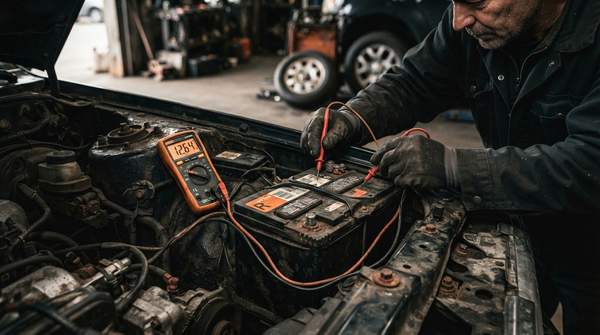
A skilled automotive technician uses a diagnostic scanner to troubleshoot complex electrical systems and network communication issues in a modern vehicle's engine bay.

When a vehicle displays multiple, seemingly unrelated warning lights—ABS, traction control, and check engine—a basic code reader often points to a 'loss of communication' error, leaving more questions than answers. This scenario, common in vehicles with complex, interconnected networks of dozens of computer modules, underscores why effective automotive electrical system diagnostics and network communication troubleshooting is the core of modern automotive repair, distinguishing professional diagnosis from guesswork.

What Is Sensor-Based Diagnostics and Network Troubleshooting?

Sensor-based diagnostics is the process of using data from a vehicle's sensors to identify and resolve faults within its electrical and electronic systems. Instead of just replacing parts based on a trouble code, this method involves analyzing the live performance of components. Network communication troubleshooting is a specialized subset of this process, focused on diagnosing issues within the vehicle's internal communication networks, such as the Controller Area Network (CAN bus), which allow various electronic control units (ECUs) to exchange information. As modern vehicles rely heavily on these intricate networks, understanding how to diagnose them is essential for service and repair, according to a guide on the topic from backlot.aths.org. This approach treats the vehicle as a complete system, requiring a technician to understand not just individual parts but how they communicate and interact.

How Automotive Electrical System Diagnostics Works: Step by Step

Accurately diagnosing complex electrical faults requires a systematic approach to prevent misdiagnosis and unnecessary parts replacement. Follow this structured process to efficiently move from symptom to solution.

  1. Step 1: Verify the Complaint and Gather Information

    Before you connect any tool, start with the fundamentals. Interview the driver to understand the symptoms completely. When did the problem start? Is it intermittent? Does it happen under specific conditions, like acceleration, braking, or when it's raining? Perform a thorough visual inspection of the engine bay and under the vehicle. Look for obvious issues like corroded battery terminals, damaged wiring harnesses, loose connectors, or signs of fluid leaks that could affect electrical components. This initial information provides crucial context that a scan tool cannot.

  2. Step 2: Perform an Initial System Scan

    Connect a professional-grade scan tool to the vehicle's OBD-II port. Perform a full system scan to retrieve Diagnostic Trouble Codes (DTCs) from all available modules—not just the Powertrain Control Module (PCM). A vehicle may have dozens of modules, including the Transmission Control Module (TCM), Anti-lock Brake System (ABS) module, and Body Control Module (BCM). Document all codes, noting which are current, pending, or historical. Pay close attention to "U-codes," which specifically indicate communication failures between modules. This network-wide view is your first map of the problem area.

  3. Step 3: Check the Foundation: Battery and Charging System

    A weak or failing battery, poor connections, or an underperforming alternator can cause a cascade of electrical gremlins and communication codes that can easily be misdiagnosed as module failures. Before diving into complex network diagnostics, verify the health of the vehicle's power supply. Use a dedicated battery tester to assess the battery's state of health, state of charge, and cranking performance. According to Texas Diamond Garage, a quality battery tester is a must-have tool for assessing battery performance. Additionally, use a multimeter to check for proper charging voltage (typically 13.5-14.5 volts with the engine running) and to perform a voltage drop test on the battery cables to identify hidden resistance from corrosion.

  4. Step 4: Analyze Network Communication Status

    With the power supply confirmed as stable, return to your scan tool. Access the network topology or module status list. This feature shows which modules are actively communicating on the network and which are offline. If a critical module like the ABS or TCM is not responding, it could be the source of the network failure, or it could be a victim of a wiring issue. This step helps you narrow your focus from the entire vehicle network to a specific branch or module circuit.

  5. Step 5: Conduct Basic Circuit and Sensor Tests with a Multimeter

    Once you have identified a specific circuit or sensor implicated by a DTC, use a digital multimeter for initial pinpoint tests. Multimeters are essential tools for measuring voltage, current, and resistance, notes Texas Diamond Garage. You can check for power and ground at a non-communicating module's connector. For a sensor, you can measure its reference voltage, signal voltage, and resistance to see if they fall within the manufacturer's specifications. For example, a throttle position sensor that shows 5 volts on the reference wire and a good ground but has no signal voltage is likely faulty. These static tests are excellent for identifying open circuits, short circuits, or components that have failed completely.

  6. Step 6: Perform Advanced Waveform Analysis with an Oscilloscope

    For intermittent issues, network communication problems, or dynamic sensor signals, a multimeter is often insufficient. This is where an oscilloscope becomes indispensable. According to Tektronix, oscilloscopes are crucial for accurately diagnosing complex electronic systems because they provide a detailed visual representation of an electrical signal over time. By connecting the oscilloscope to a sensor's signal wire or the CAN bus lines, you can analyze the waveform. Tektronix states that this allows you to see irregularities, such as voltage spikes, dropouts, or signal noise, that a multimeter would miss. A healthy CAN bus signal, for example, has a specific square wave pattern. A corrupted signal, visible on the oscilloscope, can pinpoint issues like a faulty module, a shorted wire, or a missing terminating resistor.

  7. Step 7: Isolate the Fault and Verify the Component

    Using the data from your oscilloscope and multimeter, you can now isolate the fault. This may involve using a breakout box to test individual pins at a module connector without damaging it. You might perform a "wiggle test" on a wiring harness while watching the oscilloscope to see if the signal drops out, indicating a broken wire. If a network is down, you may need to disconnect modules one at a time until communication is restored, thereby identifying the module that was corrupting the bus. Once you have pinpointed the faulty wire, connector, or component, you can proceed with the repair with confidence.

Troubleshooting Automotive Network Communication Problems: Common Pitfalls

Modern vehicle electronics are unforgiving; a simple error during automotive electrical system diagnostics and network communication troubleshooting can lead to hours of frustration and wasted expense. Be mindful of these frequent pitfalls, which are as crucial to avoid as following the correct procedure.

  • Relying Solely on DTCs: A trouble code is a starting point, not a final diagnosis. A code for an oxygen sensor, for instance, could be caused by a faulty sensor, but it could also result from a vacuum leak, a fuel pressure issue, or a wiring problem. Always perform pinpoint tests to verify the cause of the code before replacing any parts.
  • Ignoring Technical Service Bulletins (TSBs): Manufacturers often release TSBs for known issues. A quick search of a professional database for the vehicle's symptoms or DTCs can sometimes provide a documented fix, saving you hours of diagnostic time. This is especially true for complex software-related communication issues that may require a module reflash.
  • Overlooking Power and Ground Integrity: As mentioned in the step-by-step guide, all electronic components rely on a clean, stable source of power and a solid ground connection. A corroded ground strap or a loose power connection can create resistance that causes modules to malfunction or drop off the network. Always perform voltage drop tests on critical power and ground circuits.
  • Improper Tool Setup and Interpretation: An advanced tool like an oscilloscope is only as good as the technician using it. According to Tektronix, proper setup of voltage range and timebase settings is a key part of its use. An incorrectly set oscilloscope can display a misleading waveform, leading to a misdiagnosis. Invest time in training to understand not just how to connect the tool, but how to interpret the patterns it displays.

Specialized Diagnostic Tools for Modern Car Electrical Systems

While a basic toolkit is still necessary, modern diagnostics demand more advanced equipment. The increasing complexity of vehicle servicing will require technicians to adapt. As explained by Automotive Test Solutions, electronic control is a given in today's vehicles and will only grow more intricate.

Your diagnostic arsenal should include a high-quality digital multimeter for foundational tests and a professional scan tool with bi-directional controls and live data capabilities. However, for deep-level diagnostics, the oscilloscope is paramount. Tektronix asserts that an oscilloscope provides a far more detailed view of electrical signals than other tools. It is the only practical way to verify the signal integrity of a crankshaft position sensor, an ignition coil, or a CAN bus network. Investing in a multi-channel lab scope and learning to use it effectively is a direct investment in your ability to solve the toughest electrical and network problems.

Frequently Asked Questions

How do I start troubleshooting a CAN bus problem?

First, use a scan tool to perform a full network scan and identify which modules are not communicating. Next, locate the vehicle's OBD-II connector and use a multimeter to measure the resistance between the CAN High (Pin 6) and CAN Low (Pin 14) terminals. You should see approximately 60 ohms if the two terminating resistors are intact. If the reading is 120 ohms, one resistor is missing or the circuit is open. If the reading is near zero, the lines are shorted together. Finally, use an oscilloscope to visually inspect the CAN bus waveform for proper voltage levels and a clean, symmetrical pattern.

Can I use a simple multimeter for automotive electrical system diagnostics?

Yes, a multimeter is an essential and fundamental tool. It is perfect for checking battery voltage, alternator output, continuity in wires, and the resistance of sensors or solenoids. However, it cannot display the dynamic, high-speed signals used in modern sensor and network communications. For diagnosing intermittent faults or analyzing data bus signals, a more advanced tool like an oscilloscope is required to see the complete picture.

What is the difference between an electrical and an electronic system in a car?

According to Automotive Test Solutions, the distinction lies in how they control current. Electrical systems use passive components and effects like resistance (in wires), capacitance, and inductance to control current flow. A simple headlight circuit with a switch and a relay is a good example. Electronic systems use active components, like transistors and diodes, to perform functions such as amplification and rectification. These components allow for the precise, high-speed control needed for engine management, data networks, and advanced driver-assistance systems.

The Bottom Line

Accurately identifying and resolving complex electronic faults in automotive electrical systems and network communication troubleshooting requires moving beyond simple code reading. Embrace a comprehensive diagnostic strategy that includes verifying the complaint, checking the system's foundation, and analyzing live data with tools like an oscilloscope. For serious technicians or enthusiasts, the next step is investing in quality training and the right diagnostic equipment to stay ahead of evolving vehicle technology.