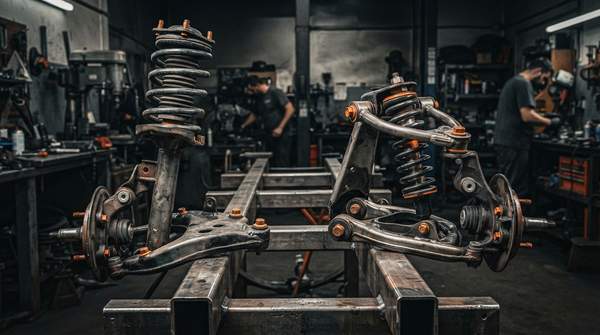
The performance of modern vehicle suspension systems is often taken for granted until you experience a jarring pothole or unsettling body roll on a sharp turn. That seamless connection between your vehicle and the road is no accident; it is the result of a complex, finely tuned network of components working in unison. Understanding how these systems function is critical for any technician aiming to diagnose issues accurately or for any enthusiast looking to optimize performance. This guide provides a detailed explanation of the principles, components, and maintenance essentials that define modern automotive suspension.
What are the Key Components of a Modern Vehicle Suspension System?
A modern vehicle suspension system is an intricate assembly of links, springs, and dampers that connects the wheels to the chassis, serving two primary functions. First, it manages the vehicle's handling and braking for active safety and driver control. Second, it provides passenger comfort by isolating the cabin from road noise, bumps, and vibrations. According to automotive resource Wuling, the system's core purpose is to absorb vibrations from the road surface while increasing the grip of the wheels. To achieve this balance between comfort and control, the system relies on several key components working in concert.

The primary components form the foundation of any suspension design. Springs are the most fundamental part, supporting the vehicle's weight and absorbing impacts from road imperfections. They come in various forms, including coil springs (the most common in modern cars), leaf springs (often used in trucks), and torsion bars. A significant component, springs absorb shocks from road friction and help increase wheel traction. Next are the shock absorbers, or dampers. Their job is not to absorb shocks—that is the spring's role—but to dampen the oscillations of the springs. Without them, a vehicle would continue to bounce long after hitting a bump. Control arms, ball joints, and bushings act as the connection points, allowing the wheels to move vertically while remaining securely attached to the vehicle's frame. Finally, most vehicles use an anti-roll bar (or sway bar) to connect opposite wheels, minimizing body roll during cornering for improved stability.
How Do Vehicle Suspension Systems Absorb Shocks and Maintain Stability?
A suspension system's reaction to a road imperfection is a rapid, multi-stage process designed to maintain tire contact and vehicle stability. Each component plays a specific, sequential role in managing the energy generated by the impact. Follow this step-by-step breakdown to understand the dynamic workflow.
- Step 1: Impact and Initial Wheel DisplacementThe process begins the moment a tire encounters an obstacle, such as a pothole or a speed bump. The force of the impact pushes the wheel assembly vertically upward, independent of the vehicle's chassis. The speed and force of this displacement are the initial inputs the suspension system must manage.
- Step 2: Energy Absorption via the SpringAs the wheel moves upward, it compresses the suspension spring. The spring absorbs the kinetic energy from the impact, converting it into potential energy stored within its compressed structure. The stiffness of the spring, known as the spring rate, determines how much it compresses under a given load. This action prevents the full force of the impact from being transferred directly to the vehicle's body.
- Step 3: Damping the Spring OscillationOnce the spring is compressed, it naturally wants to rebound and release its stored energy, which would cause the vehicle to bounce. This is where the shock absorber, or damper, intervenes. As described by Wuling, shock absorbers use a piston moving through hydraulic fluid within a cylinder. When the spring compresses and rebounds, it forces the piston to move, and the fluid resistance through small orifices inside the damper converts the kinetic energy of the spring's movement into heat, which then dissipates. This action smooths out the spring's oscillations, settling the suspension quickly.
- Step 4: Maintaining Tire-to-Road ContactAfter absorbing the initial impact and damping the rebound, the suspension's final job in this sequence is to push the wheel back down firmly onto the road surface. This ensures the tire maintains maximum grip, which is essential for steering, braking, and acceleration. A well-functioning system keeps the tire in contact with the ground over uneven terrain, a principle known as road holding.
- Step 5: Controlling Lateral Motion with Anti-Roll BarsDuring cornering, centrifugal force causes the vehicle's weight to shift to the outside wheels, compressing the outer suspension and causing the body to lean or "roll." The anti-roll bar, a torsion spring connecting the suspension on both sides of an axle, counteracts this. As the outer suspension compresses, the bar twists and applies a corresponding upward force to the inner suspension, keeping the vehicle more level and improving tire grip and stability through the turn.
Common Diagnostic Pitfalls for Suspension Issues
Diagnosing suspension problems requires a keen eye and an understanding of how symptoms relate to specific component failures. Technicians and enthusiasts alike can fall into common traps that lead to misdiagnosis or incomplete repairs. Avoiding these pitfalls ensures a more accurate and effective service.
- Relying Solely on the "Bounce Test": The traditional method of pushing down on a vehicle's corner to check for worn shocks is outdated for modern systems. While excessive bouncing can indicate a completely failed damper, many shocks lose their effectiveness gradually without causing obvious bouncing. A more reliable inspection involves checking for fluid leaks on the shock body, examining bushings for wear, and looking for signs of poor ride control during a test drive.
- Ignoring Clues from Tire Wear: Tires are one of the best indicators of suspension health. Technicians should look for abnormal wear patterns. "Cupping," or scalloped dips in the tread, often points to worn shock absorbers that are allowing the wheel to bounce. Feathered wear across the tread typically indicates an alignment issue, often caused by worn control arm bushings or ball joints.
- Misdiagnosing Noises: Suspension noises can be difficult to pinpoint. A common mistake is to replace the most obvious component without confirming the source. A deep clunking sound over bumps often points to worn ball joints or anti-roll bar links. A persistent squeaking or creaking, especially at low speeds, is frequently caused by dry or worn control arm bushings. Replicating the noise on a lift by manipulating the suspension is crucial for an accurate diagnosis.
- Replacing Components in Isolation: Suspension components should almost always be replaced in pairs per axle. For instance, replacing only the left front strut will result in an imbalance, as the new unit will have different damping characteristics than the older one on the right side. This can negatively affect handling and stability, especially during braking or cornering. Always replace shocks, struts, and springs in left-right pairs.
Advanced Considerations for Suspension Tuning and Modification
For those looking beyond standard maintenance, the world of suspension tuning offers significant opportunities to enhance vehicle performance. However, modifications require a deep understanding of suspension geometry and component synergy. According to a report from DrivingLine, modern vehicles have sophisticated chassis setups, complicating modifications like lowering compared to older cars.
One of the most common modifications is altering ride height. DrivingLine notes that dropping a vehicle's ride height can improve handling by lowering its center of gravity, which reduces body roll and helps manage weight transfer. However, this change has a ripple effect. A vehicle's ride height directly affects critical settings like wheel camber and toe, as well as suspension travel. Any change in height necessitates a full four-wheel alignment to correct the geometry and ensure the tires maintain optimal contact with the road. Failing to do so can severely compromise handling and accelerate tire wear.
Furthermore, advanced systems are pushing the boundaries of suspension technology. An article in the journal Nature describes an innovative approach to adaptive suspension control that integrates digital twin (DT) technology with neural networks (NN). This research aims to create systems that can predict road conditions and adjust damping characteristics in real-time, significantly improving ride comfort, vehicle handling, and overall system robustness. Such technologies represent the future of active suspension, moving from reactive adjustments to predictive control.
Frequently Asked Questions
What is the difference between a shock absorber and a strut?
While both components dampen spring oscillations, they serve different structural roles. A shock absorber is a standalone damper. A MacPherson strut, however, is a major structural component of the suspension. It combines the spring and damper into one unit and replaces the upper control arm, serving as a pivot point for the steering and supporting the vehicle's weight. If your vehicle has struts, they are a critical part of its steering and alignment geometry.
How often should I replace my vehicle's shocks and struts?
There is no universal replacement interval for shocks and struts; their lifespan depends heavily on driving conditions, vehicle load, and road quality. Instead of following a strict mileage schedule, it is best to inspect them regularly and watch for signs of wear. Key indicators include visible fluid leaks from the shock body, a noticeably bouncier or harsher ride, excessive body roll in turns, or a "nose dive" during braking. A general recommendation from many shops, like Big O Tires, is to have them inspected around every 50,000 miles.
Can I upgrade my suspension for better handling?
Yes, performance upgrades are widely available, but they require a balanced approach. Simply installing stiffer springs without matching them to appropriate dampers will result in a harsh, uncontrolled ride. A well-designed upgrade package, such as a coilover kit, ensures that spring rates and damping forces are properly matched. Other effective upgrades include stiffer anti-roll bars to reduce body roll and polyurethane bushings for more precise suspension movement. As highlighted by DrivingLine, any modification that changes a vehicle's suspension geometry has a direct impact on its road-holding ability and must be followed by a professional alignment.
The Bottom Line
A vehicle's suspension system is a critical, dynamic assembly responsible for both ride comfort and the fundamental safety of its occupants. Understanding how its components interact to absorb impacts, dampen oscillations, and maintain tire grip is essential for effective diagnostics and maintenance. If you notice a decline in ride quality, unusual noises, or abnormal tire wear, do not delay in seeking a professional inspection to ensure your vehicle remains safe and performs as designed.