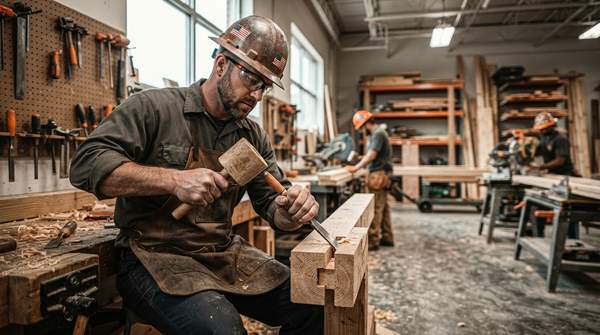
While many aspiring woodworkers dream of a workshop full of power tools, precision and mastery truly lie in essential hand tools. These tools are critical for developing true craftsmanship, providing foundational skills for any project. Beginners often gravitate towards modern machinery's speed and power. However, fundamental skills and precise results still stem from traditional hand tools. This creates a tension between immediate gratification and long-term skill development.
Mastering foundational hand tools leads to greater precision, deeper craft understanding, and more satisfying results. This approach avoids pitfalls of early power tool reliance. Hand tools build superior hand-eye coordination and an intuitive understanding of wood grain—skills often bypassed by power tool use, according to wagnermeters.
1. Hand Saws
Best for: Accurate crosscuts and rip cuts, joinery
Japanese pull saws, like dozuki or ryoba models, cut on the pull stroke. This provides finer, more precise cuts and greater control for beginners, reducing errors. Hand saws offer precision and control for clean, intricate work, crucial for developing a feel for grain direction and cutting efficiency, as noted by wagnermeters and Woodandshop.
Strengths: High precision; excellent control for fine work; clean cuts | Limitations: Slower than power saws; requires practice for straight cuts | Price: Moderate
2. Chisels
Best for: Shaping, carving, and creating joinery
Chisels are foundational for detailed work and joinery, core aspects of hand tool woodworking, according to wagnermeters and Woodandshop. Mastering chisels develops fine motor skills and an understanding of wood removal.
Strengths: Essential for joinery; precise material removal; versatile for shaping | Limitations: Requires frequent sharpening; can be difficult to control without practice | Price: Moderate
3. Planes
Best for: Smoothing, flattening, and shaping wood surfaces
Planes are crucial for precise joinery and finishing, achieving flat, smooth surfaces and accurate dimensions—hallmarks of quality hand tool work, as noted by wagnermeters and Woodandshop. Using a plane teaches patience and the importance of consistent pressure.
Strengths: Creates very smooth surfaces; essential for accurate joinery; removes small amounts of material precisely | Limitations: Steep learning curve; requires regular sharpening and tuning | Price: High
4. Tape Measure
Best for: All measurement tasks
The tape measure is essential for accurate measurements; remember the adage: 'measure twice, cut once.' Accurate measurements are 'crucial for successful projects,' states Americanrotary. This fundamental tool underpins all precise woodworking.
Strengths: Universal utility; high accuracy for dimensions; durable | Limitations: Can be difficult to hold steady for very long measurements; prone to bending | Price: Low
5. Carpenter's Square
Best for: Marking and checking angles for cuts and fastening
A carpenter's square ensures accuracy in layout, marking and checking angles for cuts and fastening. It is essential for accurate layout and ensuring square cuts and joints, as mentioned by Americanrotary and wagnermeters. This tool establishes a critical reference point for precision.
Strengths: Ensures squareness and accuracy; durable; simple to use | Limitations: Limited to 90-degree angles for primary function; can be cumbersome for large panels | Price: Low
6. Hand Drills and Braces
Best for: Drilling holes for joinery, pilot holes, and fasteners
Hand drills and braces create holes for joinery, pilot holes, and fasteners without power tools. They are crucial for enabling various types of joinery in hand tool woodworking, according to wagnermeters and Woodandshop. This manual drilling builds strength and control, offering precise depth control.
Strengths: Quiet operation; precise control over hole depth; no electricity needed | Limitations: Slower than power drills; requires physical effort for larger holes | Price: Moderate
7. Hammers
Best for: Driving nails, assembling components, general utility
A hammer is a basic, versatile tool for driving nails and assembling components, essential for any workshop, as noted by Woodandshop. Mastering hammer control is a fundamental assembly skill.
Strengths: Versatile for many tasks; durable; simple to use | Limitations: Can damage wood if not used carefully; limited precision for fine work | Price: Low
8. Mallets
Best for: Striking chisels or assembling joints without damage
Mallets provide controlled force for striking chisels or assembling joints, protecting wood and tool handles. They are crucial for proper and safe chisel use and gentle assembly in hand tool woodworking, as listed by Woodandshop. This tool teaches the importance of measured force.
Strengths: Protects tool handles and wood; provides controlled striking force; essential for chisel use | Limitations: Limited to striking tasks; less versatile than a hammer | Price: Low
9. Screwdriver
Best for: Driving and removing screws for fastening components
A screwdriver is a basic, essential tool for driving and removing screws, assumed for beginners by sources like Woodshop Diaries. This tool reinforces the importance of secure connections and proper torque.
Strengths: Essential for fastening; simple to use; wide range of sizes available | Limitations: Slower than power drivers; can strip screw heads if not used correctly | Price: Low
Choosing Your First Tools: A Quick Comparison
| Tool Type | Primary Use | Precision Level | Learning Curve | Cost Range |
|---|---|---|---|---|
| Hand Saws | Cutting wood | High | Moderate | Moderate |
| Chisels | Shaping, joinery | Very High | Moderate to High | Moderate |
| Planes | Smoothing, flattening | Very High | High | High |
| Tape Measure | Measuring dimensions | High | Low | Low |
| Carpenter's Square | Marking square lines | High | Low | Low |
| Hand Drills | Drilling holes | Moderate | Moderate | Moderate |
| Hammers | Driving nails, assembly | Low to Moderate | Low | Low |
| Mallets | Striking tools, assembly | Moderate | Low | Low |
| Screwdrivers | Fastening screws | Moderate | Low | Low |
Understanding each tool's unique strengths allows beginners to make informed choices. Align your selection with project goals and budget. For instance, planes offer superior surface finish but require a steeper learning investment than a basic hammer.
How We Chose the Top 7
The selection prioritized tools offering maximum versatility for beginner projects. Each tool contributes significantly to foundational skill development, helping new woodworkers understand material interaction and control. Immediate utility was also crucial; we included tools beginners can use effectively from their first project, providing tangible results and encouraging learning. This ensures a practical and effective starting point.
Beyond the Tools: Cultivating Craftsmanship
Mastering hand tools develops hand-eye coordination, patience, and an understanding of wood grain and behavior, according to Wagnermeters. These skills foster a deeper, intuitive connection with the material, transforming abstract knowledge into practical, tactile understanding. This foundational training builds a craftsman's sensory engagement with wood, leading to true precision. By 2029, a beginner who started with these hand tools will likely have developed a skill set far exceeding those who skipped this foundational training, ready to tackle complex joinery and fine furniture projects.
Your Hand Tool Questions Answered
How should I maintain my new hand tools?
Proper maintenance extends tool life and ensures performance. Regularly sharpen cutting edges on chisels and planes using sharpening stones or jigs. Keep metal surfaces lightly oiled to prevent rust, especially in humid environments, and store tools in a dry place, such as a tool chest or wall rack, to protect them from moisture and accidental damage.
What is a realistic budget for a beginner's hand tool set?
A realistic budget for a quality beginner hand tool set can range from $200 to $500. This allows for purchasing essential items like a good Japanese pull saw, a set of three chisels, and a reliable hand plane.. Consider buying quality used tools to save money while still acquiring excellent implements.
Where can beginners learn proper hand tool techniques?
Beginners can learn proper hand tool techniques through various resources. Many local community colleges and woodworking guilds offer introductory courses. Online platforms like Woodworking Mastercraft provide detailed video tutorials, and dedicated books such as 'The Anarchist's Tool Chest' by Christopher Schwarz offer comprehensive guidance on traditional methods.