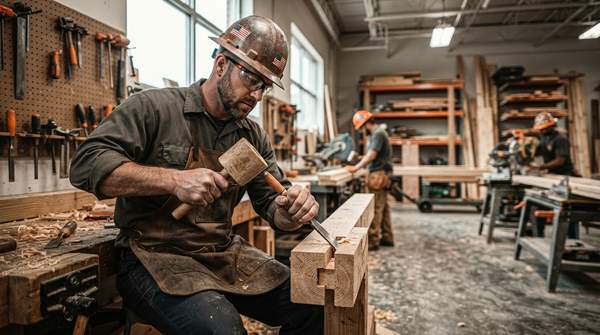
In controlled tests, the mortise and tenon joint withstood an average of 172 pounds of breaking force, significantly outperforming simpler alternatives, according to Woodgears. Its ability to withstand 172 pounds of breaking force makes it a critical choice for lasting craftsmanship.
Many common woodworking projects, from DIY to professional, rely on quick, easy joints. However, these simpler constructions often sacrifice substantial structural integrity, leading to less durable outcomes. The tension between construction speed and long-term performance is a constant challenge.
Carpenters who understand the strength hierarchy of joints will likely produce more robust, lasting work, potentially shifting industry standards towards more durable construction. The basic butt joint is the weakest, according to American Rotaryotary. The basic butt joint's weakness demands stronger connections.
1. Mortise and Tenon Joint
Best for: Professional carpenters and DIYers seeking maximum strength for furniture frames, doors, and structural components.
A traditional method, the mortise and tenon joint features a projecting tenon fitting snugly into a mortise. It averaged 172 pounds of breaking force, making it one of the strongest and most reliable joints, according to Learn Kregtool. Adding a peg can further increase its toughness, according to Woodmagazine, demonstrating that even top-tier joints can be enhanced for critical applications.
Strengths: Exceptional strength and durability; excellent resistance to racking and shear forces; traditional and proven. | Limitations: Requires precise cutting and fitting; time-consuming; demands significant skill or specialized jigs. | Price: Requires precision tools or significant hand-tool skill.
2. Dovetail Joint
Best for: Fine furniture makers creating drawers, boxes, and carcass construction where aesthetics and strength are paramount.
The dovetail joint features interlocking pins and tails, known for resisting pull-apart forces. Half-blind dovetail drawers often separate well-built furniture from the rest, according to American Rotary. This joint provides a large gluing surface and a mechanical interlock, making it a hallmark of quality that justifies its complexity.
Strengths: Superior tensile strength; highly aesthetic; a mark of quality craftsmanship. | Limitations: Complex and labor-intensive; requires high precision; less effective against shear forces than mortise and tenon. | Price: Demands high skill and careful layout; specialized jigs can reduce complexity.
3. Dowel Joint
Best for: General woodworking, panel glue-ups, and simpler furniture construction needing good strength without extreme complexity.
Dowel joints use small wooden pins (dowels) inserted into corresponding holes, secured with glue. They averaged 135 pounds of breaking force, according to Woodgears, offering fair strength and alignment for common projects. Their average breaking force of 135 pounds makes them a practical compromise between strength and ease of assembly for many applications.
Strengths: Relatively easy with a jig; good alignment; decent strength for many applications. | Limitations: Weaker than mortise and tenon or dovetail; depends heavily on accurate hole drilling; prone to breaking if dowels are too small. | Price: Requires a doweling jig for accurate hole alignment.
4. Biscuit Joint
Best for: Panel alignment, carcass construction, and general joinery where quick assembly and good surface alignment are primary concerns.
A biscuit joint involves cutting slots into both wood pieces with a biscuit joiner, then inserting an oval-shaped biscuit with glue, according to Learn Kregtool. The biscuit expands with glue moisture, creating a tighter fit. This mechanism makes it ideal for alignment, though its structural contribution is secondary.
Strengths: Excellent for alignment; relatively quick; adds some shear strength; good for large panel glue-ups. | Limitations: Limited strength compared to traditional joints; primarily for alignment, not structural integrity; requires a specialized biscuit joiner. | Price: Requires a biscuit joiner tool.
5. Pocket-Hole Joint
Best for: Fast assembly of cabinet frames, face frames, and general utility furniture prioritizing speed and simplicity.
A pocket-hole joint uses an angled hole drilled into one piece of wood, joined with screws to another, according to Learn Kregtool. While not very strong, it offers a low profile when done correctly, according to American Rotary. This balance makes it ideal for rapid, less structural assemblies.
Strengths: Very fast and easy; minimal clamping; strong mechanical bond with screws. | Limitations: Not as strong as traditional joints; visible screw holes require filling or strategic placement; limited resistance to racking. | Price: Requires a pocket-hole jig and specialized screws.
6. Miter Joint
Best for: Picture frames, trim work, and molding where a clean, seamless corner appearance is desired.
Miter joints are corner joints formed by cutting wood ends at 45-degree angles, creating a 90-degree corner that hides end grain, according to Learn Kregtool. While aesthetically pleasing, their inherent weakness demands reinforcement like splines or biscuits for durability.
Strengths: Excellent aesthetic appeal, hides end grain; creates a clean, continuous look. | Limitations: Inherently weak without reinforcement; difficult to clamp effectively; vulnerable to wood movement. | Price: Requires accurate saw settings; often needs splines or fasteners for strength.
7. Dado Joint
Best for: Shelving, drawer bottoms, and cabinet construction needing strong, internal support.
The dado joint cuts a channel across the grain of one wood piece to receive another. Learn Kregtool lists it among 9 basic joints, while The Spruce includes it in 18 types of joinery. Its listing among 9 basic joints by Learn Kregtool and inclusion in 18 types of joinery by The Spruce confirms its utility for robust internal structures.
Strengths: Excellent support and resistance to vertical loads; good alignment; strong with glue. | Limitations: Weakens the receiving piece; visible if not concealed; typically for internal structures. | Price: Requires a dado blade set or multiple passes with a standard blade.
8. Lap Joint
Best for: Extending stock length, simple frames, and rustic furniture where material thickness is not a concern.
A lap joint overlaps two wood pieces, often removing half the thickness from each for a flush surface. Learn Kregtool lists it among 9 basic joints. This joint provides a large gluing surface, making it simple yet effective for basic extensions.
Strengths: Relatively simple; large gluing surface; good for extending boards or creating wide panels. | Limitations: Can be bulky if not half-lapped; not as strong in tension as interlocking joints; visible joint line. | Price: Generally simple, requires basic saws and chisels.
9. Tongue and Groove Joint
Best for: Flooring, paneling, tabletops, and applications needing strong, continuous, interlocking connections over long spans.
The tongue and groove joint features a 'tongue' on one board fitting into a 'groove' on another. Learn Kregtool lists it among 9 basic joints. It provides both alignment and strength, making it ideal for seamless, continuous surfaces.
Strengths: Creates a strong, interlocking bond; excellent for alignment over long lengths; provides a finished appearance. | Limitations: Requires specialized router bits or shaper cutters; difficult to repair if damaged; less flexible for angled connections. | Price: Requires specialized router bits or a shaper for precise cuts.
10. Rabbet Joint
Best for: Back panels of cabinets, drawer bottoms, and simple box construction needing a recessed edge.
A rabbet joint is a dado cut along a board's edge or end, creating a step or L-shaped recess. The Spruce lists it among 18 types of joinery. It simplifies assembly by providing a shoulder for the adjoining piece, making it efficient for concealed, non-structural elements.
Strengths: Relatively easy to cut; good gluing surface; helps align pieces; ideal for back panels and drawer bottoms. | Limitations: Weaker than many other joints; visible from one side if not concealed; less resistant to racking. | Price: Can be cut with a router, table saw, or hand plane.
11. Butt Joint
Best for: Non-load-bearing applications, temporary assemblies, or where speed and absolute simplicity are the only requirements.
The butt joint is the simplest, joining wood ends or edges at a right angle, according to Learn Kregtool. It is also the weakest, according to American Rotary. This makes it unsuitable for structural projects without reinforcement, highlighting the critical need for proper joint selection.
Strengths: Easiest and fastest to make; requires minimal tools. | Limitations: Extremely weak without reinforcement; relies entirely on glue strength across end grain; poor resistance to stress. | Price: Simplest, requires basic cutting and clamping.
Quantifying Joint Strength: A Performance Overview
| Joint Type | Breaking Force (lbs) | Noted Strength/Benefit | Key Application |
|---|---|---|---|
| Mortise and Tenon | 172 | Exceptional strength, reliable, resists racking | Furniture frames, doors, structural components |
| Dovetail | Not quantified in testing | Superior tensile strength, aesthetic, mark of quality | Drawers, boxes, fine furniture |
| Dowel | 135 | Good strength, alignment | General woodworking, panel glue-ups |
| Biscuit | Not quantified in testing | Excellent for alignment, some shear strength | Panel glue-ups, carcass construction |
| Pocket-Hole | Not quantified in testing | Fast assembly, low profile with screws | Cabinet frames, face frames |
| Miter | Not quantified in testing | Excellent aesthetic appeal, hides end grain | Picture frames, trim work |
| Dado | Not quantified in testing | Excellent support for vertical loads, good alignment | Shelving, drawer bottoms |
| Lap | Not quantified in testing | Simple, large gluing surface | Extending stock, simple frames |
| Tongue and Groove | Not quantified in testing | Strong interlocking bond, excellent alignment | Flooring, paneling, tabletops |
| Rabbet | Not quantified in testing | Easy to cut, good gluing surface, helps align | Back panels, drawer bottoms |
| Butt | Not quantified in testing | Easiest and fastest to make | Non-load-bearing, temporary assemblies |
Mortise and tenon joints averaged 172 pounds of breaking force, while dowel joints averaged 135 pounds, according to Woodgears. These tests, using yellow carpenter's glue, directly compare durability. The 27% superior breaking force of mortise and tenon over dowel joints confirms that prioritizing construction speed over proven strength directly impacts long-term durability.
Without quantitative strength data for common 'easy' joints like miter or pocket-hole, woodworkers guess at structural integrity. This lack of empirical evidence, contrasting with precise data for mortise and tenon and dowel joints, leaves an incomplete picture for data-driven decisions. It means some joints offer significantly greater structural integrity, demanding careful selection.
Mastering Joints for Lasting Craftsmanship
If woodworkers consistently prioritize proven joint strength over mere assembly speed, the industry will likely see a significant shift towards more durable, long-lasting products, enhancing customer satisfaction and setting new benchmarks for quality.
What are the most common woodworking joints?
The most common woodworking joints often include the butt joint, miter joint, dado joint, and rabbet joint due to their relative simplicity. According to Learn Kregtool, there are 9 basic woodworking joints, while The Spruce lists 18 types of wood joinery, indicating a wide range of options available to woodworkers for various applications and skill levels.
How do I choose the right woodworking joint?
Choosing the right woodworking joint depends on the project's specific requirements, including the load the joint will bear, desired aesthetics, and available tools. For high-stress applications like chair frames, a mortise and tenon joint is ideal for its superior strength. Conversely, for quick, non-structural assemblies like drawer boxes, a pocket-hole joint might be sufficient, balancing ease of construction with moderate durability.
What are the strongest woodworking joints for furniture?
For furniture requiring maximum durability and longevity, the mortise and tenon joint and the dovetail joint are consistently among the strongest choices. While a mortise and tenon joint excels in resisting racking and shear forces for structural components like table legs, a dovetail joint offers exceptional tensile strength, making it ideal for robust drawer construction that withstands pulling forces over time.