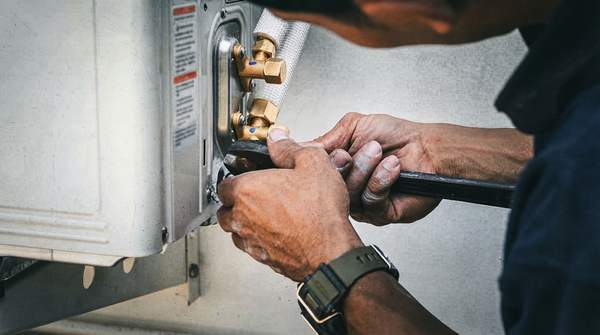
Most HVAC problems that leave a home uncomfortable fall into five familiar patterns: a system that will not start, weak or uneven airflow, an air conditioner that runs but does not cool, strange noises, and persistent bad odors. In many cases, the first fix is something you can safely do in minutes—checking a thermostat, swapping a filter, or clearing a blocked vent. The hard part is knowing where the homeowner's job ends. This guide walks through each problem with a symptom, a safe DIY sequence, and an explicit stop point where a licensed technician should take over.
Understanding Your HVAC System: When to Troubleshoot vs. Call a Pro
Industry guidance from HVAC manufacturers and service companies draws a consistent line. Homeowners can handle checks that involve no more than settings, filters, vents, and a tripped circuit breaker panel. Anything beyond that—electrical components inside the unit, refrigerant, ductwork repairs, or motor and compressor work—belongs to a professional.
Down East Heating & Air Conditioning, a North Carolina service company, frames its homeowner checklist around safety first: if you remove any panels, turn the power off at the thermostat and breaker. Erie Institute of Technology's troubleshooting guide, written by Ross Aresco, applies the same logic—start with filters and debris, and "if these steps don't prove fruitful, contacting a professional is the necessary next step."
One warning deserves emphasis before anything else. Trane Residential's guidance on an AC that will not turn on is blunt about tripped breakers: don't flip the breaker back yourself. The breaker may have tripped due to a serious issue, and letting a technician diagnose the cause is the safest path.
Problem 1: HVAC System Has No Power
Symptoms: The system is completely unresponsive—no fan, no cooling, no heating, nothing on the indoor or outdoor unit.
Safe DIY sequence: Start at the thermostat. Down East's checklist advises setting the system to Cool or Heat, the fan to Auto, and a temperature at least 3–5 degrees past room temperature, then replacing thermostat batteries if the screen is dim or unresponsive. If the thermostat checks out, look for the system's shutoff switch—Trane notes this may look like a light switch next to a furnace, though you won't see one with an air handler. Finally, check your circuit breaker box for a tripped breaker on the indoor or outdoor unit.
Stop and call a pro when: The breaker is tripped. Per Trane's safety guidance, leave it off and call an HVAC professional rather than resetting it, because a trip can signal a serious internal problem. Repeated tripping, or a unit that stays dead after all basic checks, points to internal electrical components—Trane specifically identifies failed start, run, or dual capacitors as a cause of an AC that won't turn on. Capacitors carry voltage and are not a homeowner repair. Trane also cautions that DIY repairs could void a warranty that's still in effect.