Your garage door springs — not the opener — do the actual lifting. Both of the two common residential types, torsion and extension springs, counterbalance the door's weight, and a broken one usually announces itself with a loud bang and a door that suddenly feels ten times heavier. You can identify which type you have by sight alone, in under a minute, without touching anything. And once you spot a problem, the answer is consistent across the industry: stop using the door and leave the repair to a trained professional.
Identifying Your Garage Door Springs: Torsion vs. Extension
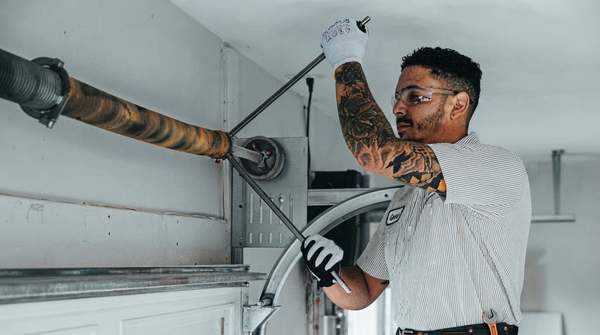
Manufacturers describe both spring types doing the same job in different ways. Torsion springs, the most common type on modern residential doors, sit on a horizontal metal shaft above the door opening and work by winding and unwinding as the door moves. Extension springs are more common on older doors and some single-car garages; they stretch and contract along the horizontal tracks on either side of the door. Because springs are under extreme tension even at rest, identification should be strictly hands-off: never loosen, adjust, or unbolt anything connected to either type.
Quick Guide: Torsion vs. Extension Spring Identification
Stand inside the garage with the door closed and look at where the springs sit and how they're shaped. The comparison below distinguishes the two systems on mounting position, appearance and mechanism — no physical contact required.
| Spring type | Location | Appearance and mechanism | Safety feature |
|---|---|---|---|
| Torsion | Mounted horizontally above the door opening, parallel to the top of the door, on a metal shaft. | A wound coil that twists around the shaft as the door closes, storing energy, and unwinds to help lift it. | No containment cable needed, but the stored winding tension makes these springs dangerous to handle. |
| Extension | Long, slender springs stretched alongside the horizontal tracks, one on each side of the door. | Coils that visibly stretch when the door closes and contract when it opens. | Should have a safety cable threaded through the spring to contain it if it breaks. |
The distinguishing test is simple: springs above the door on a shaft mean torsion; springs running along the sides above the tracks mean extension. Knowing which system you have helps you describe a problem accurately on the phone and judge whether a quote makes sense.