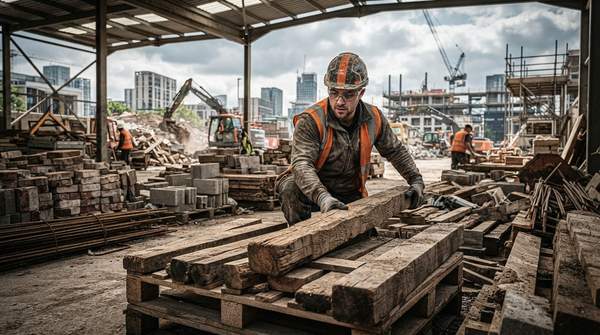
As the construction industry grapples with its environmental impact, adopting circular economy principles offers a clear path toward reducing waste and maximizing resource efficiency. Moving away from the traditional "produce, use, and discard" model, circular construction focuses on reusing, recycling, and recovering materials throughout a building's life. This approach not only minimizes waste but can also drive operational efficiencies and innovation by treating every material as a valuable resource.
The key to success lies in applying specific strategies at each stage of a project, from initial design to eventual deconstruction. By planning for longevity, adaptability, and material recovery from the outset, construction professionals can create buildings that are both sustainable and resilient. This involves a shift in mindset: viewing buildings not as disposable assets, but as material banks for the future.
Circular Construction Strategy Framework
To effectively implement circular principles, project teams can apply targeted strategies across a building's lifecycle. The following framework, based on guidance from organizations like UKGBC, categorizes key approaches by the project stage where they have the most impact and clarifies their primary goal. This allows for a more deliberate and holistic integration of circularity from concept to completion and beyond.
| Lifecycle Stage | Strategy | Primary Goal |
|---|---|---|
| Design | Design for Longevity & Adaptability | Extend the building's useful life and enable future modifications without major demolition. |
| Design | Design for Disassembly | Ensure components can be easily separated and recovered for reuse at the end of their service life. |
| Design & Construction | Use Modular & Standardised Elements | Reduce initial construction waste and simplify future deconstruction, repair, and reuse of components. |
| Construction & End-of-Life | Maximise Material Reuse & Recovery | Prioritise using existing assets and salvaged materials, and plan for the recovery of materials from deconstruction. |
| Construction | Specify Recycled & Low-Impact Materials | Reduce demand for virgin resources and minimise the environmental footprint of new construction. |