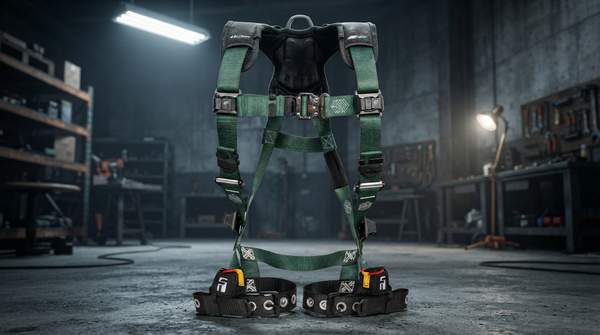
A personal fall arrest system (PFAS) is built from three components: an anchorage, a full-body harness worn by the worker, and a connecting device that links the two. That is how the U.S. Occupational Safety and Health Administration (OSHA) defines it. But knowing the parts is only half the picture. The more important safety decision happens before any component is chosen: whether to use a system that prevents a fall or one that stops a fall already in progress. Fall restraint, which keeps a worker from reaching an edge at all, is the preferred approach when feasible.
Understanding Personal Fall Protection Systems
Personal fall protection is not a single device but a coordinated system. OSHA's construction fall protection rules, set out in 29 CFR 1926 Subpart M, treat the anchorage, harness, and connecting device as interdependent parts that work together to arrest a fall and limit the forces applied to the worker's body. Treating one device as a complete system in isolation can create gaps in a safety program, as FallTech's equipment guides note.
San Francisco State University's Environment, Health and Safety office describes a fall protection hierarchy that places guardrails and other engineering controls first, followed by fall restraint, and then fall arrest. This article covers the last two: the personal systems a construction worker or home improver is most likely to wear on the body. It does not cover guardrails, safety nets, or installation and inspection procedures, and it is no substitute for certified training.
Fall Arrest vs. Fall Restraint: A Critical Distinction
The two systems differ in philosophy, not just hardware. A fall restraint system allows a person to work near a leading edge while physically preventing them from reaching that edge and falling off. SFSU's EH&S guidance compares it to a leash: it restricts movement so the worker cannot travel beyond the edge. OSHA's general industry standard 1910.140 similarly defines a travel restraint system as one that prevents a worker from reaching an unprotected edge or opening.
A fall arrest system does nothing to keep a worker from the edge. Instead, it protects after the fall has begun, preventing collision with the ground or lower structures and limiting the forces on the body. SFSU's guidance is blunt that there is still high risk of injury from the forces a fall arrest system exerts on the body. That is why restraint is the preferred personal fall protection system, and why OSHA has formally interpreted that fall restraint systems may be used in lieu of fall arrest systems when they prevent exposure to the fall hazard.
Fall Protection Systems: Prevention vs. Arrest
The table below contrasts the two systems on their core safety function: proactive prevention versus reactive mitigation. Use it to identify which system a given setup provides and why restraint is prioritized.
| System Type | Primary Function | Mechanism | Safety Outcome |
|---|---|---|---|
| Fall restraint system | Prevent the fall from occurring; the worker cannot reach the edge or opening | Restricts movement, like a leash, so the hazard area is never accessed | No fall occurs; preferred method when feasible, and OSHA permits it in lieu of fall arrest when it prevents exposure |
| Fall arrest system (PFAS) | Safely stop a fall that has already begun | Anchorage, full-body harness, and connecting device transfer and absorb energy, controlling deceleration and stopping distance | The fall is stopped before the worker hits a lower level, but forces on the body still carry a high risk of injury |
The Anchorage: Your Secure Connection Point
The anchorage is the secure point the whole system depends on. It is the fixed structure the connecting device attaches to, and everything else in the system transfers fall forces ultimately to it. SFSU's guidance specifies that the anchorage point must be capable of supporting at least 5,000 pounds. OSHA's fall arrest criteria for construction, in standard 1926.502(d), govern the requirements these anchorages must meet.
Because the anchorage carries the entire load of a stopped fall, its selection is the highest-stakes decision in assembling a PFAS. This article does not cover installation instructions for anchorages; that work requires proper training and, in many settings, a competent person—someone OSHA defines as capable of identifying existing and predictable hazards in a fall protection system and authorized to take prompt corrective action.
The Full-Body Harness: Distributing the Load
The full-body harness is the component the worker wears, and it is the primary element of the PFAS in the sense that it is what holds the person. Its job is twofold. During a fall, it distributes the arresting forces across multiple areas of the body—the thighs, pelvis, waist, chest, and shoulders, as Rigid Lifelines explains—rather than concentrating them at a single point. It also keeps the worker upright after the fall is stopped.
The harness must include a means of connecting to the rest of the system, typically through D-rings. OSHA's 1910.140 standard describes D-rings as connectors used in a harness as an integral attachment element or fall arrest attachment, and in lanyards, energy absorbers, lifelines, or anchorage connectors as integral connectors. A harness that fits poorly or connects at the wrong point undermines the force distribution the design depends on.
Connecting Devices: The Link in the System
The connecting device is the link between harness and anchorage, and it comes in several forms. A lanyard is a short, flexible line of rope, wire rope, or webbing strap with connectors at each end—one attached to the harness, the other to a deceleration device, shock absorber, anchorage connector, or anchorage point. Lifelines, vertical or horizontal, extend the connection where the anchorage is not directly overhead.
Many lanyards include an internal or external shock absorber, a deceleration device designed to reduce the force exerted on the worker during a fall. FallTech describes the division of labor plainly: the harness supports the worker and distributes arresting forces, while the connecting device controls deceleration and stopping distance. Connectors couple all these parts together, as OSHA's definitions make clear.
Key Takeaways for Fall Protection Safety
Three points carry most of the practical weight. First, restraint beats arrest: a system that keeps you from the edge means no fall, no arrest forces, and no injury from those forces. Second, a PFAS is a system, not a product—an anchorage rated to support at least 5,000 pounds, a properly fitted full-body harness, and a connecting device with appropriate deceleration must all work together. Third, equipment that has arrested a fall must be removed from service afterward.
One caution from the evidence is worth repeating: a fall arrest system, even when it works exactly as designed, still subjects the body to forces that carry a high risk of injury. It is a last line of defense, not a comfortable routine. Anyone working at heights should also plan for what happens after an arrest—a suspended worker still needs rescue.
Making the Right Choice: Prioritizing Fall Prevention
When working at heights, prioritize the implementation of a fall restraint system over a fall arrest system whenever feasible, as prevention is inherently safer than mitigation. OSHA's own interpretation letters support using restraint in place of arrest when the setup prevents exposure to the fall hazard, and SFSU's hierarchy places restraint above arrest for exactly this reason.
The measurable indicator of a correct setup is concrete: the worker's position is physically restricted from reaching any fall hazard, or if a fall arrest system is in use, all three components (anchorage, harness, connecting device) are correctly selected, inspected, and deployed according to OSHA standards. Before stepping onto a roof or leading edge, check which condition holds. If neither does, the work is not ready to begin.