Choosing work boots is not about picking the toughest-looking pair on the shelf. It is about matching specific footwear features to the specific hazards of your job site. A boot that protects a carpenter from falling lumber may be useless—or even dangerous—for an electrician working near live circuits. This guide walks through the process in three steps: identify your hazards, map them to the required safety features, and verify those features on the boot's label before you buy.
Understanding Your Job Site: Identifying Key Hazards
The first step is a honest assessment of what can actually hurt your feet on your site. Trades differ sharply in this respect. Workers in manufacturing environments rely on durable safety boots to protect against impacts, heavy materials, and long hours on their feet, according to Work Hard Dress Right's work boot guide. Construction and heavy labor combine several risks at once: falling or rolling objects, sharp debris underfoot, wet surfaces, and long shifts on hard ground.
Toe protection is a standard feature on almost all high-quality work boots and is often a requirement for stepping onto a job site, as Steel Blue, a safety footwear manufacturer, explains. Most people know steel caps, but composite toe caps are an alternative worth considering depending on your trade. Steel Blue describes its steel toe caps as resisting a 200-joule drop force, 15 kilonewtons of rolling force, nail gun puncture, and power saw cuts—useful figures to keep in mind when comparing protection levels.
Two hazards deserve special attention because they are frequently overlooked. First, puncture: Penetration Resistant outsoles improve safety on construction sites where nails and sharp debris litter the ground. Second, electricity: Electrical Hazard (EH) protection is essential for electricians, because accidental contact with live circuits requires non-conductive footwear. If either of these conditions describes your work, your boot choice is effectively narrowed before you consider anything else.
The Work Boot Safety Feature Decision Framework
The table below categorizes boot features by the primary hazard they mitigate, the protection they provide, the trades where that hazard is common, and the label code that certifies the protection. The codes come from the ASTM F2413 protective footwear standard, which HexArmor, a safety equipment company, explains how to read: a boot marked "ASTM F2413-24 M/I/C/EH" meets the 2024 version of the standard, offers male sizing, and provides impact, compression, and electrical hazard protection.
| Common Hazard | Required Safety Feature | Protection Provided | Commonly Affected Trades | ASTM Standard Code |
|---|---|---|---|---|
| Falling or rolling objects (impact and compression) | Safety toe (steel, composite, or alloy) | Impact resistance of 75 foot-pounds and compression resistance of 2,500 pounds at the 75 rating | Construction, manufacturing, heavy labor | I/75 and C/75 |
| Sharp debris underfoot (nails, metal scraps) | Puncture-resistant outsole | Reduces penetration through the sole | Construction, demolition | PR |
| Accidental contact with live electrical circuits | Electrical Hazard protection (non-conductive construction) | Secondary protection reducing the flow of electricity through the body | Electricians, utility workers | EH |
| Impact to the bones above the toe | Metatarsal guard | Protects the metatarsal area from crushing impacts | Heavy industry, steel work | Mt/75 |
| Static buildup near sensitive equipment | Static dissipative footwear | Reduces accumulation of excess static electricity | Electronics manufacturing | SD |
Reading the ratings matters. The University of Washington's protective footwear requirements document explains that impact and compression ratings come in 75, 50, and 30 levels, correlating to 2,500, 1,750, and 1,000 pounds of compression respectively. The "75" level is the highest of the three, so a boot labeled I/75 and C/75 has been tested to the most demanding impact and compression thresholds in the standard. The two digits after "F2413" indicate the year of the standard version the boot was tested against.
One caution on electrical protection: EH-rated footwear is a secondary measure, not a license to work energized circuits. It is designed to reduce the flow of electricity through the body during accidental contact—your employer's lockout and grounding procedures remain the primary protection.
Making Your Selection: A Checklist for Trades Professionals
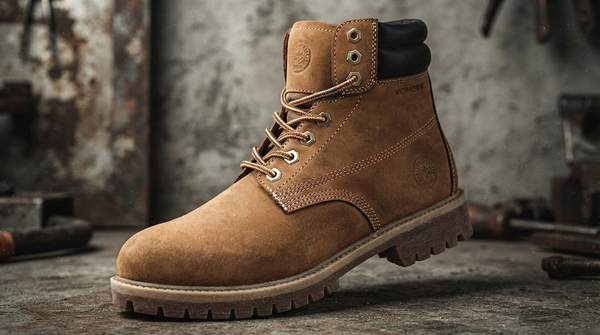
Safety features are only half the decision; construction and materials determine how the boot performs over a ten-hour shift and a year of wear. Sole type is the biggest fork in the road. A wedge sole sits flat against the ground and spreads pressure across the whole foot, which many tradespeople prefer for standing on concrete all day, while a defined heel offers better grip on rungs and uneven terrain. Toe shape—such as a moc toe versus a round toe—affects fit and flexibility in the forefoot.
Upper materials drive durability. Full-grain leather resists abrasion and can be reconditioned, while synthetic materials stay lighter and dry faster. Small details add up: Steel Blue points out that scuff caps and bump caps prolong boot life by preventing wear around the toe, and hygiene treatments prevent material degradation and discomfort over time. The manufacturer also emphasizes that all-day comfort features minimize the risk of repetitive strain injury, back and knee pain, and muscle soreness—real costs for anyone billing hours on their feet.
Work through your selection in this order:
- List your hazards. Falling objects? Sharp debris? Live circuits? Wet or oily floors? Static-sensitive equipment?
- Match each hazard to a feature using the framework above—safety toe, PR outsole, EH rating, metatarsal guard, or slip resistance.
- Check the label. Confirm the boot's tongue or interior shows the ASTM F2413 designation and the specific codes your hazards require.
- Then choose construction—sole type, upper material, and comfort details—based on your surfaces and shift length.
Two boundaries apply to everything above. This is a guide to selecting features, not a review of specific boot models or brands. And because recommendations here are based on common trade hazards, your employer's specific PPE requirements always govern—follow those first.
Selecting Your Ideal Work Boot: A Final Checklist
Choose work boots by systematically matching their safety features and construction elements to the specific hazards and demands of your trade. Before you pay, turn the boot over or open the tongue and check the label: the selected work boot's internal label clearly displays the ASTM F2413 standard and all required safety feature codes (e.g., I/C/75, EH, PR, Mt) that correspond to your job's identified hazards. If a code your hazard requires is missing from the label, no amount of marketing copy on the box substitutes for it.