For basic home watch maintenance on a non-luxury watch, five tools cover the common jobs: a spring bar tool, a watch case opener, precision screwdrivers, non-magnetic tweezers, and an eye loupe. That's the minimal viable kit for the two tasks beginners attempt most often—changing a battery and adjusting a strap or bracelet. Longer lists exist, some running to nine or twelve tools, but many of those items serve advanced work like hand removal or movement servicing, which this guide deliberately leaves out.
The 5 Essential Tools for Basic Watch Maintenance
Spring bar tool. This is the tool for anything strap- or bracelet-related. WatchPlaza's beginner guide describes its forked end, which fits into the spring bar's notch so you can remove or attach the bars that secure the strap to the case. Without it, strap changes become a frustrating scrape against the watch lugs with improvised implements that can slip and scratch.
Watch case opener. Before you can see inside a watch, you need a safe way to open the case, as Eternal Tools puts it when listing the case opener as the first step in any watch repair. For a battery change, this is non-negotiable: the battery sits under the case back, and the opener is what gets you there without marring it.
Precision screwdrivers. WatchPlaza calls the screwdriver and tweezers "the bread and butter of watch movement tools," noting that screwdrivers must be the right size and quality to avoid damaging tiny screws. Some case backs and bracelet links are screw-fixed, so a small, well-fitted driver set earns its place even in a basic kit.
Non-magnetic tweezers. Batteries and small internal parts are handled with tweezers, and they must be non-magnetic and fine-tipped so you can grip small components without dropping them or magnetizing them. Magnetized tweezers risk interfering with the movement—a problem you don't want to introduce while doing a simple battery swap.
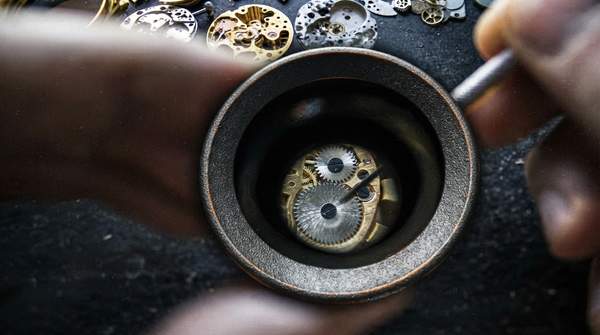
Eye loupe. Watch components are tiny, and Eternal Tools notes you'll struggle to see what you're doing without magnification, making a loupe one of the first things to add to a kit. For beginners, two types cover the range: a general eyeglass at roughly 3–4× magnification for everyday work, and an inspection eyeglass at around 10–12× for close examination.
Essential Tools for Common Beginner Watch Tasks
The five tools above aren't all needed for every job. Mapping each task to the subset it actually requires removes the guesswork from preparation—grab only what the task demands. Sofly's beginner guide identifies the tool sets for the two most common tasks, and the table below combines that with the function descriptions from the other sources.
| Beginner Task | Required Tools | Each Tool's Role in the Task |
|---|---|---|
| Battery replacement | Watch case opener, non-magnetic tweezers, precision screwdriver | The opener removes the case back to reach the battery; tweezers lift the small battery and any retaining components without magnetizing them; a screwdriver handles screw-fixed case backs or battery clips. |
| Strap change / adjustment | Spring bar tool | The forked end releases the spring bars securing the strap to the case, allowing removal, attachment, or adjustment. |
| Metal bracelet link adjustment | Spring bar tool, precision screwdriver | The spring bar tool removes the bracelet from the case; a screwdriver handles screw-fixed links. (A dedicated pin remover also helps for pin-held links, per Sofly and WatchPlaza.) |
| Any of the above | Eye loupe | Magnifies the tiny parts and spring bar notches so you can see what you're doing at every step. |
Read the table as a pre-job checklist: a battery change means opener, tweezers, and screwdriver on the bench; a strap adjustment means the spring bar tool, with the loupe nearby either way. Sofly also lists a case press among battery-replacement tools for closing the case securely, which is worth knowing about even though it sits outside the core five.