The safety case for any lift table rests on a handful of specific mechanisms—overload protection, emergency stop buttons, scissor guards, safety lock bars, platform rails, and pressure-sensitive mats—each of which addresses a distinct hazard: overloading, crushing, shearing, or uncontrolled descent. Manufacturer and industry guidance consistently points to the same core features, and to the same operational disciplines that make them effective. This guide consolidates them into a checklist you can use to evaluate a purchase or audit equipment you already run.
Understanding Lift Table Safety: A Core Requirement
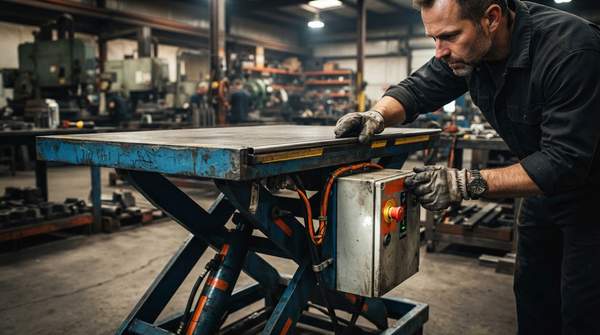
Lift tables occupy a specific injury territory: pinch points where the scissor legs close, crush zones beneath the platform, and structural failure when rated loads are exceeded. Safety guidance from lift table manufacturer Ningbo Ruyi identifies the primary considerations as never exceeding rated load capacity, keeping personnel clear of the scissor mechanism during operation, centring and stabilising loads before lifting, never using the table as a personnel platform unless specifically rated for that purpose, and always engaging mechanical safety locks before working beneath or alongside a raised table.
That framing matters for buyers. A lift table's features are not interchangeable conveniences; each one maps to a specific failure mode. When comparing models or auditing existing equipment, the useful question is not "does it have safety features?" but "which hazards does this specific configuration protect against, and which does it leave open?" The checklist below is built around that question.
Essential Mechanical Safety Features
Overload protection prevents the table from raising a load beyond its set weight limit. Both VEVOR's buying guidance and Sinolift's industry overview describe this as essential to preventing equipment damage and accidents, with Sinolift noting that overload systems stop the table from being raised with excessive weight. Knowing the table's rated capacity—and verifying the load before lifting—is what makes the feature meaningful.
Mechanical safety lock bars serve a different purpose: they physically secure the platform in a raised position. Ningbo Ruyi's guidance requires mechanical locks before anyone works beneath or alongside a raised table, and prohibits working under an unsupported platform outright. This is the feature that turns maintenance from a gamble into a procedure—it is the last barrier if hydraulics fail while a technician is underneath.
Load centreing belongs on the mechanical list even though it is an operator action rather than a device. Ningbo Ruyi treats centred, stable loads as a primary safety consideration, because an off-centre load changes the stress the scissor mechanism carries and increases tip-over risk.
Critical Electrical and Operational Safeguards
Emergency stop buttons are the universal baseline. VEVOR describes them as standard on all lift tables, with placement that matters: the button should be reachable from any side of the table so an operator can halt movement immediately in an emergency. Source 4 Industries includes emergency stops among the core features to look for when selecting a table, alongside overload protection.
For powered tables, the electrical layer deserves its own look. Ningbo Ruyi's training guidance covers electrical safety in powered lift tables as part of the equipment-specific knowledge operators need—control functions, emergency stop procedures, and hazard identification for the specific model. Sinolift also reports that many models include automatic shut-off functions that activate when the table is obstructed, which adds a second electrical barrier independent of operator reaction time.
When evaluating a powered table, check that the emergency stop is genuinely isolating rather than decorative, and that obstruction-triggered shut-off, if present, actually halts descent—not just the pump.
Advanced Protection: Guards and Mats
Scissor mechanism guards address the most characteristic lift table hazard: the pinch and crush points where the legs pivot. Ningbo Ruyi's guidance pairs guards and physical barriers with safe exclusion zones—keeping personnel out of the mechanism's operating envelope during movement is a procedural requirement, not just a design preference.
Platform guards and rails keep loads—and, where rated, personnel—from falling off the elevated platform. Source 4 Industries lists them among the safety features to compare when choosing between single and double scissor configurations.
Pressure-sensitive safety mats are the most advanced layer in this evidence set. Ergonomic Partners describes a custom lift-and-tilt installation where diamond-plated rubber mats on each side of the platform prevent table movement while an operator is standing or stepping on them. The protection is positional: if a person is in the hazard zone, the table will not move. This is an example from one custom installation rather than a standard specification across all tables, but it illustrates the protection pattern—automatic, person-present detection—to ask vendors about.
Lift Table Safety Feature Checklist
Use the table below to evaluate any lift table purchase or audit existing equipment. Each row pairs a feature with the specific hazard it is designed to mitigate, so a gap in one row is a visible gap in protection, not just a missing line item. Features are grouped from load-related protection through operator-presence systems.
| Safety Feature | Purpose / Hazard Prevented |
|---|---|
| Overload protection | Stops the table from lifting loads above its set weight limit, preventing structural damage and overload-related accidents. Check the rated capacity and the load before every lift. |
| Mechanical safety lock bars | Physically secure the raised platform so it cannot descend if hydraulics fail; required before any work beneath or alongside a raised table. Working under an unsupported platform is prohibited. |
| Emergency stop button | Halts the table immediately in an emergency. Placement should allow access from any side of the table. |
| Scissor mechanism guards | Block access to pinch and crush points in the scissor legs; paired with exclusion zones that keep personnel out of the mechanism's operating envelope during movement. |
| Platform guards / rails | Prevent loads or personnel from falling off the elevated platform, supporting load stability at height. |
| Pressure-sensitive safety mats | Detect when a person is standing or stepping in the hazard zone around the table and prevent movement while they are present, guarding against crushing during operation. |
| Electrical safeguards (powered tables) | Isolating emergency stop and obstruction-triggered shut-off prevent electrical hazards and uncontrolled movement; verify compliance with applicable electrical codes for the installation environment. |
A word on the third and sixth rows: the specific hazard prevented by pressure-sensitive mats—crushing during movement—is inferred from their documented function of stopping table movement when someone is on the mat, combined with the crush-zone risks lift tables are known for. Likewise, the lock-bar purpose follows from their required use before working under a raised table. Neither is a manufacturer specification quoted verbatim.
Integrating Safety Features with Operational Procedures
Hardware only delivers protection when procedure supports it. Ningbo Ruyi's training framework connects the two directly: operators should learn the location of every pinch point, crush zone, tip-over condition, and hydraulic failure mode for their specific model; how to determine load weight and centre it; the full pre-operation inspection checklist and how to take defective equipment out of service; exclusion zone management and communication with co-workers; when the safety lock is required and how to install it correctly; and the prohibited uses—personnel elevation on non-rated tables, overloading, bypassing guards, and makeshift modifications.
Two disciplines deserve emphasis. Pre-use inspection is the mechanism that catches a failed guard or a damaged lock bar before it matters. Load management—confirming weight and centring—is what makes the overload protection and stability margins real rather than nominal. VEVOR's operator guidance adds personal protective equipment: safety shoes, gloves for grip, eye protection where required, and avoiding loose clothing.
Ensuring Continuous Lift Table Safety
The decision this evidence supports is straightforward: prioritize lift tables equipped with a comprehensive set of safety features and implement rigorous operational procedures, including regular inspections and proper load management. A table with overload protection but no lock bars, or an emergency stop reachable from only one side, leaves a known hazard open.
Two qualifications bound this guide. It is a general reference, not a substitute for manufacturer-specific operating manuals or formal safety training, and it does not cover every feature that exists across all lift table types. It also does not interpret any local, state, or federal regulatory compliance requirement.
The measurable indicator is concrete: consistent adherence to pre-use inspection checklists and load management protocols, together with a reduction in reported near-misses or incidents related to lift table operation. Training should also be documented—who was trained, on which equipment, by whom, and when—so the inspection and load-management habits are verifiable rather than assumed. Use the checklist above on your next purchase or audit, and treat any row you cannot answer as the next question for your vendor or supervisor.
Sources
- Lift Table Safety Considerations: Hazards, Inspections & Rules — XILIN
- How to Choose the Right Table Scissor Lift for Your Needs — VEVOR Blog
- Top 10 Lift Tables for Efficient Material Handling and Workplace Safety
- Single Scissor Lift Table vs. Double Scissor Lift Table: Which is Righ — Source 4 Industries
- Lift Table Videos — Ergonomic Partners