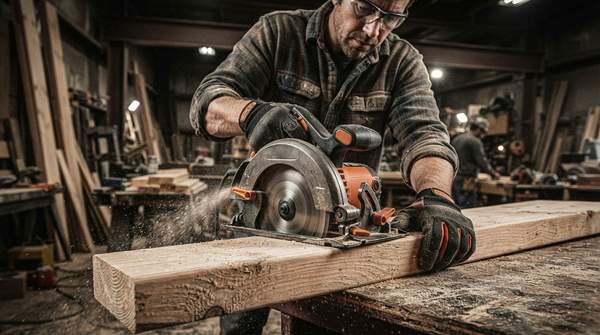
For most DIY work, a sidewinder is the right circular saw; for framing, long rips, dense or wet lumber, and demolition, a worm drive or its hypoid cousin earns its extra weight. That is the short version of a choice that Popular Mechanics describes as deceptively large: motor orientation affects gearing, gearing affects blade speed and torque, and those choices shape the saw's size, balance, leverage, and sightlines. This guide breaks down the three main drive designs and maps each to the work it handles best.
Understanding Circular Saw Drive Types
Circular saws look interchangeable until you notice where the motor sits. A sidewinder—more precisely called a direct drive saw, as Pro Tool Reviews explains—mounts the blade directly on the motor shaft, with the motor positioned perpendicular to the blade. A worm drive positions its motor longitudinally, behind the blade, and uses a worm gear meshing with a second gear on the blade arbor to turn the rotation ninety degrees. That gearset provides gear reduction, which is the source of the design's signature torque.
A hypoid saw is a close relative of the worm drive that swaps the gear type. As Acme Tools describes it, the hypoid gear is a spiral bevel gear whose axis is not in line with the axis of the meshing gear. The practical consequences of these three layouts—torque, speed, weight, and handling—are what actually separate the categories, and they follow directly from the mechanics.
Sidewinder (Direct Drive): Speed and Portability
Because the blade mounts straight onto the motor shaft, a sidewinder spins faster than a geared saw and delivers generally lower torque. That combination suits faster, lighter cuts rather than brute-force ripping through dense stock. The direct-drive layout also keeps the body compact, with the handle more on top of the saw rather than behind it.
The payoff is handling. Writing at Popular Mechanics, Paul Smith notes that "a lighter sidewinder is easier to move around"—a difference that matters most when the saw leaves the bench: holding it against a wall, carrying it up a ladder, working overhead, or picking it up hundreds of times for short cuts. For home projects—building shelves, repairing a deck, ripping plywood, or general renovations—Smith still steers most buyers toward a sidewinder, recommending a 7-1/4-inch model over a smaller 6-1/2-inch saw if any meaningful framing is on the list.