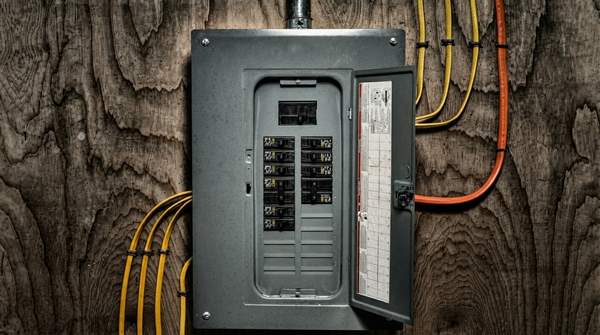
Most homes contain one of a small number of wiring systems, and which one you have matters far more than age alone. Modern non-metallic cable — commonly called Romex, technically named Non-metallic (NM) cable — includes a grounding conductor and is the modern standard for household wiring. Knob-and-tube wiring, phased out in the 1940s, has no ground wire at all and cannot service three-pronged appliances. Armored and metal-clad cables sit between the two, using a metal sheath for physical protection. This guide explains how to tell them apart visually, why the presence or absence of a ground wire is the single most important safety distinction, and when a professional inspection is warranted.
Identifying Common Residential Wiring Types
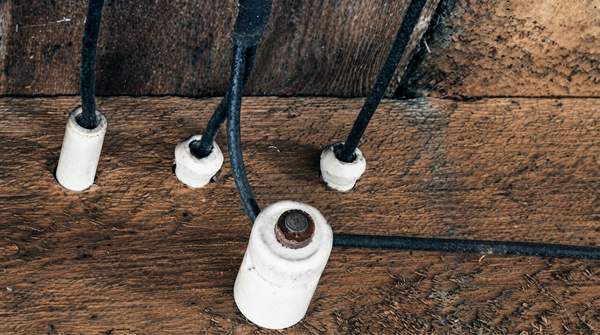
Homeowners rarely encounter bare single wires; they see cable assemblies — grouped conductors wrapped in a common covering. Romex is encased in a plastic jacket, typically yellow for 12-gauge wire and white for 14-gauge. Armored cable, often called BX, is wrapped in a flexible metal sheath. Knob-and-tube is the outlier: instead of a single cable, it uses single insulated copper conductors, with a black cable and a white cable running separately to each electrical point.
Location also offers clues. According to electrical training material from CBT Technology Institute, location influences the suitable cable type: UF cable is required for underground use, while BX cable may be appropriate for exposed locations in a basement. All installations, the same source notes, must comply with the National Electrical Code (NEC) or local electrical codes, which specify the types of wiring permitted in different applications.
Knob & Tube Wiring: An Obsolete System
Knob-and-tube is the oldest wiring a homeowner is likely to find, and it was phased out in the 1940s after better alternatives came along. The system consists of insulated copper conductors passing through lumber framing drill-holes via protective porcelain insulating tubes, supported along their length by nailed-down porcelain knobs. Its coating — rubber or asphalt-saturated cotton cloth — is a reliable visual marker.
The system does not meet modern electrical safety codes, as the Center for Energy and Environment explains: it was designed to carry a light electrical load and is overloaded easily in a modern home with multiple appliances often running at once. Over time, heat from the wires causes the rubber coating to become brittle and break, which can lead to exposed live wires. Because it is often hidden in attics or wall cavities, its condition is difficult to assess.
Its legal status is more nuanced than many assume. InterNACHI, the home inspector association, reports that while knob-and-tube is considered obsolete, there is no code requiring its complete removal — treatment varies by jurisdiction — but it is not permitted in any new construction.
Quick Guide to Residential Wiring Types
| Wiring Type | Typical Era of Use | Key Visual Identifiers | Ground Wire Present? | Primary Safety/Use Consideration |
|---|---|---|---|---|
| Knob-and-tube | Phased out in the 1940s | Separate black and white single conductors with rubber or asphalt-saturated cotton cloth coating; porcelain knobs and tubes | No | Designed for lighter electrical loads; degraded insulation, overloading and improper modifications raise shock and fire risk; cannot service three-pronged appliances |
| Non-metallic (NM-B / Romex) | Modern standard | Plastic jacket, typically yellow for 12-gauge and white for 14-gauge | Yes | Standard for modern residential installations, offering safety features like the grounding conductor and fire resistance |
| Armored (AC / BX) and metal-clad (MC) cable | Older and continuing use | Flexible metal sheath enclosing the conductors | Yes (via grounding path) | May be appropriate for exposed locations such as basements, where the metal sheath provides physical protection |
| Underground feeder (UF) cable | Modern outdoor use | Heavy-duty jacket suited to burial | Yes | Required for underground use |
Read this table as a first-pass diagnosis: match what you see in an attic, basement, or junction box cover against the visual identifiers, then check the grounding column to gauge the system's baseline safety. Because each row carries different risks, the identification itself points toward what to verify next with a professional.
Armored (AC/MC) Cable: Enhanced Protection
Armored cable, frequently called BX, encloses its conductors in a flexible metal sheath rather than the plastic jacket of Romex. The metal wrap is the point: it provides physical protection where cable would otherwise be exposed. That is why, per the CBT Technology Institute guidance, BX may be appropriate for exposed locations in a basement — an environment where NM cable's plastic jacket alone would be more vulnerable. The metal sheath also provides the grounding path that knob-and-tube entirely lacks.
The Critical Role of Grounding in Home Electrical Safety
Grounding is the divide between the two eras of residential wiring. Since a knob-and-tube system lacks the ground wire found in modern systems, there is no protection when a fault occurs, increasing the risk of shock or fire, as the Center for Energy and Environment puts it. This is also why the old system cannot service any three-pronged appliances — the third prong has nothing to connect to.
The American Society of Home Inspectors adds useful nuance: knob-and-tube is not the only ungrounded wiring — many multiwire circuits used from the 1940s through the 1960s also lack grounding — and in many jurisdictions there are solutions short of full rewiring, such as adding GFCI outlets for each circuit. What matters is confirming what your local electrical authority and home insurers will accept. Note also that some insurers withdraw coverage for homes containing knob-and-tube simply because of its age.
Recognizing Hazards: When to Call an Electrician
Even live knob-and-tube is not automatically an emergency; the hazards build over time and through human intervention. InterNACHI summarizes the practical risk: knob-and-tube wiring is likely to be a safety hazard due to improper modifications and the addition of building insulation. Insulation is a specific trigger — the Center for Energy and Environment notes that insulation contractors will not insulate spaces with active knob-and-tube wiring because it increases fire risk, and most will require an electrician to verify the wiring is not active before proceeding. If it is active, it must be replaced in order to insulate the home safely.
Watch for these warning signs: brittle, cracked, or exposed cloth or rubber insulation on conductors; circuits that trip or overload under modern appliance loads; evidence of splices or modifications not made to modern standards; and any wiring running through or in contact with insulation.
When to Seek Professional Electrical Evaluation
This article is for identification and general education only — it is not a guide for performing electrical work. Homeowners should arrange for a professional electrical inspection if they identify knob-and-tube wiring, observe signs of degraded insulation, experience frequent circuit overloads, or find any unsafe modifications to their electrical system. The same advice applies before insulating an attic or wall cavity where old wiring may run. The concrete next step: obtain a qualified electrician's report confirming the safety and code compliance of the home's wiring system — the document that tells you whether what you spotted on your own is a manageable condition or a system due for replacement.
Sources
- Types of Electrical Wiring Electricians Should Know — CBT Technology Institute
- Dealing with knob-and-tube wiring — Center for Energy and Environment
- Knob-and-Tube Wiring — NACHI
- Knob-and-Tube Wiring: A Revisit - American Society of Home Inspectors, Inc.