Trades

Lowe's Boosts Skilled Trades Investment, CEO Touts Human Expertise Over AI

Amid a growing labor shortage, Lowe's is quintupling its investment in skilled trades training. CEO Marvin Ellison asserts that human ingenuity and physical skill will remain irreplaceable, even as AI advances.

RD
Rick Donovan

April 8, 2026 · 6 min read

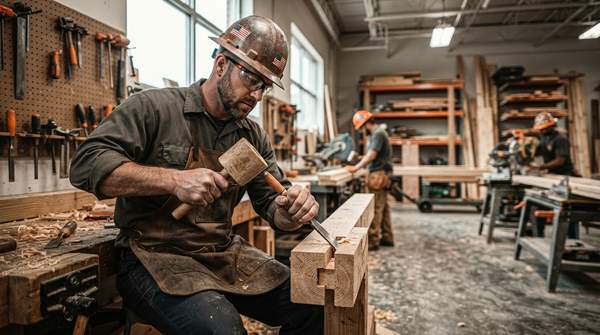
A skilled carpenter working with traditional tools, with a subtle, futuristic AI interface in the background, highlighting human expertise over technology.

The Lowe's Foundation is increasing its commitment to skilled trades, announcing a $250 million investment over the next decade to train 250,000 workers as CEO Marvin Ellison emphasizes the limits of artificial intelligence in replacing human expertise.

This initiative represents a five-fold increase from the foundation's previous goal and arrives at a critical moment for American industry. With a persistent and widening shortage of skilled labor in fields like carpentry, plumbing, and electrical work, the investment aims to directly address the workforce gap. Ellison's commentary positions the value of hands-on trades as a durable career path, arguing that the physical and problem-solving nature of the work provides a bulwark against automation that is expected to disrupt administrative and analytical professions.

What We Know So Far

  • The Lowe's Foundation will invest $250 million by 2035 to help train and develop 250,000 skilled tradespeople, according to a company press release.
  • This new commitment is a five-fold increase from the foundation's original goal, which it is on track to meet a year ahead of schedule.
  • The program targets essential trades facing significant labor shortages, including plumbing, carpentry, electrical, and HVAC.
  • To date, the foundation has invested nearly $53 million in 65 nonprofits and community colleges across the country to support trades education.
  • The investment comes as the Associated Builders and Contractors trade association estimates the U.S. construction industry alone will need hundreds of thousands of additional workers in the coming years to meet demand.

Lowe's CEO on AI's Impact on Skilled Labor

Lowe's Chairman and CEO Marvin Ellison asserts that AI's clear physical boundaries highlight the enduring value of human skill in the trades, driving the company's massive new investment in training craftspeople.

In statements reported by Fortune, Ellison offered a practical assessment of the technology's limits. "As powerful as AI will become, AI can’t climb a ladder to change the batteries in your smoke detector," he said. This simple, tangible example cuts through the hype, highlighting the complex blend of manual dexterity, spatial awareness, and on-site problem-solving that defines skilled trade work. The point is not that AI is irrelevant, but that it cannot replicate the physical work of a plumber fixing a burst pipe or an electrician wiring a new home.


Ellison argues that AI's acceleration in white-collar fields makes hands-on, physically demanding professions more secure and valuable, rendering the skilled-trades initiative critical. He stated "American prosperity is at stake," positioning the effort to close the workforce gap as a national imperative.

Why AI Cannot Replace Skilled Trades

The distinction between artificial intelligence and human tradecraft lies in the gap between data processing and physical execution. An AI can analyze blueprints, diagnose system failures based on sensor data, or even generate optimal repair procedures. However, it cannot perform the physical tasks required to implement those solutions in the unpredictable environment of a job site. The work of an electrician, carpenter, or HVAC technician is not just about knowing the answer; it's about applying it with skilled hands in complex, often constrained, physical spaces.

From my own experience on job sites and in workshops, the most valuable skill a tradesperson possesses is adaptive problem-solving. No two jobs are ever identical. A plumber might discover decades-old, non-standard piping behind a wall, requiring an improvised solution that a purely digital model could never anticipate. A carpenter must feel the grain of the wood and adjust their cuts based on its unique properties. These are acts of physical intelligence and intuition, honed over thousands of hours of practice. AI lacks this sensory feedback loop and the ability to make nuanced physical adjustments in real time.

Tasks like changing furnace filters, cleaning dryer vents, or repairing a roof hole remain beyond AI's reach, requiring human mobility, dexterity, and understanding of physical systems. While robotics may handle some structured tasks, the dynamic, varied nature of repair and construction work and the unexpected challenges it presents remain uniquely human domains.

Addressing the National Skilled Trades Shortage

A severe and growing labor crisis, marked by retiring skilled professionals and insufficient new talent, threatens to slow economic growth, increase construction and home maintenance costs, and delay critical infrastructure projects. The Lowe's Foundation's $250 million commitment directly responds to this crisis.

The numbers from the Associated Builders and Contractors (ABC) paint a stark picture of the demand. According to a PR Newswire report, the ABC estimates that 349,000 net new construction workers are needed to meet demand this year alone. Other reports cite ABC projections of needing roughly 350,000 additional workers in 2026 and a staggering 456,000 in 2027 for construction services. This deficit is driven by a combination of factors, including an aging workforce, a long-standing cultural emphasis on four-year college degrees over vocational training, and lingering misconceptions about the trades as a career path.

To rebuild the talent pipeline, Lowe's Foundation has already invested nearly $53 million in 65 partner organizations, including community colleges and nonprofits providing hands-on training. According to StockTitan, the foundation is on pace to prepare 50,000 tradespeople by 2027 under its original goal, one year ahead of schedule. This strategy escalates significantly with a new commitment to train 250,000 workers by 2035.

What Happens Next

The Lowe's Foundation will deploy its expanded $250 million commitment over the next decade, aiming to train 250,000 skilled tradespeople by 2035. Immediate next steps involve identifying and funding additional community colleges, vocational schools, and nonprofit partners to scale up training programs nationwide.

While Lowe's $250 million investment is significant, it alone cannot solve the national shortage; broader industry involvement is crucial. Effective resolution requires a coordinated push from other major corporations, industry associations, and government bodies, including public-private partnerships, education reform re-emphasizing vocational pathways, and a cultural shift in how society views trades careers. As Ellison noted, the industry must "do a better job of presenting skilled trades as rewarding, viable careers, not just backup plans."

The industry will closely watch the execution of Lowe's plan, specifically how funds are allocated, training programs developed, and new talent attracted. The success of this ambitious "bet on a blue-collar future," as one Fox Business report called it, could provide a blueprint for addressing pressing economic challenges.