Without an intervening suspension structure, a simple pothole could cause your tires to lose contact with the road, turning a smooth drive into a dangerous, uncontrolled bounce. This loss of contact compromises vehicle control, increasing accident risk.
Vehicle suspension systems appear to simply provide a smooth ride, but they simultaneously perform a complex, dynamic dance to maximize tire friction and ensure steering stability. This constant interplay, often unnoticed, dictates the car's interaction with the road.
The sophisticated, velocity-sensitive engineering within modern suspension systems is crucial for both everyday comfort and critical safety. It is a foundational element of vehicle design, directly impacting driver experience and control.
More Than Just a Smooth Ride: The Core Purpose of Suspension
A car suspension's primary job involves three critical functions: maximizing tire friction, providing steering stability, and ensuring passenger comfort, according to automotive experts. These functions are not isolated; they operate in constant dynamic tension.
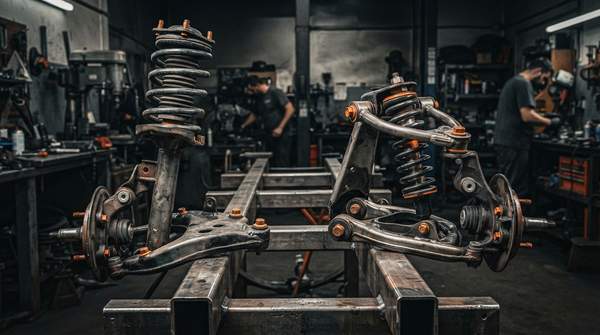
Any vehicle suspension relies on three fundamental components: springs, dampers (shock absorbers), and sway bars (anti-roll bars). Springs absorb road shocks, while dampers control spring oscillation. Sway bars manage body roll during cornering, distributing forces across the axle.
The chassis determines a vehicle's driving behavior and "DNA," a principle extending from racing vehicles to all cars, as outlined in Suspension System | Springer Nature Link. The intricate interplay of these components, combined with kinematic considerations, means the suspension system dictates a car's entire driving character. It is the true arbiter of a car's personality.
The Hidden Engineering: How Modern Suspension Adapts to the Road
All modern shock absorbers are velocity-sensitive: the faster the suspension moves, the more resistance the shock absorber provides. This is critical for managing vehicle dynamics during unexpected road impacts.
While suspension aims to maximize friction, stability, and comfort, the velocity-sensitive nature of dampers implies a dynamic prioritization. In high-speed movements, like hitting a large bump, comfort is momentarily de-prioritized. The increased resistance actively maximizes tire contact and stability, preventing dangerous loss of control, according to automotive research.
The design of wheel suspensions starts with kinematic considerations and leads via component design to vehicle dynamics, states a comprehensive study on the role of CFD in modern.... Vehicle manufacturers engineer suspensions to prioritize safety and control during dynamic events, often at the subtle expense of perceived ride comfort. This trade-off, largely unnoticed by drivers, ensures critical tire-to-road contact is maintained.
Understanding Vehicle Suspension Systems: Active vs. Passive Designs
Passive suspension systems, common in most vehicles, utilize fixed-rate springs and velocity-sensitive dampers to react to road conditions. While effective at managing tire contact and stability by increasing resistance with suspension speed, these systems operate on pre-set parameters. They cannot actively adapt to changing road surfaces or driver inputs in real-time, representing a compromise between comfort, handling, and stability.
Active suspension systems, however, employ sensors and computer-controlled actuators to continually adjust damping forces and even spring rates. These systems actively respond to bumps and body roll, offering a superior balance of comfort and handling by adjusting characteristics in milliseconds. Though more complex and expensive, active systems move beyond fixed resistance to dynamically manage vehicle dynamics, enhancing control and ride quality.
The Impact of Advanced Suspension on Driving Experience in 2026
Drivers and passengers directly benefit from modern suspension technology through enhanced safety, comfort, and control. Well-engineered systems offer predictable handling, reduced fatigue on long journeys, and improved emergency maneuverability.
For vehicle manufacturers, suspension design is a critical differentiator in performance and brand identity. A car's "feel" is largely defined by its suspension, influencing everything from a luxury sedan's smooth ride to a sports car's precise cornering.
Conversely, poorly designed or inadequately maintained suspension systems compromise safety, handling, and passenger comfort. This leads to a diminished driving experience and increased accident risk, particularly during sudden evasive actions.
What are the main types of car suspension systems?
Car suspension systems primarily fall into two categories: independent and dependent. Independent suspension allows each wheel to move vertically without affecting the others, providing better ride quality and handling. Dependent systems, like solid axles, link wheels on the same axle, meaning movement on one side impacts the other.
How does a modern car suspension work?
A modern car suspension integrates springs to absorb road impacts and velocity-sensitive dampers to control spring oscillation. This combination ensures optimal tire contact, improving traction and stability. Components like control arms and bushings connect the wheel hub to the vehicle's frame, guiding wheel movement.
What are the benefits of advanced suspension technology?
Advanced suspension technology offers superior handling and stability, especially during high-speed maneuvers or over uneven terrain. It enhances passenger comfort by minimizing vibrations and impacts, and improves braking effectiveness by keeping tires firmly planted. These systems contribute to overall vehicle safety and driver confidence.
This engineering decision shapes a vehicle's fundamental character and driving performance. By Q4 2026, leading automotive manufacturers like BMW and Mercedes-Benz will likely continue to refine these systems, integrating more sophisticated active components to further enhance the delicate balance between control, safety, and driver comfort, driving advancements across the industry.