How Do Advanced Concrete Curing Methods Improve Durability?

Concrete cured with carbonation can achieve over 10% higher compressive strength than traditional moisture-cured concrete at the same age, according to pmc .

KB
Kyle Brenner

April 18, 2026 · 5 min read

Futuristic construction site showcasing advanced concrete pouring with enhanced durability and strength, symbolizing innovation in civil engineering.

Concrete cured with carbonation can achieve over 10% higher compressive strength than traditional moisture-cured concrete at the same age, according to pmc. Over 10% higher compressive strength means structures can withstand greater loads and stresses, directly contributing to safer, more resilient infrastructure. The implications for long-lasting construction projects are substantial.

Many construction projects, however, continue to rely on standard moisture curing. This practice overlooks alternative methods like carbonation curing, which offer significantly superior mechanical and durability properties for construction strength and durability. This reliance on conventional approaches postpones the adoption of advancements that could extend the lifespan of critical infrastructure.

Construction projects that fail to adopt optimized curing practices risk compromising the long-term integrity and service life of their concrete structures. This can potentially lead to premature degradation and increased maintenance costs over time.

Beyond the Basics: The Promise of Advanced Curing

Carbonation-cured concrete consistently exhibits mechanical and durability properties superior to those of moisture-cured concrete, pmc reports. This advanced curing method fundamentally optimizes the concrete's internal pore structure and micro-hardness. This optimization directly translates into superior resistance against common degradation factors like abrasion and chloride ion penetration, a benefit not achieved by simple moisture retention.

Further investigation showed carbonation-cured concrete exhibited better abrasion resistance and chloride ion permeability than its moisture-cured counterpart, according to pmc. Advanced curing techniques like carbonation, which result in better abrasion resistance and chloride ion permeability, offer a pathway to fundamentally more robust and resilient concrete. This approach moves beyond basic moisture retention, focusing on a deeper material transformation.

Mastering Traditional Curing: Essential Standards

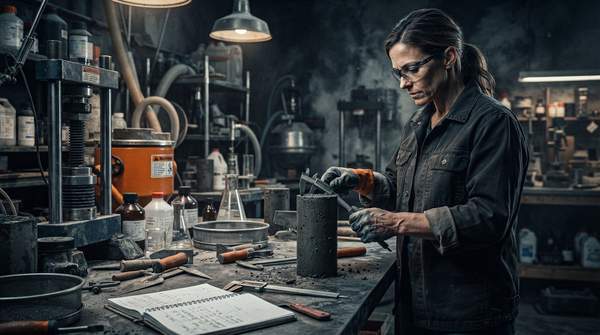
Concrete specimens must be molded and cured according to ASTM C31 standards when concrete strength is used as a basis for acceptance, according to sicerts. This adherence ensures consistency in testing and performance evaluations. For concrete design strength of 6,000 psi or greater, the initial curing temperature must range from 68-78 degrees F, sicerts specifies. This precise temperature control is vital for proper hydration and strength development in high-performance mixes.
Adhering strictly to these established standards is foundational for achieving reliable concrete performance, even with conventional methods. However, the discrepancy between the proven superior performance of advanced curing methods and the continued adherence to traditional ASTM standards for concrete acceptance, as shown by pmc and sicerts, creates a critical lag in industry regulation. This lag could be compromising the long-term resilience of new infrastructure.

Based on pmc's findings that carbonation-cured concrete achieves over 10% higher compressive strength and superior durability, construction projects that continue to rely solely on traditional moisture curing are demonstrably choosing a lower-performing material. This choice risks premature degradation and higher maintenance costs.

The High Cost of Inadequate Curing

Inadequate curing directly leads to increased permeability in the near-surface area of concrete, as reported by pmc. This increased permeability allows harmful substances, like chlorides, to penetrate deeper into the concrete, accelerating deterioration. Temperatures above 90 °C may also lead to microstructural damage and strength reduction in Geopolymer Concrete (GPC), according to Nature.

Failing to implement correct curing practices can severely undermine the structural integrity and durability of concrete. This can lead to costly failures and reduced service life. The optimal curing environments for advanced concrete types are fundamentally different from traditional methods, and applying conventional wisdom could be detrimental to advanced materials.

Optimizing Geopolymer Concrete for Peak Performance

Replacing fly ash with Ground Granulated Blast-furnace Slag (GGBFS) can shorten curing time and increase the compressive strength of ambient-cured GPC, Nature indicates. This strategic material substitution offers not only superior material properties but also significant project efficiency gains over traditional approaches. The ratio of sodium silicate (Na₂SiO₃) to sodium hydroxide (NaOH) also significantly influences GPC strength, with an optimum Na₂SiO₃/NaOH ratio generally reported between 2.0–2.5, according to Nature.

Achieving the full benefits of advanced concrete, like GPC, demands a level of material science precision that far exceeds the general requirements of traditional moisture curing. This suggests a higher barrier to entry for superior performance, requiring optimal Na₂SiO₃/NaOH ratios and strict temperature limits. Strategic material choices and precise chemical ratios are crucial for unlocking the full potential of GPC, offering pathways to faster and stronger concrete.

The precise material science required for optimized geopolymer concrete, including specific Na₂SiO₃/NaOH ratios and controlled temperatures as highlighted by Nature, suggests that companies failing to invest in specialized expertise and processes are forfeiting both superior material properties and the potential for accelerated project timelines.

Your Curing Questions Answered

What are the most common concrete curing methods?

Common methods include continuous water curing, fogging, and ponding, which directly maintain surface moisture. Another prevalent method involves applying a liquid membrane-forming compound to the concrete surface, creating a seal that prevents evaporation and retains internal moisture.

How long does concrete need to cure for maximum strength?

While initial strength develops quickly, concrete typically requires a minimum of 7 days of continuous moist curing to achieve about 70% of its specified compressive strength. Full design strength can take 28 days or even longer, depending on the specific mix design and ambient environmental conditions.

What is the difference between wet curing and membrane curing?

Wet curing methods, such as ponding or using wet coverings, directly supply water to the concrete surface, ensuring continuous hydration of the cement. Membrane curing involves applying a liquid compound that forms an impermeable film, sealing in the concrete's internal moisture to prevent evaporation without adding external water.

Building for the Future: The Imperative of Smart Curing

Understanding the nuances of different curing methods is key to making informed decisions for any construction project. The construction industry must recognize that relying solely on traditional moisture curing often compromises long-term infrastructure durability and strength. Superior, albeit more technically demanding, advanced methods like carbonation curing are readily available and demonstrate significant advantages.

Investing in superior curing practices is not just about meeting specifications; it is about constructing resilient, long-lasting infrastructure for generations to come. The discrepancy between the proven superior performance of advanced curing methods and the continued adherence to traditional ASTM standards for concrete acceptance creates a critical lag in industry regulation that could be compromising the long-term resilience of new infrastructure.

By the end of 2026, major infrastructure developers like Bechtel could see significant project cost reductions and extended service life by integrating carbonation curing into at least 25% of their new concrete structures. This shift could lead to a demonstrable increase in overall infrastructure durability.