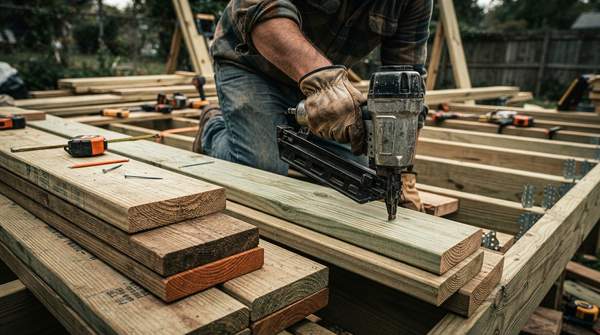
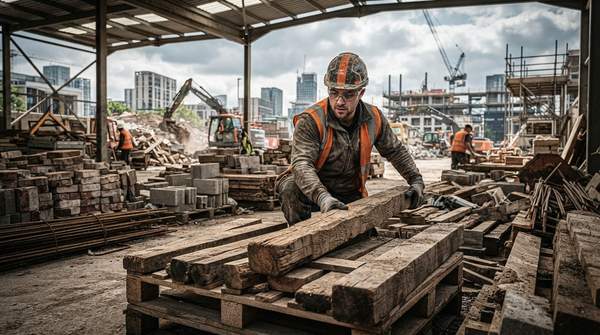
Every year, the global construction industry alone secures its structures with fasteners worth billions. Yet, the fastest-growing demand isn't for a common nail, but for highly specialized components in factories and advanced machinery. This pervasive market, underpinning nearly every physical structure and product—an average home contains thousands of fasteners—often obscures nuanced shifts.
While construction remains the largest market for fasteners, the industrial segment is experiencing the fastest growth, according to Marketresearchfuture. Fastener manufacturers focused solely on construction volume risk being outmaneuvered by agile competitors specializing in high-growth industrial applications. Professionals failing to adapt to this increasing specialization and rapid evolution within the industrial fastener market will fall behind in efficiency and technological advancement.
What Exactly is a Fastener?
A fastener is a mechanical device that joins two or more objects, creating permanent or temporary connections. These components are essential for non-permanent joints, allowing disassembly for maintenance or replacement—a critical feature in many applications.
Common types include screws, bolts, nuts, rivets, washers, anchors, and clips. Each serves distinct purposes. Manufacturers select materials like steel, stainless steel, brass, aluminum, or nylon based on required strength, corrosion resistance, or weight. Their universal application, from aerospace to consumer electronics, means fasteners are the unseen components enabling the assembly and integrity of virtually all manufactured goods and structures. Ignoring their specific engineering means risking structural integrity and operational efficiency.
Beyond the Basics: A Look at Fastener Types and Applications
Threaded fasteners—screws and bolts—use helical ridges for secure, adjustable, and removable connections. Non-threaded fasteners, like rivets and pins, typically form permanent joints. Specialized coatings, such as zinc plating or hot-dip galvanizing, enhance performance with corrosion resistance or improved grip.
Proper torque specifications are crucial; incorrect torque causes loosening, over-tightening, or material failure. Innovations like self-drilling screws and structural blind rivets streamline assembly by reducing pre-drilling or dual-side access. The sheer diversity and engineering behind fasteners prove that selection is a precise science, directly impacting project safety and longevity.
The Economic Engine: Why Fasteners Drive Global Industries
Fastener choice hinges on material compatibility, load capacity, environmental conditions, and desired permanence. Improper selection or installation leads to catastrophic structural failure, costly repairs, and safety hazards. Innovation in fastener technology—new materials, load-specific designs, or easier installation—directly impacts project efficiency and cost. The integrity of any structure, from a skyscraper to a piece of furniture, relies on fastener quality and correct application. Fastener failures cause significant economic losses and even loss of life, underscoring the necessity for stringent quality control and material science expertise. Therefore, treating fasteners as mere commodities, rather than critical engineering components, invites severe financial and safety repercussions.
Common Questions About Fasteners
What is the key difference between a bolt and a screw?
Bolts typically use a nut for fastening, distributing load over a larger area. Screws thread directly into a material. Bolts are often preferred for through-hole applications requiring higher clamping force or when joining two unthreaded components.
When is it advisable to use stainless steel fasteners?
Stainless steel, particularly 304 and 316 grades, offers excellent corrosion resistance in wet or outdoor environments, making it ideal for marine or chemical applications. However, it generally has lower tensile strength than hardened carbon steel and can be susceptible to galling without proper lubrication.
What does 'tensile strength' mean for a fastener?
Tensile strength measures a fastener's resistance to breaking under tension, or pulling apart. For example, a Grade 8 bolt has a minimum tensile strength of 150,000 psi, making it suitable for heavy-duty automotive or machinery applications where high stress is expected.
By 2028, manufacturers like FastenTech Solutions, which invest in specialized industrial fastener R&D, will likely see significant market share gains over generalist suppliers.