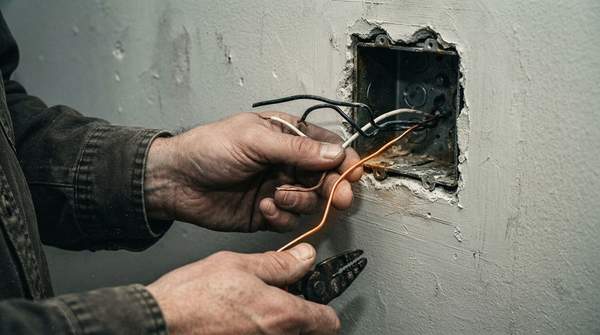
Home electrical fires account for an estimated 51,000 incidents each year, resulting in nearly 500 deaths, more than 1,400 injuries, and $1.3 billion in property damage. This poses a critical threat to safety and financial stability.
Despite this significant toll, the National Electrical Code (NEC) undergoes meticulous revisions every three years to enhance electrical safety standards. However, home electrical fires persist at alarming rates. This suggests the issue lies not in the code's evolution, but in its implementation or compliance. A persistent gap in awareness and strict adherence to these evolving safety standards likely means preventable electrical hazards will continue to pose a significant risk.
Arcing faults start over 28,000 home fires annually in the United States, causing hundreds of deaths and injuries, and exceeding $700 million in property damage, according to the Electrical Safety Foundation International (ESFI). Electrical hazards are a critical, often overlooked, threat to home safety.
Beyond arcing, electrical receptacles are involved in 5,300 fires every year. Forty deaths and over 100 consumer injuries annually result from these incidents. Preventable electrical issues have widespread impact.
The National Electrical Code: Your Evolving Safety Guide
The National Electrical Code (NEC) is revised every three years to address persistent electrical hazards, as confirmed by Cve. This foundational document sets U.S. electrical safety standards. Its rigorous update process, exemplified by 3,745 code change proposals and 1,625 public comments reviewed in 2014 (ESFI), integrates new technologies and addresses emerging risks. This continuous evolution means professionals must stay current to ensure compliance.
Key Code Requirements for DIYers and Tradespeople
Understanding specific NEC guidelines prevents electrical fires. For instance, all 125-volt, single-phase, 15- and 20-ampere receptacles in bathrooms or on rooftops must have ground-fault circuit-interrupter (GFCI) protection, as outlined by OSHA. This prevents severe electrical shocks in wet environments.
Furthermore, receptacles on 15- and 20-ampere branch circuits must be grounding type, with limited exceptions. OSHA also mandates no grounded conductor may attach to any terminal or lead in a way that reverses its designated polarity. Proper electrical work demands precise adherence to these specific code provisions, not just general knowledge, to ensure safety.
Specific Safeguards: From Conductors to Costs
Beyond GFCI and grounding, other detailed safety measures offer significant protection. A conductor used as a grounded conductor must be identifiable and distinguishable from all other conductors, according to OSHA. This prevents dangerous misconnections.
The financial argument for proactive safety is compelling. The increased cost per average new home for Tamper-Resistant Receptacles (TRRs) is less than $50, notes ESFI. The minimal investment contrasts sharply with the $1.3 billion in annual property damage from electrical fires. Even minor details like conductor identification and affordable safety devices like TRRs offer significant protection for negligible cost.
The Human Factor: Preventing Mistakes and Their Consequences
Despite clear code requirements and affordable safety solutions, human error remains a primary driver of electrical incidents. Installing the wrong breaker, misjudging amperage, or using undersized wires creates conditions ripe for electrical fires, as highlighted by electricalexperts. Such mistakes often result from a lack of proper training or disregard for established safety protocols. Many preventable electrical fires stem from a systemic failure to adhere to foundational safety protocols, not unforeseen hazards.
Beyond Wiring: Essential Home Fire Safety
While strict adherence to the NEC is paramount for preventing electrical fires, a comprehensive approach to home safety must also include functional smoke detectors. Sixty-five percent of home fire deaths result from fires in homes with no working smoke detectors, according to ESFI. Smoke detectors are critical for alerting residents to a fire, regardless of its origin, allowing timely evacuation.
If current enforcement and public awareness efforts do not improve, preventable electrical hazards will likely continue to pose a significant risk to lives and property in the coming years.