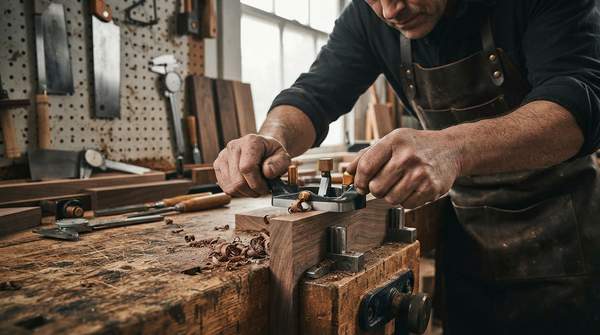
In any modern workshop, the choice between hand tools and power tools is not a simple binary but a strategic decision based on the project's specific demands. While power tools offer undeniable speed and repeatability for dimensioning lumber and making rough cuts, achieving the highest level of craftsmanship often requires the tactile feedback and fine control that only hand tools can provide. For tasks involving detailed joinery, intricate shaping, and flawless finishing, a curated set of precision hand tools is indispensable, allowing a woodworker to achieve a degree of refinement that machines alone cannot produce.
The Enduring Value of Precision Hand Tools
Opting for a hand tool over a machine is often a choice for greater control and a more direct connection with the material. Woodworker Keaton Beyer describes using power tools as managing interns that require "extreme supervision," whereas hand tools foster a feeling of being more in touch with the work itself. This advantage is most apparent in fine tasks, where hand tools can make cuts in places that would be impractical, impossible, or dangerous to reach with power tools. The ability to trim a board to a perfect fit or cut a dowel precisely flush are common examples where hand power prevails.
This level of control, however, comes with trade-offs. Hand tools are inherently slower, a factor that may be a benefit for hobbyists who enjoy the deliberate pace and fulfillment of the process. For those who need to produce products on a schedule, supplementing with power tools is a practical necessity. Furthermore, hand tools demand a significant investment in skill. As Beyer notes, a woodworker must be dedicated to learning the craft and diligent in practicing to achieve consistent results, as cutting a perfectly straight line with a handsaw is a developed technique. Despite the learning curve, the precision and safety offered by hand tools for detailed work make them an essential part of a complete woodworking toolkit.
Precision Hand Tool Selection Guide
To help woodworkers match the right tool to the job, this guide categorizes a selection of specialized hand tools by their optimal use in precision tasks. The following table explains where each tool excels, allowing you to make an informed choice for fine-tuning joinery, shaping complex curves, or ensuring perfect measurements. Understanding these specific applications is key to moving beyond general-purpose tools and selecting the ideal instrument for achieving a higher level of detail and accuracy in your work.
| Tool | Primary Precision Application | Why It Excels |
|---|---|---|
| Router Plane | Ideal for precise joinery clean-up, creating recesses for inlays and hardware, and intricate material removal. | It combines accuracy with finesse, allowing for the fine-tuning of joinery depths long after the initial cuts have been made by machine or hand. |
| Japanese Saw | Used for making precise cross-cuts and rip-cuts with exceptionally thin blades. | The thin blades feature dual-edge teeth and cut on both the push and pull strokes, offering greater control and producing a narrower kerf for faster, more precise cuts. |
| Coping or Fret Saw | Essential for cutting curves, openwork patterns, and other intricate shapes. | With a U-shaped frame and a fine-toothed, replaceable blade, these saws are specifically designed for navigating non-straight lines where other saws are unsuitable. |
| Dial Caliper | Used for precision measurement and setting up machines like router bits and tablesaw blades. | It offers highly accurate readings in fine increments, such as 1/100 of an inch, eliminating guesswork when verifying material thickness or setting tool heights. |
| Layout Tools (e.g., Combination Square) | Form the foundation for all accurate work by helping create precise measurements and marks. | These tools serve as crucial references for squareness and flatness, ensuring accuracy before any cutting or shaping begins. |