Lowe's is pouring $250 million into training 250,000 skilled tradespeople over the next decade, a significant investment in human capital. This commitment comes even as the company recently cut 600 corporate jobs and observed rising customer experience metrics driven by AI assistants in its stores. Lowe's dual approach highlights a strategic pivot in how a major retailer views its workforce and operational efficiency for the coming years.
This creates a tension: Lowe's is making a massive investment in human skilled trades, but it is also streamlining its corporate workforce and boosting efficiency with AI. The simultaneous investment in human expertise and automation indicates a careful re-evaluation of where value is created within the organization.
The evidence suggests that companies are not simply replacing humans with AI, but rather strategically re-evaluating where human expertise is most critical and investing in those specific, often hands-on, technical roles. The re-prioritization of human capital, particularly in skilled trades, represents a calculated move to secure future growth by addressing critical labor bottlenecks.
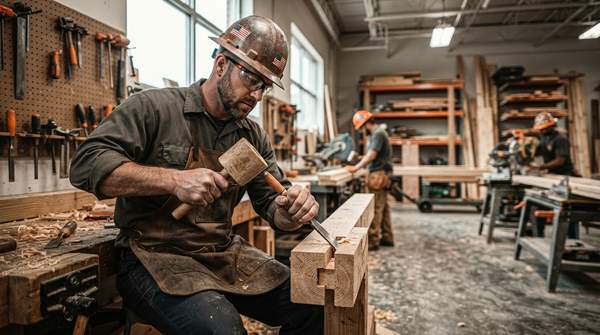
Lowe's is investing $250 million over the next decade to train 250,000 workers in skilled trades, according to Black Enterprise and MoneyWise. Lowe's $250 million financial commitment signals the company's conviction in the enduring value of human craftsmanship, even in an increasingly automated world. The initiative targets essential professions such as carpentry, electrical work, and plumbing, according to The Christian Science Monitor. These are fields where hands-on expertise remains irreplaceable by current artificial intelligence technologies.
Lowe's strategic investment positions the company to address a growing demand for specialized physical services. The company's focus on cultivating a robust, hands-on workforce indicates a belief that future retail success lies in meeting this demand, rather than solely expanding white-collar overhead. Lowe's commitment highlights a calculated resource allocation aimed at securing future revenue streams by ensuring a pipeline of qualified professionals for home improvement projects.

The Strategic Logic: AI-Driven Efficiency Meets Human Expertise
Lowe's has already invested over $50 million since 2023 in partnership with nonprofit and community college training programs, according to MoneyWise. Lowe's prior investment of over $50 million since 2023 underscores a sustained effort to build a skilled workforce. Concurrently, Lowe's is employing artificial intelligence to enhance sales, improve customer shopping experiences, and increase workspace productivity, according to The Times of India.
Customer experience metrics are up in the 2% range in stores where workers are using Mylow AI assistant, according to customerexperiencedive. The 2% rise in customer experience metrics suggests that AI can drive tangible business improvements and customer satisfaction by streamlining transactional interactions. By optimizing corporate functions and customer service through AI, Lowe's appears to free up capital and focus, allowing for greater investment in the human element of skilled trades.
Lowe's dual strategy demonstrates that AI can augment, rather than simply replace, human capabilities. The AI tools handle routine tasks, allowing human employees to concentrate on more complex interactions and specialized services. Lowe's approach builds a human workforce capable of executing the projects AI helps facilitate, creating a symbiotic relationship between technology and human expertise.
The Cost of Efficiency: Corporate Cuts and Redefined Roles
Lowe's cut 600 corporate and support roles earlier this month, according to customerexperiencedive. The reduction of 600 corporate and support roles occurred despite positive financial performance, with Lowe's comparable sales rising 1.3% year over year in the fourth quarter of 2025. Net sales for the same period grew 10.9% to nearly $20.6 billion, according to customerexperiencedive.
The simultaneous rise in sales and corporate job cuts suggests that AI-driven productivity gains are enabling the streamlining of certain administrative and support functions. The simultaneous rise in sales and corporate job cuts indicates a strategic reallocation of human capital, where roles susceptible to automation are reduced, while investment flows into areas requiring hands-on human skill. The company is prioritizing efficiency in its corporate structure to fund other critical areas.
Lowe's strategic shedding of 600 corporate roles, while simultaneously pouring $250 million into skilled trades, signals a clear corporate conviction that the future of retail success lies not in expanding white-collar overhead, but in cultivating a robust, hands-on workforce capable of meeting the rising demand for specialized physical services. Lowe's strategic shedding of 600 corporate roles redefines the value proposition of different types of labor within the company, favoring specialized technical skills over general administrative functions.
Beyond Traditional Trades: The Demand for Tech-Augmented Skills
Lowe's foundation will invest $250 million over the next 10 years to train workers in skilled trades like plumbing, carpentry, and electrical, according to MoneyWise.com. While these are traditional trades, the broader market shows a rising demand for skills that integrate with modern technology. Demand for robotics technicians has increased 107% since late 2022, according to ulanetwork. The 107% increase in demand for robotics technicians indicates a growing need for professionals who can install, maintain, and repair automated systems.
Similarly, demand for HVAC engineers has risen 67%, according to ulanetwork. Modern HVAC systems often incorporate smart technology and complex digital controls, requiring specialized expertise beyond conventional mechanical skills. The rising demand for robotics technicians and HVAC engineers suggests that the future of skilled trades lies in areas that can integrate with and maintain increasingly complex, smart home and industrial systems, rather than purely manual labor.
The rising demand for tech-augmented skills shows that the investment in skilled trades is not merely about filling a labor gap in existing professions. It is a proactive move to secure future revenue streams by addressing the growing demand for specialized, hands-on technical skills that AI cannot replicate. Tradespeople who adapt to evolving technological demands, such as those involving smart home installations or industrial automation, stand to benefit most from this shift.
The Future of Work: A Hybrid Human-AI Ecosystem
The reported 2% rise in customer experience metrics in stores utilizing Mylow AI assistant, coupled with the significant investment in human trades, suggests that companies can leverage AI to streamline transactional interactions, thereby freeing up resources to double down on the complex, human-centric services that truly differentiate and drive long-term value. Lowe's dual strategy signals a future where businesses will increasingly rely on a hybrid ecosystem, where AI handles data-intensive and repetitive tasks, while highly skilled humans perform complex, hands-on, and customer-facing work that requires nuanced judgment and adaptability.
The hybrid human-AI ecosystem model prioritizes human expertise where it is most critical, such as in intricate installations, custom projects, or problem-solving that requires physical presence and creative solutions. AI's role becomes one of optimization and support, allowing human professionals to operate more efficiently and focus on higher-value tasks. Lowe's investment in skilled trades therefore represents a bet on the enduring necessity of human interaction with complex physical systems.
By 2025, companies like Lowe's will continue to refine this hybrid approach, demonstrating how technology can enhance, rather than entirely supersede, human labor in specialized fields. The strategic re-prioritization of human capital in skilled trades, funded in part by AI-driven corporate efficiencies, will likely shape workforce development well into the next decade.