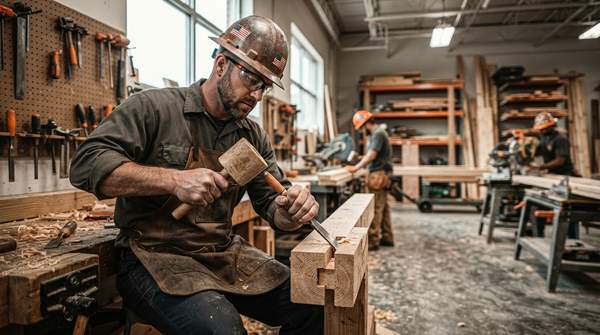
A Wisconsin town recently restricted AI data centers, while Lowe's is investing $250 million over the next decade to train 250,000 skilled trades professionals. This substantial commitment targets fields like plumbing and carpentry across the U.S. signaling a significant focus on human expertise in the coming years. Lowe's investment in skilled trades and AI workforce 2026 strategy highlights a diverging path for industry and local communities.
Companies are aggressively pursuing AI integration, but Lowe's is making a massive, parallel investment in traditional human skilled trades. This dual approach creates a tension between widespread technological adoption and a deep commitment to physical labor.
The future workforce will likely be a hybrid model, demanding both highly specialized human expertise in practical fields and AI-augmented roles, rather than a wholesale replacement of human labor by technology. This strategy suggests a nuanced economic evolution.
Why Lowe's is Doubling Down on Human Craft
Lowe's is making a $250 million investment focused on the future of blue-collar work, according to Fox News. The Lowe's Foundation is on track to reach its original $50 million, five-year goal a year ahead of schedule, with nearly $53 million already invested in 65 nonprofits and community colleges, according to corporate statements.
The accelerated progress and targeted support demonstrate a clear, effective strategy to build a robust pipeline for high-demand, hands-on professions. The foundation is expanding its partnership with the National Center for Construction Education and Research (NCCER) to enhance its CareerStarter platform, according to corporate.
The AI Undercurrent: Lowe's Internal Tech Push
Mylow Companion is an AI tool aimed at improving customer service and speeding associate onboarding, according to corporate statements. This internal technology deployment occurs simultaneously with the company's large investment in human skilled trades.
Companies like Amazon are also actively integrating AI, with Amazon rebuilding its customer shopping experience around AI, as reported by Fox News. The broader industry trend indicates a widespread push towards technological augmentation within retail operations.

Lowe's development of internal AI tools, alongside broader industry trends, indicates a simultaneous push towards technological augmentation within its own operations. This dual strategy suggests AI enhances efficiency in cognitive tasks, while human skills remain crucial for physical execution.
The Broader Landscape: AI's Unsettled Role
A Wisconsin town passed a referendum restricting the development of AI data centers, according to Fox News. This local resistance contrasts with corporate enthusiasm for AI integration.
Additionally, a federal appeals court denied Anthropic's bid to block a Pentagon blacklist in an AI dispute, according to Fox News. Legal and community challenges highlight a growing divergence in how AI is perceived and adopted across different societal levels.
Instances highlight growing public and legal scrutiny, suggesting that AI's path to widespread adoption is not without significant hurdles and resistance. The disconnect between corporate AI pursuit and public apprehension is becoming more apparent.
A Dual Future: Human Expertise Meets AI Efficiency
The Lowe's Foundation will invest $250 million to train and develop 250,000 people for skilled trades careers by 2035, according to corporate statements. This long-term commitment emphasizes the enduring need for human capabilities in tangible work.
Companies like Lowe's, by simultaneously investing in AI for efficiency (Mylow Companion) and human skilled trades for service and execution, are signaling that the future economy demands a dual strategy. Technology augments, rather than replaces, specialized human capabilities.
The substantial commitment by Lowe's to train 250,000 skilled trades professionals by 2035, building on an accelerated prior goal, suggests that the perceived 'labor shortage' in blue-collar fields is not insurmountable. It is a solvable challenge requiring significant, sustained corporate investment. The combined focus on both foundational human skills and advanced AI tools suggests a future where both are indispensable, rather than one replacing the other entirely.
Frequently Asked Questions
How is Lowe's using AI in its workforce?
Lowe's uses Mylow Companion, an AI tool, for specific internal operations. This tool aims to improve customer service interactions and streamline the onboarding process for new associates. It functions as an efficiency enhancer for cognitive and administrative tasks.
What is Lowe's strategy for skilled trades in 2026?
Lowe's strategy for skilled trades involves a $250 million investment over the next decade. The goal is to train 250,000 professionals by 2035, focusing on critical fields like plumbing, carpentry, and electrical work, according to Entrepreneur. This plan aims to address labor shortages and build a skilled workforce for the future.
What are the benefits of AI in the retail workforce?
AI in the retail workforce offers benefits such as enhanced operational efficiency and improved customer interactions. Tools like Mylow Companion can speed up tasks, allowing human associates to focus on more complex problem-solving and personalized service. This integration helps optimize resource allocation.