The advanced vehicle diagnostics and remote services market is predicted to increase to USD 24.28 billion by 2035, according to Precedence Research. This growth fundamentally transforms how vehicles are maintained and repaired, emphasizing proactive, data-driven solutions. The shift impacts fleet management and individual vehicle owners, establishing new standards for efficiency and operational uptime.
However, an inherent tension exists: while vehicle systems continue to grow in complexity, advanced diagnostic tools are simultaneously simplifying and accelerating the identification and resolution of issues. This paradox challenges traditional repair methodologies, pushing the automotive service sector towards a more automated and predictive future.
Companies that integrate advanced diagnostics and predictive maintenance will gain a significant competitive edge through superior uptime and operational efficiency, while those that do not will face increasing costs and disruptions. This operational divide will redefine success in the automotive services industry over the next decade.
Understanding the Diagnostic Revolution
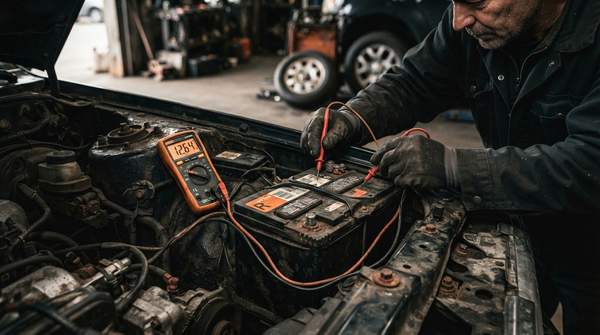
Advanced diagnostic tools can identify problems in minutes rather than hours, according to Spectrum Auto Inc. This rapid identification capability transforms traditional troubleshooting workflows, allowing technicians to move quickly from symptom to solution. At its core, these tools, particularly OBD2 scanners, connect to a vehicle’s onboard computer system to retrieve error codes, providing immediate insight into potential malfunctions.
For example, an error code like P20EE helps mechanics quickly identify specific problems and expedite repairs, according to EdTech Innovation Hub. This functionality reduces the need for extensive manual inspection, allowing shops to process more vehicles efficiently. Vehicle designs are also evolving to complement these diagnostic capabilities, as seen with the Cummins 2027 X15 diesel engine.
The Cummins 2027 X15 diesel engine, engineered to meet EPA 2027 requirements, features a simplified exhaust aftertreatment system and cartridge-style filters for maintenance, according to Heavy Duty Trucking. This design simplifies physical maintenance tasks, even as the overall system for managing vehicle health becomes more technologically sophisticated and data-dependent. This means that while physical repairs might become less complex, the digital complexity of diagnostics and system management is increasing, shifting the technician's focus.
The Future: Predictive, Remote, and Integrated Maintenance
Clarios Connected Services utilizes real-time battery data and artificial intelligence to assist fleets in managing battery performance and reducing idling. This system monitors battery condition and provides notifications when replacement is needed, according to Heavy Duty Trucking. Such capabilities move beyond simple error code retrieval to offer proactive, condition-based maintenance, optimizing operational readiness.
Another significant advancement is the integration of Continental’s ContiConnect digital tire monitoring system with Samsara’s fleet management platform. This allows users to view tire and trailer health information within a single interface, enabling real-time fault identification and proactive maintenance scheduling, according to Heavy Duty Trucking. This convergence of data streams simplifies operational oversight and prevents minor issues from escalating into major failures.
Hyundai Translead’s LinkVue trailer camera system further exemplifies this trend by supporting third-party integrations, providing 360-degree visibility to reduce blind spots and improve maneuvering. The data generated by this system can be incorporated into broader operational platforms, according to Heavy Duty Trucking. The true power of advanced diagnostics lies in integrating diverse data streams to anticipate failures, optimize operations, and prevent costly downtime through intelligent, connected systems, fundamentally reshaping how vehicle health is managed.
The Shifting Role of the Automotive Technician
As diagnostic tools become more sophisticated, the role of the automotive technician is undergoing a significant transformation. Traditional mechanical diagnosis, which once required extensive experience in interpreting subtle symptoms and understanding complex system interactions, is increasingly being abstracted by AI-powered systems. These advanced tools present technicians with clear, data-driven recommendations, often pinpointing the exact component requiring replacement.
This shift means technicians spend less time on deep, analytical troubleshooting and more time interpreting tool outputs and executing prescribed fixes. For example, while Spectrum Auto Inc. highlights that technicians can show customers actual error codes and their meanings, systems like Clarios Connected Services describe AI-driven monitoring that notifies for replacement without necessarily revealing the underlying AI logic, according to Heavy Duty Trucking. This divergence creates a challenge for transparency, as the direct link between a specific error code and a problem might be replaced by opaque, predictive recommendations.
The increasing reliance on automated diagnostics risks deskilling the diagnostic craft, moving technicians from diagnosticians to component installers. While efficiency gains are undeniable, the deeper mechanical intuition and problem-solving skills that once defined a master technician could diminish. The focus shifts from understanding how a system fails to simply knowing what the diagnostic tool indicates should be replaced.
Economic Implications for Repair Shops and Fleets
The projected USD 24.28 billion market for advanced diagnostics by 2035 signals that the future of vehicle maintenance isn't about fixing what's broken, but about preventing it from breaking at all. This fundamental reshaping of the economic viability of traditional repair shops favors those adopting predictive technologies. Fleet operators, commercial vehicle owners, and early-adopting repair shops are the primary beneficiaries of this shift, experiencing reduced downtime and optimized performance.
Companies that cling to reactive maintenance models are not just losing money on downtime, but are actively ceding market share to competitors leveraging AI-driven predictive insights. The economic value of predictive maintenance, driven by connected car data from systems like Clarios Connected Services and Continental ContiConnect, extends beyond mere efficiency gains. It fundamentally shifts revenue from reactive repair services to proactive, data-driven subscriptions and service agreements.
Traditional repair shops reliant solely on manual inspection methods and vehicle owners unaware of these advancements risk significant inefficiencies and higher long-term operational costs. Without the ability to anticipate failures, these entities face unexpected breakdowns, higher repair expenses, and longer vehicle downtimes. This creates a clear competitive disadvantage in a market increasingly defined by uptime and predictive capabilities.
What are the most advanced car diagnostic tools available in 2026?
The most advanced car diagnostic tools in 2026 integrate AI, real-time data streaming, and predictive analytics. These systems often feature cloud connectivity for remote diagnostics and over-the-air updates. Such tools move beyond simple code readers, offering comprehensive vehicle health reports and even suggesting specific repair procedures based on collected data, dramatically reducing diagnostic time for complex issues.
How do advanced diagnostic tools help with car maintenance?
Advanced diagnostic tools significantly enhance car maintenance by enabling predictive maintenance strategies. They monitor vehicle components in real-time, detect anomalies before they lead to failures, and provide alerts for proactive servicing. This approach minimizes unexpected breakdowns, extends component lifespan, and optimizes maintenance schedules, leading to reduced operational costs and increased vehicle uptime for fleets and individual owners.
What features should I look for in an advanced automotive scanner?
When selecting an advanced automotive scanner, prioritize features such as multi-brand compatibility, comprehensive system coverage (engine, transmission, ABS, airbags, etc.), and bi-directional control capabilities for actuating components. Look for cloud-based data storage, remote diagnostic access, and integration with repair databases. The ability to perform coding and programming functions for modules is also a valuable feature for modern vehicles.
If current trends persist, the automotive service industry will likely see a complete redefinition of maintenance, driven by integrated, predictive diagnostics that prioritize uptime and data-informed decision-making.