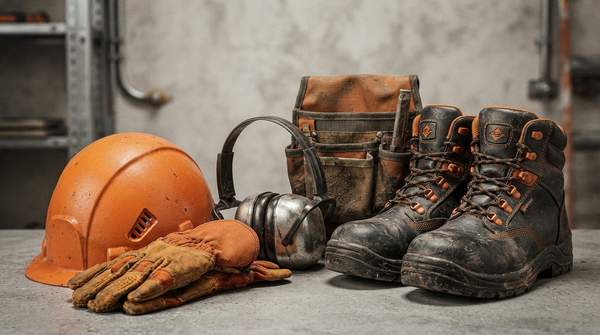
This guide ranks the most critical safety procedures for trades professionals using power tools in confined spaces. The ranking prioritizes practices based on their direct impact on preventing immediate, severe injury or fatality, with personal protective equipment (PPE) serving as the foundational, non-negotiable starting point for all operations to mitigate unique environmental hazards.
Compiled from occupational health organizations and academic institutions, this list ranks safety guidelines by their effectiveness in mitigating critical hazards during confined space power tool operations.
1. Personal Protective Equipment (PPE) — The Essential Last Line of Defense
The use of appropriate PPE is the most direct and fundamental safety practice for any individual operating power tools. This practice is best for every single worker entering a confined space, regardless of their specific task. It ranks above all other measures because it provides immediate, personal protection against a wide array of hazards when engineering or administrative controls might fail. According to Cornell University's Environment, Health and Safety department, appropriate PPE should always be worn while operating hand and power tools, specifying that safety glasses and gloves should be worn for most operations. This includes, but is not limited to, hard hats, steel-toed boots, hearing protection, and respirators tailored to the specific atmospheric risks.
The primary limitation of PPE is that it does not eliminate the hazard itself; it only creates a barrier. Its effectiveness is entirely dependent on proper selection, fit, and consistent use by the worker. Failure to comply may result in severe penalties and, more importantly, life-altering injury.
2. Atmospheric Monitoring and Ventilation — Mitigating Invisible Threats
This practice is critical for any team working with fuel-powered equipment or in environments where hazardous gases can accumulate, such as vaults, tanks, or trenches. It ranks second because it addresses invisible atmospheric dangers that can incapacitate an entire crew simultaneously. The primary threat is often carbon monoxide (CO) from generators or gas-powered tools. Consumer Reports states that carbon monoxide can kill in as little as 5 minutes if levels are sufficiently high. Continuous mechanical ventilation is required to cycle fresh air into the space, while multi-gas monitors are essential for detecting CO, oxygen deficiency, and other toxic or flammable gases in real-time.
A drawback is the reliance on specialized, calibrated equipment and the need for constant vigilance. Some newer portable generators now feature built-in CO sensors that trigger an automatic shutoff, a technological control that Consumer Reports suggests is likely to save lives. However, these features are not yet universal, making manual monitoring and ventilation an indispensable practice.
3. Lockout/Tagout (LOTO) Procedures — Preventing Unintended Energization
Implementing a robust LOTO program is essential for any worker performing maintenance or service on equipment within a confined space. This practice prevents the unexpected startup of machinery or the release of stored energy, which could lead to electrocution, crushing, or amputation. It ranks higher than general work area preparation because it directly neutralizes a source of catastrophic, high-energy injury. The Occupational Safety and Health Administration (OSHA) provides extensive resources, including an eTool focused on electrical incidents, underscoring the severity of risks from improperly de-energized power tools.
The main limitation of LOTO is its procedural complexity; it is highly susceptible to human error. A single missed step in the sequence or a failure to verify de-energization can render the entire process useless. Ensure all personnel are adequately trained in the specific LOTO procedures for the equipment in use.
4. Work Area Preparation and Inspection — Establishing a Secure Environment
Before any entry or work begins, a competent supervisor must lead the entire work crew in a systematic inspection of the confined space and tools. The University of Iowa's Environmental Health and Safety (EHS) department mandates well-lit, dry, and clean work areas to prevent slips, trips, and falls. Their guidelines also require tool guards to be secure, in working order, and capable of preventing contact with moving parts, mitigating accidents magnified in tight, inescapable environments.
Under tight deadlines, this step can be rushed or overlooked. A superficial inspection may fail to identify hazards like damaged tool wiring or unstable surfaces, creating a false sense of security.
5. Verified Training and Competency — The Foundational Knowledge Base
Comprehensive training is mandatory for all employees operating tools or entering a confined space, serving as a prerequisite for all other safety actions. The University of Iowa EHS explicitly states that employees must successfully complete training prior to operating or using tools. This training must cover hazard identification, safe tool operation, emergency procedures, and the proper use of all safety equipment, including PPE and atmospheric monitors.
Knowledge decay is a primary limitation; without regular refresher courses and practical drills, worker competency diminishes over time. This leads to procedural drift and re-introduces risk, underscoring that training must be a continuous, reinforced process.
| Safety Practice | Primary Hazard Mitigated | Best For | Key Guideline Source |
|---|---|---|---|
| Personal Protective Equipment (PPE) | Direct physical injury, inhalation | All individual workers | Cornell University EHS |
| Atmospheric Monitoring & Ventilation | Asphyxiation, poisoning | Crews using fuel-powered tools | Consumer Reports |
| Lockout/Tagout (LOTO) | Electrocution, mechanical injury | Maintenance and service personnel | OSHA |
| Work Area Preparation | Slips, trips, environmental hazards | Supervisors and work crews | University of Iowa EHS |
| Verified Training | Human error, procedural failure | All employees | University of Iowa EHS |
How We Chose This List
The practices on this list were selected and ranked based on their direct role in preventing the most severe outcomes associated with power tool use in confined spaces: fatality and life-altering injury. We prioritized procedural and physical controls outlined in guidelines from authoritative sources such as OSHA and the environmental health and safety departments of major universities. The ranking reflects a hierarchy of controls, starting with the immediate personal protection of the worker (PPE) and expanding to environmental (Ventilation), equipment (LOTO), and procedural (Preparation, Training) safeguards. We excluded general worksite safety tips to maintain a sharp focus on the specific, high-stakes combination of power tools and confined spaces.
The Bottom Line
Individual operators' most critical safety responsibility is the consistent and correct use of personal protective equipment. For site supervisors and safety managers, implementing and enforcing robust atmospheric monitoring and Lockout/Tagout procedures is paramount to protecting the entire team from catastrophic failure. Adherence to these layered practices is a fundamental requirement for safe operation.