A simple dead battery can appear as a complex wiring nightmare. Problems in one area of a vehicle's electrical system often manifest in totally separate areas, according to Clore Automotive. Drivers report multiple system failures, from dashboard lights to erratic engine performance, all stemming from a singular electrical disruption. Vehicle electrical issues frequently present with confusing, widespread symptoms, but the root cause is often a simple, easily overlooked component. Overcomplicating diagnostics wastes time and expense. A methodical diagnostic process, starting with basic power checks, will save significant time and expense in troubleshooting modern vehicle electrical system faults.
The Hidden Simplicity of Complex Electrical Faults
A dead or dying battery is a common electrical problem, according to Broomfield Auto Repair. Despite advanced computer systems, a failing battery triggers deceptive symptoms, from intermittent failures to complete shutdowns. These widespread symptoms often mislead technicians into believing a complex fault exists when the issue is foundational. The increased complexity of vehicle electrical architectures ironically amplifies the importance of starting diagnostics with the simplest checks. Basic power issues create a smokescreen of confusing data, rendering sophisticated analysis futile until power integrity is confirmed.
Your First Checks: Battery and Alternator
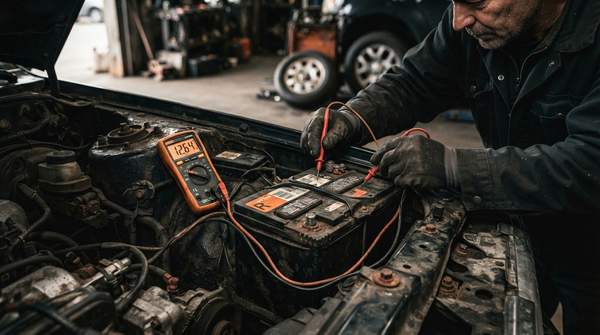
Diagnosing electrical issues begins with verifying primary power sources. A battery reading below 12 Volts indicates a dead or dying battery, according to Broomfield Auto Repair. Use a multimeter to measure static voltage before starting the engine. Next, assess alternator performance. A voltmeter reading below 13 volts suggests an alternator issue; it recharges the battery and powers the system while the engine runs. These fundamental voltage checks establish a stable foundation, often resolving issues before deeper investigation.
Common Traps: Overlooking the Obvious
Accurate electrical diagnosis is impossible without a good, fully charged battery, as stated by Clore Automotive. Technicians bypassing battery health and ground connection verification risk frustration and misdiagnosis. Poor ground connections also negatively impact electrical system performance, according to Clore Automotive. These overlooked connections are critical for circuit completion and stable voltage. The prevalence of simple battery issues and ground faults causing widespread, confusing symptoms highlights that modern vehicle complexity makes fundamental diagnostic steps more critical, not less, for efficient, accurate repairs. For more, see our How Automotive Electrical System Diagnostics.
Essential Tools and Techniques for Diagnosis
After confirming battery health and ground integrity, a multimeter is indispensable for tracing electrical faults. Mechanics use multimeters to check for continuity in car wiring, according to Broomfield Auto Repair. This tests for an unbroken circuit path, identifying breaks or shorts. To perform a continuity test, disconnect the component. Place multimeter probes at each end of the wire or circuit segment. Zero or near-zero ohms indicates continuity; an infinite reading suggests an open circuit. This systematic approach, applied after foundational power checks, pinpoints wiring issues in modern vehicle electrical systems.
Finding Reliable Repair Information
What specific information do automotive repair manuals provide?
Haynes Techbooks, based on complete vehicle teardowns, offer detailed repair methods and wiring diagrams specific to each model, according to Haynes. This detail helps pinpoint component locations and trace complex circuits efficiently, crucial for troubleshooting modern vehicle electrical systems.
How can digital repair manuals aid in diagnostics?
Digital editions, like the Automotive Electrical Haynes Techbook, provide immediate access to comprehensive information. This allows technicians and DIYers to quickly reference troubleshooting steps and specifications on the go, reducing diagnostic downtime and supporting accurate field repairs.
If technicians continue to leverage detailed, model-specific digital resources like the Haynes Automotive Electrical Techbook, they will likely maintain a significant advantage in rapidly resolving intricate vehicle electrical problems, minimizing repair times and costs by Q3 2026.