Smart safety shoes and connected work boots, which detect movements, proximity to hazards, and alert in case of falls or slips, are among the top advancements transforming jobsite protection. This ranked guide details impactful safety innovations for safety managers, site supervisors, and trades professionals. Innovations were evaluated by their direct impact on preventing common worksite incidents, data-driven capabilities, and practical applicability across various trades.
Technologies on this list were evaluated for their potential to mitigate leading causes of workplace fatalities and injuries. Criteria included real-world implementation reports and their capacity for proactive, data-driven safety management.
1. Smart Wearables — For Proactive Personal Monitoring
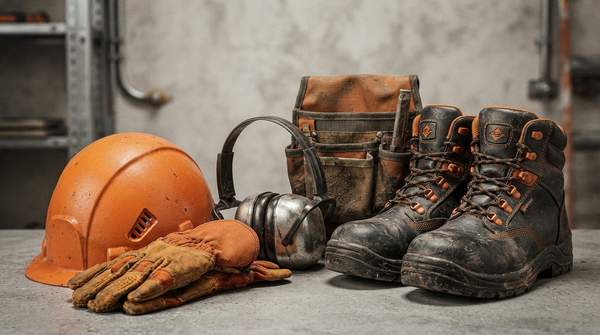
Connected footwear and helmets, as smart wearables, rank highest for providing direct, real-time data on a worker's condition and environment. These devices transform passive PPE into active safety monitoring systems, offering critical protection for trades professionals at heights, in isolation, or extreme temperatures. The technology suits organizations with large field teams or those in high-risk sectors like construction, mining, and utilities, where immediate incident response is paramount.
This category outranks others due to its focus on the individual, offering personalized alerts and biometric monitoring. According to a report from Health and Safety International, smart helmets can use sensors to detect bodily functions like heart rate and body temperature, alerting both the worker and a supervisor to potential overexertion or heat stress. Similarly, connected work boots can track a worker's movements, detect falls or slips, and identify proximity to designated hazards. This is particularly significant given the statistics highlighted by cceonlinenews.com, which reports that the U.S. Bureau of Labor Statistics recorded 1,032 fatalities in construction and extraction in a recent year, with 370 resulting from falls, slips, and trips. Adherence to safety protocols is improved when technology can provide immediate feedback and alerts. The global industrial safety footwear market, valued at approximately $11.6 billion in 2024, is projected to grow to over $26 billion by 2032, according to the same report, indicating significant industry investment in this area.
A primary limitation involves data privacy and network infrastructure. The collection of biometric and location data requires transparent policies and secure data management to protect worker privacy. Furthermore, the effectiveness of real-time alerts is contingent on reliable cellular or Wi-Fi connectivity, which can be a challenge in remote or underdeveloped jobsites.
2. Unmanned Aerial Vehicles (Drones) — For Comprehensive Hazard Identification
Site inspection drones rank second by providing a comprehensive, bird's-eye jobsite view without exposing personnel to physical risks. Ideal for project managers and safety inspectors overseeing large-scale commercial construction, infrastructure, and energy installations, drones inspect hard-to-reach or questionable areas, conduct post-incident investigations, and monitor site progress safely.
Drones rank above other site-wide monitoring systems due to their versatility and speed. A single drone flight can accomplish in minutes what might take a human inspector hours or days, such as surveying a roof, inspecting a bridge, or assessing a disaster site. According to Aware360, drones can provide insights on unstable locations and deliver materials and essential supplies, reducing the need for workers to enter potentially hazardous zones. Health and Safety International also reports that drones allow firms to scan construction sites for potential threats and identify hazards, thereby improving inspection accuracy and safety. This preventative capability is a significant step forward in proactive risk management.
The main drawback is operational complexity and regulation. Operating commercial drones requires certified pilots who are knowledgeable about airspace restrictions, which can vary significantly by location. The equipment is also susceptible to weather conditions like high winds and heavy rain, which can limit its operational window. Failure to comply with aviation regulations may result in severe penalties.
3. IoT Sensors and Site Monitoring — For Predictive Environmental Control
IoT sensors and integrated site monitoring systems provide continuous, data-driven oversight of a worksite's environment and equipment. Best for supervisors and safety officers in complex or enclosed environments like industrial plants, tunnels, and multi-story building projects, this technology addresses atmospheric hazards or equipment collisions. A network of sensors allows managers to monitor air quality to structural integrity in real time.
This innovation's strength lies in its predictive, always-on nature. While drones provide periodic snapshots, an IoT network offers a constant stream of data, enabling the detection of slow-developing issues before they become critical. Health and Safety International reports that IoT sensors can be implemented on heavy equipment to warn operators of impending collisions, diagnose machine health issues before they lead to failure, and monitor for environmental hazards like carbon monoxide or low oxygen levels. This shifts safety management from a reactive posture to a predictive one, allowing for intervention based on data trends.
The primary limitation is the initial cost and complexity of implementation. Designing and installing a comprehensive sensor network requires significant upfront investment and technical expertise. Integrating data from disparate types of sensors into a single, user-friendly dashboard can also present a considerable IT challenge. Ensure all personnel are adequately trained on the system's alerts and required responses.
4. Virtual Reality (VR) Training — For Immersive and Safe Skill Development
Virtual Reality (VR) training platforms allow workers to experience and respond to hazardous situations in a controlled, simulated environment. This technology is exceptionally well-suited for training personnel for high-consequence, low-frequency events where real-world practice is impractical or dangerous. This includes scenarios like confined-space rescues, emergency equipment operation, response to chemical spills, or working at extreme heights. It is most beneficial for training departments and safety instructors in any trade where procedural muscle memory is critical.
VR training ranks highly because it bridges the gap between theoretical knowledge and practical application without exposing trainees to actual harm. According to Aware360, VR training allows employees to experience "pseudo-hazardous situations," which improves retention and decision-making under pressure. Trainees can repeat complex procedures until mastery is achieved, an approach that is often not feasible in live training exercises due to cost and safety constraints. The ability to simulate equipment malfunctions or escalating emergencies provides a level of preparedness that classroom instruction alone cannot match.
A significant drawback is the cost and scalability. High-fidelity VR hardware and the development of custom training software can be expensive. Furthermore, while VR excels at replicating visual and auditory stimuli, it may not fully convey the physical and psychological stress of a genuine emergency, potentially leaving a gap between simulated performance and real-world response.
5. Building Information Modeling (BIM) — For Pre-emptive Safety Planning
Building Information Modeling (BIM) is a software-based approach that allows for the creation and management of digital representations of physical structures. This innovation is most impactful for architects, engineers, and project managers during the pre-construction and design phases. By building a detailed virtual model of a project, stakeholders can identify and mitigate potential safety hazards before any physical work begins.
BIM's unique contribution to safety is its "prevention by design" capability. It addresses safety at the earliest possible stage, which is far more effective and less costly than retrofitting solutions on an active jobsite. According to Health and Safety International, BIM software enables stakeholders to design, share, and test virtual models, allowing them to visualize complex construction sequences, identify potential fall hazards, plan for safe equipment access, and ensure that emergency egress routes are adequate. This collaborative planning process ensures safety considerations are integrated into the project's DNA. As an example of design-phase integration, BZI recently announced new products like its ExoClip™ and ExoWall™ are available for architects to incorporate into early-stage designs, according to a Business Wire press release.
The main limitation of BIM is its dependency on user expertise and data accuracy. The effectiveness of a BIM model for safety planning is entirely contingent on the quality and completeness of the data entered. It requires a significant upfront investment in specialized software and extensive training for the design and management teams to use it effectively. A poorly constructed model can create a false sense of security.
| Innovation Name | Category/Type | Best For | Key Feature |
|---|---|---|---|
| Smart Wearables | Personal Protective Equipment (PPE) | Individual workers in high-risk roles | Real-time biometric and location monitoring |
| Site Drones (UAVs) | Site Monitoring & Inspection | Large-scale project and safety managers | Rapid, remote hazard identification |
| IoT Sensors | Environmental & Asset Monitoring | Complex or enclosed worksites | Continuous, predictive data collection |
| Virtual Reality (VR) Training | Personnel Training & Simulation | High-risk procedure and emergency training | Risk-free, repeatable scenario practice |
| Building Information Modeling (BIM) | Pre-construction & Design | Architects, engineers, and project planners | Identifying and mitigating hazards in the design phase |
How We Chose This List
Items were selected and ranked based on practical application in the trades. Primary consideration went to technologies directly addressing leading causes of injuries and fatalities, like falls from height and equipment-related incidents. We prioritized proactive, preventative innovations over reactive ones. Further evaluation considered technology maturity and current availability for jobsite implementation. Conceptual or niche innovations were excluded, favoring those with broad adoption potential across multiple trades sectors.
The Bottom Line
Advanced technology adoption enhances worksite safety standards. Smart Wearables offer direct impact for individual worker protection and immediate incident response. For large, complex sites, Drones and IoT Sensor Networks provide comprehensive oversight to proactively identify and mitigate hazards. Supporting a robust safety plan with these technological innovations is paramount for protecting personnel.